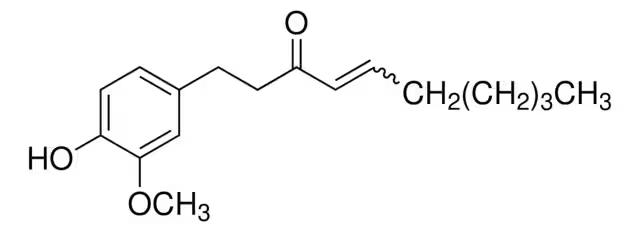
CAS Number555-66-8
Synonyms(E)-1-(4-Hydroxy-3-methoxy-phenyl)-dec-4-en-3-one; (4E)-1-(4-Hydroxy-3-methoxyphenyl)dec-4-en-3-one; 6-Shogaol; Trans-6-Shogaol; MFCD01736094; 4-Decen-3-one, 1-(4-hydroxy-3-methoxyphenyl); Shogaol; (4E)-1-(4-Hydroxy-3-methoxyphenyl)-4-decen-3-one; [6]-Shogaol
Molecular FormulaC17H24O3
Molecular Weight276.37
Purity≥90.0 (HPLC)%
Density1.0±0.1 g/cm3
Boiling Point427.5±35.0 °C at 760 mmHg
AppearanceLiquid;Light yellow to Yellow clear liquid
Symbol
Signal WordWarning
| Chemical & Physical Properties | |
|---|---|
| CAS Number | 555-66-8 |
| Catalog No. | 2A-9009010 |
| Chinese Name | 6-姜烯酚 |
| Synonyms | (E)-1-(4-Hydroxy-3-methoxy-phenyl)-dec-4-en-3-one; (4E)-1-(4-Hydroxy-3-methoxyphenyl)dec-4-en-3-one; 6-Shogaol; Trans-6-Shogaol; MFCD01736094; 4-Decen-3-one, 1-(4-hydroxy-3-methoxyphenyl); Shogaol; (4E)-1-(4-Hydroxy-3-methoxyphenyl)-4-decen-3-one; [6]-Shogaol |
| Molecular Formula | C17H24O3 |
| Molecular Weight | 276.37 |
| Purity | ≥90.0 (HPLC) |
| Density | 1.0±0.1 g/cm3 |
| Boiling Point | 427.5±35.0 °C at 760 mmHg |
| Appearance | Liquid;Light yellow to Yellow clear liquid |
| Storage Condition | 2-8°C |
| Application | 6-shogaol is an active substance isolated from ginger and has a variety of biological activities, including anti-cancer, anti-inflammatory and antioxidant. |
| PubChem ID | 329755838 |
| MDL Number | MFCD01736094 |
| SMILES | CCCCC\C=C\C(=O)CCc1ccc(O)c(OC)c1 |
| InChI | 1S/C17H24O3/c1-3-4-5-6-7-8-15(18)11-9-14-10-12-16(19)17(13-14)20-2/h7-8,10,12-13,19H,3-6,9,11H2,1-2H3/b8-7+ |
| InChI Key | OQWKEEOHDMUXEO-BQYQJAHWSA-N |
| Beilstein/REAXYS | 2056098 |
| NACRES Code | NA.24 |
| UNSPSC | 85151701 |
| Hazard Symbols | Transport |
| MSDS | msds/9010_1_555_66_8.pdf |
| Bioactivity | 6-shogaol, an active compound isolated from Ginger (Zingiber officinale Rosc), exhibits a variety of biological activities including anticancer, anti-inflammation, and anti-oxidation. Related Catalog Signaling Pathways >> Autophagy >> Autophagy Natural Products >> Flavonoids Research Areas >> Cancer In Vitro 6-shogaol has anticancer activity against several cell lines[1]. 6-shogaol is identified to be cytotoxic in various cell lines, with KB (IC50=7.4±2.2 μM) and HL60 (IC50=7.9±2.0 μM) cells most susceptible to 6-shogaol[2]. 6-shogaol (IC50=8 μM) has much stronger growth inhibitory effects than 6-gingerol (IC50=150 μM) on HCT-116 human colon cancer cells[3]. 6-shogaol stimulates phosphorylations of mitogen-activated protein kinases (MAPKs) such as ERK, JNK, and p38. Moreover, the 6-shogaol-induced expressions of Nrf2 and HO-1 are attenuated by treatments of SB202190 (a p38 specific inhibitor) and LY294002 (an Akt specific inhibitor)[4]. In Vivo The 6-shogaol decreases the diethylnitrosamine (DEN)-mediated elevations of serum aspartate transaminase and alanine transaminase as well as the DEN-induced hepatic lipid peroxidation. Inductions of Nrf2 and HO-1 by 6-shogaol are also confirmed in the mice. The administration of 6-shogaol to the mice also restores the DEN-reduced activity and protein expression of hepatic antioxidant enzymes such as superoxide dismutase, glutathione peroxidase and catalase[4]. Cell Assay The effects of 6-shogaol on the viability of HepG2 cells are determined by a MTT assay after 24 h treatment. The data are expressed as percent cell viability compared to that of control. The concentrations of the treatments 6-shogaol varied from 10 to 100 μg/mL[4]. Animal Admin Mice: Male Balb/c mice are treated with 6-shogaol-rich ginger extracts (10 and 100 mg/kg b.w.) or silymarin (100 mg/kg b.w.), a positive control, and challenged with diethyl-nitrosoamine (DEN, 30 mg/kg b.w.) 3 days per week for 3 weeks[4]. References [1]. Semwal RB, et al. Gingerols and shogaols: Important nutraceutical principles from ginger. Phytochemistry. 2015 Sep;117:554-68. [2]. Peng F, et al. Cytotoxic, cytoprotective and antioxidant effects of isolated phenolic compounds from fresh ginger. Fitoterapia. 2012 Apr;83(3):568-85. [3]. Sang S, et al. Increased growth inhibitory effects on human cancer cells and anti-inflammatory potency of shogaols from Zingiber officinale relative to gingerols. J Agric Food Chem. 2009 Nov 25;57(22):10645-50. [4]. Bak MJ, et al. 6-shogaol-rich extract from ginger up-regulated the antioxidant defense systems in cells and mice. Molecules. 2012 Jul 4;17(7):8037-55. Chemical & Physical Properties Density 1.0±0.1 g/cm3 Boiling Point 427.5±35.0 °C at 760 mmHg Molecular Formula C17H24O3 Molecular Weight 276.371 Flash Point 150.3±19.4 °C Exact Mass 276.172546 PSA 46.53000 LogP 3.85 Vapour Pressure 0.0±1.1 mmHg at 25°C Index of Refraction 1.522 InChIKey OQWKEEOHDMUXEO-BQYQJAHWSA-N SMILES CCCCCC=CC(=O)CCc1ccc(O)c(OC)c1 Storage condition 2-8°C |
| Use of | 6-shogaol, an active compound isolated from Ginger (Zingiber officinale Rosc), exhibits a variety of biological activities including anticancer, anti-inflammation, and anti-oxidation. Properties Articles26 Name (E)-1-(4-hydroxy-3-methoxyphenyl)dec-4-en-3-one Synonym More Synonyms 6-Shogaol Biological Activity Description 6-shogaol, an active compound isolated from Ginger (Zingiber officinale Rosc), exhibits a variety of biological activities including anticancer, anti-inflammation, and anti-oxidation. Related Catalog Signaling Pathways >> Autophagy >> Autophagy Natural Products >> Flavonoids Research Areas >> Cancer In Vivo The 6-shogaol decreases the diethylnitrosamine (DEN)-mediated elevations of serum aspartate transaminase and alanine transaminase as well as the DEN-induced hepatic lipid peroxidation. Inductions of Nrf2 and HO-1 by 6-shogaol are also confirmed in the mice. The administration of 6-shogaol to the mice also restores the DEN-reduced activity and protein expression of hepatic antioxidant enzymes such as superoxide dismutase, glutathione peroxidase and catalase[4]. References [1]. Semwal RB, et al. Gingerols and shogaols: Important nutraceutical principles from ginger. Phytochemistry. 2015 Sep;117:554-68. [2]. Peng F, et al. Cytotoxic, cytoprotective and antioxidant effects of isolated phenolic compounds from fresh ginger. Fitoterapia. 2012 Apr;83(3):568-85. [3]. Sang S, et al. Increased growth inhibitory effects on human cancer cells and anti-inflammatory potency of shogaols from Zingiber officinale relative to gingerols. J Agric Food Chem. 2009 Nov 25;57(22):10645-50. [4]. Bak MJ, et al. 6-shogaol-rich extract from ginger up-regulated the antioxidant defense systems in cells and mice. Molecules. 2012 Jul 4;17(7):8037-55. Chemical & Physical Properties Molecular Formula C17H24O3 Exact Mass 276.172546 PSA 46.53000 Index of Refraction 1.522 InChIKey OQWKEEOHDMUXEO-BQYQJAHWSA-N |
| Transport Info | Shipping Name: UN |
| MSDS Transport Info | Module 14. Shipping information 14.1 UN dangerous goods number European Land Transport Dangerous Regulations: -International Maritime Dangerous Regulations: -International Air Transport Dangerous Regulations: - 14.2 United Nations shipping name European Land Transport Dangerous Regulations: Non-dangerous goods IMDG Code: Non-dangerous goods International air transport dangerous goods regulations: non-dangerous goods 14.3 Transport hazard categories European Land Transport Dangerous Regulations: -International Maritime Dangerous Regulations: -International Air Transport Dangerous Regulations: - 14.4 Package group European Land Transport Dangerous Regulations: -International Maritime Dangerous Regulations: -International Air Transport Dangerous Regulations: - 14.5 Environmental hazards European Land Transport Danger Regulations: No International Maritime Danger Regulations International Air Transport Danger Regulations: No Marine pollutants (yes/no): No 14.6 Special reminder to users No data available |
| Related Products in Botanical Reference Standards | ||
|---|---|---|
| Tectochrysin | 520-28-5 | 2A-9008774 |
| (-)-Arctigenin | 7770-78-7 | 2A-9008920 |
| (-)-Fisetinidol | 490-49-3 | 2A-9008922 |
| 3'-Methoxypuerarin | 2A-300067 | 2A-9008984 |
| 6-Hydroxyluteolin-7-O-sambubioside | 2A-300091 | 2A-9009008 |
| 8-Gingerol | 23513-08-8 | 2A-9009018 |
| Acacetin | 480-44-4 | 2A-9009027 |
| Actein | 18642-44-9 | 2A-9009058 |
| Agnuside | 11027-63-7 | 2A-9009080 |
| Aloenin | 38412-46-3 | 2A-9009120 |
| Browse all Botanical Reference Standards products » | ||
Phone:
630-322-8886
630-322-8887
Email:
Office Locations:
Chicago, IL, USA
San Francisco, CA, USA


 EN
EN


 SDS
SDS