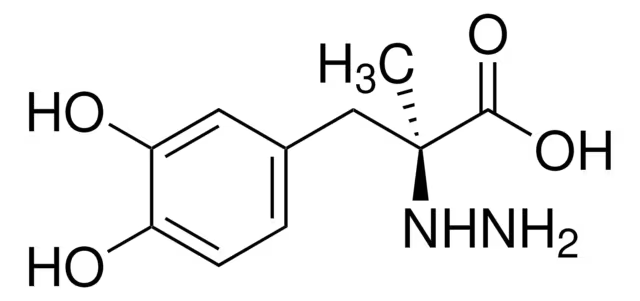
CAS Number28860-95-9
SynonymsBenzenepropanoic acid, α-hydrazinyl-3,4-dihydroxy-α-methyl-, (αS)-, hydrate (1:1); Carbidopa; (S)-Carbidopa; 1-a-(3,4-Dihydroxybenzyl)-a-hydrazinopropionic Acid; MFCD00069231; L-a-Methyldopahydrazine; (aS)-a-Hydrazino-3,4-dihydroxy-a-methylbenzenepropanoic Acid; a-Methyldopahydrazine; Lodosin; EINECS 249-271-9; carbidopa [INN_en]; (S)-(-)-Carbidopa; HMD; (2S)-3-(3,4-Dihydroxyphenyl)-2-hydrazino-2-methylpropanoic acid hydrate (1:1); (2S)-3-(3,4-Dihydroxyphenyl)-2-hydrazino-2-methylpropanoic acid; S-(−)-Carbidopa; (2S)-3-(3,4-dihydroxyphenyl)-2-hydrazinyl-2-methylpropanoic acid hydrate (1:1); S-(-)-Carbidopa; (-)-L-a-Hydrazino-3,4-dihydroxy-a-methylhydrocinnamic Acid; (2S)-3-(3,4-dihydroxyphenyl)-2-hydrazinyl-2-methylpropanoic acid; Hydrazino-a-methyldopa
Molecular FormulaC10H14N2O4
Molecular Weight226.23
Purity≥98 (TLC)%
Density1.4±0.1 g/cm3
Boiling Point528.7±50.0 °C at 760 mmHg
Melting Point206 - 208ºC
Appearancepowder
EINECS249-271-9
Symbol
Signal WordWarning
| Chemical & Physical Properties | |
|---|---|
| CAS Number | 28860-95-9 |
| Catalog No. | 2A-9008944 |
| Chinese Name | 卡别多巴 |
| Synonyms | Benzenepropanoic acid, α-hydrazinyl-3,4-dihydroxy-α-methyl-, (αS)-, hydrate (1:1); Carbidopa; (S)-Carbidopa; 1-a-(3,4-Dihydroxybenzyl)-a-hydrazinopropionic Acid; MFCD00069231; L-a-Methyldopahydrazine; (aS)-a-Hydrazino-3,4-dihydroxy-a-methylbenzenepropanoic Acid; a-Methyldopahydrazine; Lodosin; EINECS 249-271-9; carbidopa [INN_en]; (S)-(-)-Carbidopa; HMD; (2S)-3-(3,4-Dihydroxyphenyl)-2-hydrazino-2-methylpropanoic acid hydrate (1:1); (2S)-3-(3,4-Dihydroxyphenyl)-2-hydrazino-2-methylpropanoic acid; S-(−)-Carbidopa; (2S)-3-(3,4-dihydroxyphenyl)-2-hydrazinyl-2-methylpropanoic acid hydrate (1:1); S-(-)-Carbidopa; (-)-L-a-Hydrazino-3,4-dihydroxy-a-methylhydrocinnamic Acid; (2S)-3-(3,4-dihydroxyphenyl)-2-hydrazinyl-2-methylpropanoic acid; Hydrazino-a-methyldopa |
| Molecular Formula | C10H14N2O4 |
| Molecular Weight | 226.23 |
| Purity | ≥98 (TLC) |
| Density | 1.4±0.1 g/cm3 |
| Boiling Point | 528.7±50.0 °C at 760 mmHg |
| Melting Point | 206 - 208ºC |
| Appearance | powder |
| Storage Condition | Seal and store at -20ºC |
| Application | Carbidopa is a dopa decarboxylase inhibitor that can act on Parkinson's disease. |
| EINECS | 249-271-9 |
| HTC | 2932999099 |
| PubChem ID | 24892402 |
| MDL Number | MFCD00069231 |
| SMILES | CC(Cc1ccc(O)c(O)c1)(NN)C(O)=O |
| InChI | 1S/C10H14N2O4/c1-10(12-11,9(15)16)5-6-2-3-7(13)8(14)4-6/h2-4,12-14H,5,11H2,1H3,(H,15,16)/t10-/m0/s1 |
| InChI Key | TZFNLOMSOLWIDK-JTQLQIEISA-N |
| NACRES Code | NA.77 |
| UNSPSC | 12352202 |
| Hazard Symbols | Transport |
| MSDS | msds/8944_1_28860_95_9.pdf |
| Bioactivity | Carbidopa is an inhibitor of DOPA decarboxylase, which is used in parkinson disease.Target: DOPA decarboxylaseCarbidopa (CD), a competitive inhibitor of aromatic l-amino acid decarboxylase that does not cross the blood-brain barrier, is routinely administered with levodopa (LD) to patients with Parkinson disease (PD) to reduce the peripheral decarboxylation of LD to dopamine [1]. CD premedication improves 11C-5-HTP PET image quality and facilitates detection of NET lesions. Because of the similarity of metabolic pathways, this method could probably be applied to improve PET imaging using other tracers like 18F-DOPA and 11C-DOPA [2]. Carbidopa (100 microM) decreased growth of (but did not kill) SK-N-SH neuroblastoma and A204 rhabdomyosarcoma cells and did not affect proliferation of DU 145 prostate, MCF7 breast, or NCI-H460 large cell lung carcinoma lines. sublethal doses of carbidopa produced additive cytotoxic effects in carcinoid cells in combination with etoposide and cytotoxic synergy in SCLC cells when coincubated with topotecan [3]. Related Catalog Signaling Pathways >> Others >> Others Research Areas >> Neurological Disease References [1]. Durso, R., et al., Variable absorption of carbidopa affects both peripheral and central levodopa metabolism. J Clin Pharmacol, 2000. 40(8): p. 854-60. [2]. Orlefors, H., et al., Carbidopa pretreatment improves image interpretation and visualisation of carcinoid tumours with 11C-5-hydroxytryptophan positron emission tomography. Eur J Nucl Med Mol Imaging, 2006. 33(1): p. 60-5. [3]. Gilbert, J.A., L.M. Frederick, and M.M. Ames, The aromatic-L-amino acid decarboxylase inhibitor carbidopa is selectively cytotoxic to human pulmonary carcinoid and small cell lung carcinoma cells. Clin Cancer Res, 2000. 6(11): p. 4365-72. Chemical & Physical Properties Density 1.4±0.1 g/cm3 Boiling Point 528.7±50.0 °C at 760 mmHg Melting Point 206 - 208ºC Molecular Formula C10H14N2O4 Molecular Weight 226.23 Flash Point 273.5±30.1 °C PSA 115.81000 LogP -0.19 Vapour Pressure 0.0±1.5 mmHg at 25°C Index of Refraction 1.641 InChIKey TZFNLOMSOLWIDK-JTQLQIEISA-N SMILES CC(Cc1ccc(O)c(O)c1)(NN)C(=O)O |
| Use of | Properties Articles32 Name carbidopa (anhydrous) Synonym More Synonyms Carbidopa Biological Activity Related Catalog Signaling Pathways >> Others >> Others Research Areas >> Neurological Disease References [1]. Durso, R., et al., Variable absorption of carbidopa affects both peripheral and central levodopa metabolism. J Clin Pharmacol, 2000. 40(8): p. 854-60. [3]. Gilbert, J.A., L.M. Frederick, and M.M. Ames, The aromatic-L-amino acid decarboxylase inhibitor carbidopa is selectively cytotoxic to human pulmonary carcinoid and small cell lung carcinoma cells. Clin Cancer Res, 2000. 6(11): p. 4365-72. Chemical & Physical Properties Molecular Formula C10H14N2O4 PSA 115.81000 LogP -0.19 Index of Refraction 1.641 InChIKey TZFNLOMSOLWIDK-JTQLQIEISA-N |
| Tax Rebate | 13.0% |
| Supervision | None. MFN tariff: 6.5%. Ordinary tariff: 20.0% |
| Transport Info | Product name: Purity: 98.0% |
| MSDS Transport Info | Module 14. Shipping information 14.1 UN dangerous goods number European Land Transport Dangerous Regulations: -International Maritime Dangerous Regulations: -International Air Transport Dangerous Regulations: - 14.2 Names specified by the United Nations (UN) European Land Transport Dangerous Regulations: Non-dangerous goods IMDG Code: Non-dangerous goods International air transport dangerous goods regulations: non-dangerous goods 14.3 Transport hazard categories European Land Transport Dangerous Regulations: -International Maritime Dangerous Regulations: -International Air Transport Dangerous Regulations: - 14.4 Package group European Land Transport Dangerous Regulations: -International Maritime Dangerous Regulations: -International Air Transport Dangerous Regulations: - 14.5 Environmental hazards European Land Transport Dangerous Regulations: No International Maritime Transport Dangerous Regulations Maritime Pollutants: No International Air Transport Risk Regulations: No 14.6 Special reminder to users No data available |
| Related Products in API & Advanced Intermediates | ||
|---|---|---|
| (L)-Albuterol; Salbutamol | 34391-04-3 | 2A-9008937 |
| (R)-(+)-Carvedilol | 95093-99-5 | 2A-9008939 |
| (R)-(+)-Metoprolol | 81024-43-3 | 2A-9008940 |
| (R)-Bicalutamide | 113299-40-4 | 2A-9008941 |
| (R)-Fluoxetine | 114247-09-5 | 2A-9008943 |
| (S)-(-)-Carvedilol | 95094-00-1 | 2A-9008945 |
| (S)-(-)-Metoprolol | 81024-42-2 | 2A-9008946 |
| (S)-(-)-Verapamil hydrochloride | 36622-28-3 | 2A-9008947 |
| 3,6-Diacetylmorphine | 561-27-3 | 2A-9008980 |
| 6-Acetylmorphine | 2784-73-8 | 2A-9009003 |
| Browse all API & Advanced Intermediates products » | ||
Phone:
630-322-8886
630-322-8887
Email:
Office Locations:
Chicago, IL, USA
San Francisco, CA, USA


 EN
EN


 SDS
SDS