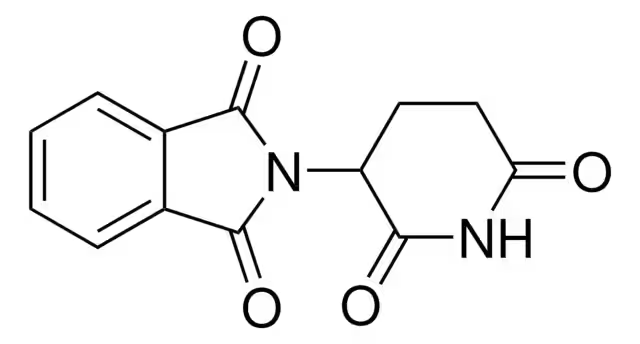
CAS Number50-35-1
SynonymsEINECS 200-031-1; (±)-Thalidomide; Softenon; Thalomide; )-Thalidomide; 2-(2,6-dioxopipéridin-3-yl)-1H-isoindole-1,3(2H)-dione; Neurodyn; 2-(2,6-Dioxopiperidin-3-yl)isoindoline-1,3-dione; 2-(2,6-Dioxo-3-piperidinyl)-1H-isoindole-1,3(2H)-dione; Neosedyn; (±)-2-(2,6-Dioxo-3-piperidinyl)-1H-isoindole-1,3(2H)-dione; Neosydyn; 2-(2,6-Dioxopiperidin-3-yl)-1H-isoindole-1,3(2H)-dione; N-(2,6-Dioxo-3-piperidinyl)phthalimide; Talidomide [DCIT]; Contergan; 2-(2,6-Dioxopiperidin-3-yl)-1H-isoindol-1,3(2H)-dion; Thalidomide; MFCD00153873
Molecular FormulaC13H10N2O4
Molecular Weight258.23
Purity≥98%
Density1.5±0.1 g/cm3
Boiling Point509.7±43.0 °C at 760 mmHg
Melting Point269-271°C
Appearancepowder
EINECS200-031-1
Symbol
Signal WordWarning
| Chemical & Physical Properties | |
|---|---|
| CAS Number | 50-35-1 |
| Catalog No. | 2A-9008826 |
| Chinese Name | 沙利度胺 |
| Synonyms | EINECS 200-031-1; (±)-Thalidomide; Softenon; Thalomide; )-Thalidomide; 2-(2,6-dioxopipéridin-3-yl)-1H-isoindole-1,3(2H)-dione; Neurodyn; 2-(2,6-Dioxopiperidin-3-yl)isoindoline-1,3-dione; 2-(2,6-Dioxo-3-piperidinyl)-1H-isoindole-1,3(2H)-dione; Neosedyn; (±)-2-(2,6-Dioxo-3-piperidinyl)-1H-isoindole-1,3(2H)-dione; Neosydyn; 2-(2,6-Dioxopiperidin-3-yl)-1H-isoindole-1,3(2H)-dione; N-(2,6-Dioxo-3-piperidinyl)phthalimide; Talidomide [DCIT]; Contergan; 2-(2,6-Dioxopiperidin-3-yl)-1H-isoindol-1,3(2H)-dion; Thalidomide; MFCD00153873 |
| Molecular Formula | C13H10N2O4 |
| Molecular Weight | 258.23 |
| Purity | ≥98 |
| Density | 1.5±0.1 g/cm3 |
| Boiling Point | 509.7±43.0 °C at 760 mmHg |
| Melting Point | 269-271°C |
| Appearance | powder |
| Water Solubility | 45% (w/v) aq 2-hydroxypropyl-β-cyclodextrin: 0.6 m |
| Storage Condition | This product is sealed and stored in a dry place a |
| Packaging | III |
| Application | Thalidomide is originally a sedative that inhibits ereblon (part of the cullin-4 E3 ubiquitin ligase complex CUL4-RBX1-DDB1) with a Kd value of approximately 250 nM and has immunomodulatory, anti-infl |
| EINECS | 200-031-1 |
| HTC | 2925190090 |
| UN(IATA) | UN 2811 |
| PubChem ID | 24278765 |
| MDL Number | MFCD00153873 |
| SMILES | O=C1CCC(N2C(=O)c3ccccc3C2=O)C(=O)N1 |
| InChI | 1S/C13H10N2O4/c16-10-6-5-9(11(17)14-10)15-12(18)7-3-1-2-4-8(7)13(15)19/h1-4,9H,5-6H2,(H,14,16,17) |
| InChI Key | UEJJHQNACJXSKW-UHFFFAOYSA-N |
| NACRES Code | NA.77 |
| eCl@ss | 39180303 |
| UNSPSC | 12352111 |
| Hazard Symbols | 6.1(b) |
| Risk Codes | R46;R61;R21;R25;R62 |
| Safety Description | S53;S22;S26;S36/37/39;S45 |
| MSDS | msds/8826_1_50_35_1.pdf |
| Bioactivity | Thalidomide is initially promoted as a sedative, inhibits ereblon (CRBN), a part of the cullin-4 E3 ubiquitin ligase complex CUL4-RBX1-DDB1, with a Kd of ∼250 nM, and has immunomodulatory, anti-inflammatory and anti-angiogenic cancer properties. Related Catalog Signaling Pathways >> Metabolic Enzyme/Protease >> E1/E2/E3 Enzyme Research Areas >> Inflammation/Immunology Research Areas >> Cancer Target Kd: ∼250 nM (CRL4CRBN)[1] In Vitro Thalidomide is initially promoted as a sedative, has immunomodulatory, anti-inflammatory and anti-angiogenic cancer properties, and targets ereblon (CRBN), a part of the cullin-4 E3 ubiquitin ligase complex CUL4-RBX1-DDB1, with a Kd of ∼250 nM[1]. Thalidomide (50 μg/mL) potentiates the anti-tumor activity of icotinib against the proliferation of both PC9 and A549 cells, and this effect is correlated with apoptosis and cell migration. In addition, Thalidomide and icotinib inhibits the EGFR and VEGF-R2 pathways in PC9 cells[3]. In Vivo Thalidomide (100 mg/kg, p.o.) inhibits the collagen deposition, down-regulates the mRNA expression level of α-SMA and collagen I, and significantly reduces the pro-inflammatory cytokines in RILF mice. Thalidomide alleviates RILF via suppression of ROS and down-regulation of TGF-β/Smad pathway dependent on Nrf2 status[2]. Thalidomide (200 mg/kg, p.o.) combined with icotinib shows synergistic anti-tumor effects in nude mice bearing PC9 cells, suppressing tumor growth and promoting tumor death[3]. Cell Assay THP-1 cells, A549 cells and KYSE30 cells are cultured in RPMI-1640 Medium supplemented with 10% fetal bovine serum and maintained at 37 °C in an atmosphere of 5% CO2 and 95% room air. THP-1 cells is irradiated with a single dose of 4 Gy 6-MV X-ray and treated with or without Thalidomide (0.2 μmol/mL)-containing medium for 48 h after radiation. The concentration of Thalidomide is selected based on the preliminary results[2]. Animal Admin Mice[2] A total of 24 WT C57BL/6 mice are randomly divided into 4 groups for the experiments (n = 6 in each group): a control group, an irradiated group, a group irradiated along with Thalidomide, and a Thalidomide only group. Based on the preliminary results, 100 mg/kg Thalidomide is used in the experiment. Thalidomide is dissolved in DMSO vehicle. The treatment group receives the indicated dose of Thalidomide in 200 μL by gavage every other day beginning on day 1 for six treatments. The control mice receives 200 μL 0.1% DMSO contained-saline only. The lungs are harvested at 12 weeks after irradiation for the analysis. A total of 20 Nrf2-/- mice are randomly divided into 4 groups for the experiments (n = 5 in each group). The experiment procedures of Nrf2-/- mice are the same as WT C57BL/6 mice. In addition, a total of 30 WT C57BL/6 mice are randomly divided into 5 groups for the subsequent experiments (n = 6 in each group): a control group, an irradiated group, a group irradiated along with CDDO-Me and Thalidomide, a group irradiated along with CDDO-Me, and a group irradiated along with Thalidomide. 600 ng and 100 mg/kg are selected as the dose of CDDO-Me and Thalidomide for the experiment, respectively. The treatment group receives the indicated dose of CDDO-Me or Thalidomide in 200 μL by gavage every other day beginning on day 1 for six times. For the combined group of CDDO-Me and Thalidomide, CDDO-Me is delivered in 200 μL by gavage every other day beginning on day 1 for six treatments. Thalidomide is delivered in 200 μL by gavage every other day beginning on day 2 for six treatments[2]. References [1]. Fischer ES, et al. Structure of the DDB1-CRBN E3 ubiquitin ligase in complex with thalidomide. Nature. 2014 Aug 7;512(7512):49-53. [2]. Bian C, et al. Thalidomide (THD) alleviates radiation induced lung fibrosis (RILF) via down-regulation of TGF-β/Smad3 signaling pathway in an Nrf2-dependent manner. Free Radic Biol Med. 2018 Dec;129:446-453. [3]. Sun X, et al. Synergistic Inhibition of Thalidomide and Icotinib on Human Non-Small Cell Lung Carcinomas Through ERK and AKT Signaling. Med Sci Monit. 2018 May 15;24:3193-3203. Chemical & Physical Properties Density 1.5±0.1 g/cm3 Boiling Point 509.7±43.0 °C at 760 mmHg Melting Point 269-271°C Molecular Formula C13H10N2O4 Molecular Weight 258.229 Flash Point 262.1±28.2 °C Exact Mass 258.064056 PSA 83.55000 LogP 0.54 Vapour Pressure 0.0±1.3 mmHg at 25°C Index of Refraction 1.646 InChIKey UEJJHQNACJXSKW-UHFFFAOYSA-N SMILES O=C1CCC(N2C(=O)c3ccccc3C2=O)C(=O)N1 Storage condition Store at RT Stability Stable. Combustible. Incompatible with strong oxidizing agents. Water Solubility 45% (w/v) aq 2-hydroxypropyl-β-cyclodextrin: 0.6 mg/mL | <0.1 g/100 mL at 22 ºC |
| Use of | Thalidomide is initially promoted as a sedative, inhibits ereblon (CRBN), a part of the cullin-4 E3 ubiquitin ligase complex CUL4-RBX1-DDB1, with a Kd of ∼250 nM, and has immunomodulatory, anti-inflammatory and anti-angiogenic cancer properties. Properties Articles144 Name 2-(2,6-dioxopiperidin-3-yl)-1H-isoindole-1,3(2H)-dione Synonym More Synonyms Thalidomide Biological Activity Description Thalidomide is initially promoted as a sedative, inhibits ereblon (CRBN), a part of the cullin-4 E3 ubiquitin ligase complex CUL4-RBX1-DDB1, with a Kd of ∼250 nM, and has immunomodulatory, anti-inflammatory and anti-angiogenic cancer properties. Related Catalog Research Areas >> Inflammation/Immunology Research Areas >> Cancer References [1]. Fischer ES, et al. Structure of the DDB1-CRBN E3 ubiquitin ligase in complex with thalidomide. Nature. 2014 Aug 7;512(7512):49-53. [2]. Bian C, et al. Thalidomide (THD) alleviates radiation induced lung fibrosis (RILF) via down-regulation of TGF-β/Smad3 signaling pathway in an Nrf2-dependent manner. Free Radic Biol Med. 2018 Dec;129:446-453. [3]. Sun X, et al. Synergistic Inhibition of Thalidomide and Icotinib on Human Non-Small Cell Lung Carcinomas Through ERK and AKT Signaling. Med Sci Monit. 2018 May 15;24:3193-3203. Chemical & Physical Properties Molecular Formula C13H10N2O4 Exact Mass 258.064056 PSA 83.55000 Index of Refraction 1.646 InChIKey UEJJHQNACJXSKW-UHFFFAOYSA-N Storage condition Store at RT Stability Stable. Combustible. Incompatible with strong oxidizing agents. |
| Tax Rebate | 9.0% |
| Supervision | None MFN tariff: 6.5% Ordinary tariff: 30.0% |
| Transport Info | Product name: Purity: 98.0% |
| MSDS Transport Info | Module 14. Shipping information United Nations classification: Item 1 Poisons. UN number: 2811 Proper Shipping Name: Toxic Solid, Organic, Not Otherwise Specified Packing grade: III |
| Related Products in API & Advanced Intermediates | ||
|---|---|---|
| Testosterone enanthate | 315-37-7 | 2A-9008799 |
| Testosterone isocapronate | 15267-86-9 | 2A-9008800 |
| Testosterone phenylpropionate | 1255-49-8 | 2A-9008801 |
| Testosterone propionate | 57-85-2 | 2A-9008802 |
| Testosterone undecanoate | 5949-44-0 | 2A-9008803 |
| Theophylline | 58-55-9 | 2A-9008827 |
| Timolol maleate | 26921-17-5 | 2A-9008841 |
| Triamcinolone acetonide acetate | 76-25-5 | 2A-9008867 |
| (L)-Albuterol; Salbutamol | 34391-04-3 | 2A-9008937 |
| (R)-(+)-Carvedilol | 95093-99-5 | 2A-9008939 |
| Browse all API & Advanced Intermediates products » | ||
Phone:
630-322-8886
630-322-8887
Email:
Office Locations:
Chicago, IL, USA
San Francisco, CA, USA


 EN
EN


 SDS
SDS