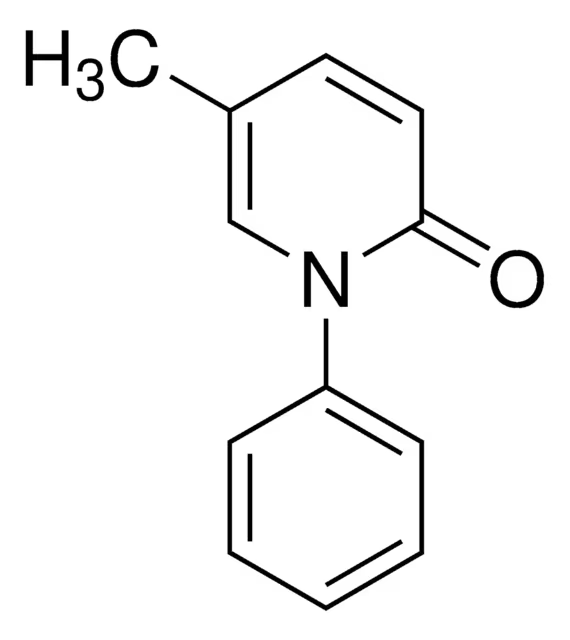
CAS Number53179-13-8
SynonymsTORASEMIDETECHPIRFENIDONE; 5-Methyl-1-phenyl-2-(1H)-pyridone; 5-methyl-1-phenyl-2-pyridone; 5-Methyl-N-phenyl-2-1H-pyridone; Pirespa; S-7701; amr-69; 5-methyl-1-phenyl-1H-pyridin-2-one; 5-Methyl-1-phenyl-2(1H)-pyridinone; 5-methyl-1-phenyl-pyridin-2-one; Etuary; 5-Methyl-1-phenylpyridin-2(1H)-one; MFCD00866047; Pirfenidone; 5-21-07-00197 (Beilstein Handbook Reference); Esbriet
Molecular FormulaC12H11NO
Molecular Weight185.22
Purity≥97 (HPLC)%
Density1.1±0.1 g/cm3
Boiling Point329.1±15.0 °C at 760 mmHg
Melting Point96-97ºC
Appearancepowder
Symbol
Signal WordWarning
| Chemical & Physical Properties | |
|---|---|
| CAS Number | 53179-13-8 |
| Catalog No. | 2A-9008683 |
| Chinese Name | 吡非尼酮 |
| Synonyms | TORASEMIDETECHPIRFENIDONE; 5-Methyl-1-phenyl-2-(1H)-pyridone; 5-methyl-1-phenyl-2-pyridone; 5-Methyl-N-phenyl-2-1H-pyridone; Pirespa; S-7701; amr-69; 5-methyl-1-phenyl-1H-pyridin-2-one; 5-Methyl-1-phenyl-2(1H)-pyridinone; 5-methyl-1-phenyl-pyridin-2-one; Etuary; 5-Methyl-1-phenylpyridin-2(1H)-one; MFCD00866047; Pirfenidone; 5-21-07-00197 (Beilstein Handbook Reference); Esbriet |
| Molecular Formula | C12H11NO |
| Molecular Weight | 185.22 |
| Purity | ≥97 (HPLC) |
| Density | 1.1±0.1 g/cm3 |
| Boiling Point | 329.1±15.0 °C at 760 mmHg |
| Melting Point | 96-97ºC |
| Appearance | powder |
| Water Solubility | DMSO: ≥10 mg/mL, soluble |
| Storage Condition | Store at RT |
| Application | Pirfenidone is a drug used to treat idiopathic pulmonary fibrosis. It inhibits FGFR, EGFR, PDGFR, and TGF-β, thereby slowing down tumor cell proliferation. |
| HTC | 2933399090 |
| PubChem ID | 24278625 |
| MDL Number | MFCD00866047 |
| SMILES | O=C(C=CC(C)=C1)N1C2=CC=CC=C2 |
| InChI | 1S/C12H11NO/c1-10-7-8-12(14)13(9-10)11-5-3-2-4-6-11/h2-9H,1H3 |
| InChI Key | ISWRGOKTTBVCFA-UHFFFAOYSA-N |
| NACRES Code | NA.77 |
| UNSPSC | 12352200 |
| Hazard Symbols | Transport |
| Risk Codes | R22 |
| Safety Description | S36 |
| MSDS | msds/8683_2_53179_13_8.pdf |
| Bioactivity | Pirfenidone is a drug used for the treatment of idiopathic pulmonary fibrosis. It inhibits FGFR, EGFR, PDGFR, TGF-β, thereby slowing tumor cell proliferation. Related Catalog Signaling Pathways >> Stem Cell/Wnt >> TGF-beta/Smad Signaling Pathways >> TGF-beta/Smad >> TGF-beta/Smad Research Areas >> Inflammation/Immunology Target TGF-β2[1] In Vitro Pirfenidone (PFD) reduces the protein levels of the matrix metalloproteinase (MMP)-11, a TGF-β target gene and furin substrate involved in carcinogenesis. These data define PFD or PFD-related agents as promising agents for human cancers associated with enhanced TGF-β activity[1]. In RAW264.7 cells, a murine macrophage-like cell line, Pirfenidone suppresses the proinflammatory cytokine TNF-α by a translational mechanism, which is independent of activation of the MAPK2, p38 MAPK, and JNK. In the murine endotoxin shock model, Pirfenidone potently inhibits the production of the proinflammatory cytokines, TNF-α, interferon-γ, and interleukin-6, but enhances the production of the anti-inflammatory cytokine, interleukin-10[2]. Pirfenidone (PFD) shows its inhibitory effects on the proliferation of HLECs. Cell proliferation is attenuated in the 0.3 mg/mL group after 24 hours compare with the control group (P=0.044). The effect is more apparent in the 0.5 mg/mL group at 24, 48, and 72 hours (P<0.05). The proliferation is almost completely inhibited with 1 mg/mL PFD at all the time-points (P<0.01)[3]. In Vivo Administration of Pirfenidone (300 mg/kg/day) for 4 wk. Pirfenidone significantly attenuates the score when administered in Bleomycin (BLM)-treated mice (P<0.0001). Moreover, collagen content is quantified in the lungs to evaluate the anti-fibrotic effects of Pirfenidone. The collagen content in the lungs of BLM-treated mice is significantly increased compared with that in saline- or Pirfenidone-treated mice, and this increase is significantly attenuated by Pirfenidone administration on day 28 after BLM treatment (P=0.0012)[4]. Cell Assay HLECs are seeded in 96-well plates (1×10⁴ cells/well) for 24 hours in α-MEM/10% FBS/1%NEAA, and are cultured in stationary tubes in serum-free medium for 24 hours. And then the culture medium is removed and cells are bathed in α-MEM with 10% FBS and 1% NEAA supplemented with 0, 0.01, 0.1, 0.2, 0.3, 0.5, or 1 mg/mL Pirfenidone for 0, 4, 12, 24, 48, or 72 hours. After incubation with 180 µL α-MEM and 20 µL of 5 mg/mL MTT for 4 hours at 37°C, the MTT solution is discarded. The Formosan precipitates are dissolved in 180 µL DMSO by agitating the dishes for 10 minutes at 200 rpm on an orbital shaker. The absorbance at 490 nm in each well is read with a micro plate reader. We further examined the effects of PFD by refining the concentrations at 0.2, 0.25, 0.3, 0.4, 0.5 and 0.6 mg/mL using the MTT assay[3]. Animal Admin Mice[4] Nine-week-old female C57BL/6 mice are used. Pirfenidone is administered orally for 14 days after osmotic pump implantation. The volume of administration is determined according to body weight. Animals are allocated into 4 groups (n=6/group): normal control, BLM, Pirfenidone (300 mg/kg/day), and BLM + Pirfenidone. The Pirfenidone dose is selected according to a report published elsewhere. Pirfenidone is also administered in a therapeutic setting beginning at day 10 to assess the effect of the drug on the fibrotic phase of BLM model mice. References [1]. Burghardt I, et al. Pirfenidone inhibits TGF-beta expression in malignant glioma cells. Biochem Biophys Res Commun. 2007 Mar 9;354(2):542-7. [2]. Nakazato H, et al. A novel anti-fibrotic agent pirfenidone suppresses tumor necrosis factor-alpha at the translational level. Eur J Pharmacol. 2002 Jun 20;446(1-3):177-85. [3]. Yang Y, et al. Inhibition of Pirfenidone on TGF-beta2 induced proliferation, migration and epithlial-mesenchymal transitionof human lens epithelial cells line SRA01/04. PLoS One. 2013;8(2):e56837. [4]. Inomata M, et al. Pirfenidone inhibits fibrocyte accumulation in the lungs in bleomycin-induced murine pulmonary fibrosis. Respir Res. 2014 Feb 8;15:16. [5]. Brooks D, et al. Limited fibrosis accompanies triple-negative breast cancer metastasis in multiple model systems and is not a preventive target. Oncotarget. 2018 May 4;9(34):23462-23481. Chemical & Physical Properties Density 1.1±0.1 g/cm3 Boiling Point 329.1±15.0 °C at 760 mmHg Melting Point 96-97ºC Molecular Formula C12H11NO Molecular Weight 185.222 Flash Point 152.7±11.6 °C Exact Mass 185.084061 PSA 22.00000 LogP 1.82 Appearance of Characters solid Vapour Pressure 0.0±0.7 mmHg at 25°C Index of Refraction 1.592 InChIKey ISWRGOKTTBVCFA-UHFFFAOYSA-N SMILES Cc1ccc(=O)n(-c2ccccc2)c1 Storage condition Store at RT Water Solubility DMSO: ≥10 mg/mL, soluble |
| Use of | Pirfenidone is a drug used for the treatment of idiopathic pulmonary fibrosis. It inhibits FGFR, EGFR, PDGFR, TGF-β, thereby slowing tumor cell proliferation. Properties Articles69 Name pirfenidone Synonym More Synonyms Pirfenidone Biological Activity Description Pirfenidone is a drug used for the treatment of idiopathic pulmonary fibrosis. It inhibits FGFR, EGFR, PDGFR, TGF-β, thereby slowing tumor cell proliferation. Related Catalog Signaling Pathways >> Stem Cell/Wnt >> TGF-beta/Smad Signaling Pathways >> TGF-beta/Smad >> TGF-beta/Smad Research Areas >> Inflammation/Immunology References [1]. Burghardt I, et al. Pirfenidone inhibits TGF-beta expression in malignant glioma cells. Biochem Biophys Res Commun. 2007 Mar 9;354(2):542-7. [2]. Nakazato H, et al. A novel anti-fibrotic agent pirfenidone suppresses tumor necrosis factor-alpha at the translational level. Eur J Pharmacol. 2002 Jun 20;446(1-3):177-85. [4]. Inomata M, et al. Pirfenidone inhibits fibrocyte accumulation in the lungs in bleomycin-induced murine pulmonary fibrosis. Respir Res. 2014 Feb 8;15:16. [5]. Brooks D, et al. Limited fibrosis accompanies triple-negative breast cancer metastasis in multiple model systems and is not a preventive target. Oncotarget. 2018 May 4;9(34):23462-23481. Chemical & Physical Properties Molecular Formula C12H11NO Exact Mass 185.084061 PSA 22.00000 Appearance of Characters solid Index of Refraction 1.592 InChIKey ISWRGOKTTBVCFA-UHFFFAOYSA-N Storage condition Store at RT |
| Tax Rebate | 13.0% |
| Supervision | None. MFN tariff: 6.5%. Ordinary tariff: 20.0% |
| Transport Info | Product name: Purity: 98.0% |
| MSDS Transport Info | Module 14. Shipping information 14.1 UN dangerous goods number European Land Transport Dangerous Regulations: -International Maritime Dangerous Regulations: -International Air Transport Dangerous Regulations: - 14.2 Names specified by the United Nations (UN) European Land Transport Dangerous Regulations: Non-dangerous goods IMDG Code: Non-dangerous goods International air transport dangerous goods regulations: non-dangerous goods 14.3 Transport hazard categories European Land Transport Dangerous Regulations: -International Maritime Dangerous Regulations: -International Air Transport Dangerous Regulations: - 14.4 Package group European Land Transport Dangerous Regulations: -International Maritime Dangerous Regulations: -International Air Transport Dangerous Regulations: - 14.5 Environmental hazards European Land Transport Dangerous Regulations: No International Maritime Transport Dangerous Regulations Maritime Pollutants: No International Air Transport Risk Regulations: No 14.6 Special reminder to users No data available |
| Related Products in Specialty Chemicals | ||
|---|---|---|
| Phenylbiguanide | 102-02-3 | 2A-9008668 |
| Phenylpropiolic acid | 637-44-5 | 2A-9008671 |
| Phytic acid | 83-86-3 | 2A-9008675 |
| p-Iodoanisole | 696-62-8 | 2A-9008676 |
| Piperonylic acid | 94-53-1 | 2A-9008681 |
| Poly(acrylamide) | 9003-05-8 | 2A-0201773 |
| PolymaleicacidAq | 26099-09-2 | 2A-9008686 |
| Potassium 2-ethylhexanoate | 3164-85-0 | 2A-0201196 |
| Potassium 4-bromobenzenesulfonate | 66788-58-7 | 2A-9008688 |
| Potassium D-(-)-N-(1-methoxycarbonylpropen-2-yl)amino-4-hydroxyphenylacetate | 69416-61-1 | 2A-9008689 |
| Browse all Specialty Chemicals products » | ||
Phone:
630-322-8886
630-322-8887
Email:
Office Locations:
Chicago, IL, USA
San Francisco, CA, USA


 EN
EN


 SDS
SDS