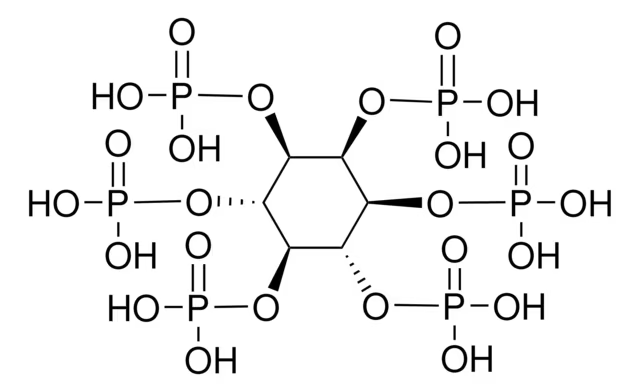
CAS Number83-86-3
Synonymsmyo-inositol-1,2,3,4,5,6-hexakis-dihydrogenphosphate; Phytine; Phyticacid; Fytic acid; inositol hexakisphosphate; Alkalovert; myo-Inositol hexaphosphate; (2,3,4,5,6-pentaphosphonooxycyclohexyl) dihydrogen phosphate; Inositol hexaphosphate; Phytate; myo-inositol 1,2,3,4,5,6-hexakisphosphate; Alkovert; 1,2,3,4,5,6-Cyclohexanehexol, hexakis(dihydrogen phosphate), sodium salt (1:12); Acidum fyticum; MFCD00082309; Dodecasodium 1,2,3,4,5,6-cyclohexanehexayl hexakis(phosphate); EINECS 201-506-6
Molecular FormulaC6H18O24P6
Molecular Weight660.04
Purity45.0-55.0%
Density2.4±0.1 g/cm3
Boiling Point105 °C
AppearanceColorless to light yellow liquid
EINECS201-506-6
Symbol
Signal WordWarning
| Chemical & Physical Properties | |
|---|---|
| CAS Number | 83-86-3 |
| Catalog No. | 2A-9008675 |
| Chinese Name | 植酸 |
| Synonyms | myo-inositol-1,2,3,4,5,6-hexakis-dihydrogenphosphate; Phytine; Phyticacid; Fytic acid; inositol hexakisphosphate; Alkalovert; myo-Inositol hexaphosphate; (2,3,4,5,6-pentaphosphonooxycyclohexyl) dihydrogen phosphate; Inositol hexaphosphate; Phytate; myo-inositol 1,2,3,4,5,6-hexakisphosphate; Alkovert; 1,2,3,4,5,6-Cyclohexanehexol, hexakis(dihydrogen phosphate), sodium salt (1:12); Acidum fyticum; MFCD00082309; Dodecasodium 1,2,3,4,5,6-cyclohexanehexayl hexakis(phosphate); EINECS 201-506-6 |
| Molecular Formula | C6H18O24P6 |
| Molecular Weight | 660.04 |
| Purity | 45.0-55.0 |
| Density | 2.4±0.1 g/cm3 |
| Boiling Point | 105 °C |
| Appearance | Colorless to light yellow liquid |
| Water Solubility | MISCIBLE |
| Storage Condition | 1. This product should be sealed and stored in a c |
| Packaging | III |
| Application | Phytic acid is the primary phosphorus storage compound in most seeds and grains. |
| EINECS | 201-506-6 |
| HTC | 2919900090 |
| PubChem ID | 24881460 |
| MDL Number | MFCD00082309 |
| SMILES | OP(O)(=O)O[C@@H]1[C@H](OP(O)(O)=O)[C@H](OP(O)(O)=O)[C@@H](OP(O)(O)=O)[C@H](OP(O)(O)=O)[C@H]1OP(O)(O)=O |
| InChI | 1S/C6H18O24P6/c7-31(8,9)25-1-2(26-32(10,11)12)4(28-34(16,17)18)6(30-36(22,23)24)5(29-35(19,20)21)3(1)27-33(13,14)15/h1-6H,(H2,7,8,9)(H2,10,11,12)(H2,13,14,15)(H2,16,17,18)(H2,19,20,21)(H2,22,23,24)/t1-,2-,3-,4+,5-,6- |
| InChI Key | IMQLKJBTEOYOSI-GPIVLXJGSA-N |
| Beilstein/REAXYS | 2201952 |
| NACRES Code | NA.22 |
| UNSPSC | 12352100 |
| Hazard Symbols | 8 |
| Risk Codes | R36/37/38 |
| Safety Description | S26;S37/39 |
| MSDS | msds/8675_1_83_86_3.pdf |
| Bioactivity | Phytic acid is a major phosphorus storage compound of most seeds and cereal grains. Related Catalog Signaling Pathways >> Metabolic Enzyme/Protease >> Xanthine Oxidase Research Areas >> Inflammation/Immunology Natural Products >> Others Target Human Endogenous Metabolite In Vitro Phytic acid, a major phosphorus storage compound of most seeds and cereal grains, contributes about 1 to 7% of their dry weight. It may account for more than 70% of the total kernel phosphorus. Phytic acid has the strong ability to chelate multivalent metal ions, especially zinc, calcium, and iron. The binding can result in very insoluble salts that are poorly absorbed from the gastrointestinal tract, which results in poor bioavailability of minerals. Phytic acid is also considered to be a natural antioxidant and is suggested to have potential functions of reducing lipid peroxidation and as a preservative in foods[1]. Phytic acid inhibits the formation of uric acid from xanthine with an IC50 of about 30 mM. The generation of the superoxide is greatly affected by phytic acid; the IC50 is about 6 mM, indicating that the superoxide generating domain of XO is more sensitive to phytic acid[2]. There has been observed an inhibition of tumor growth and induction of cell differentiation in the presence of phytic acid in a few cancer cell lines including colon, nipple, breast, prostate, cervix, liver, pancreas, melanoma and glioblastoma[3]. In Vivo Phytic acid has a neuroprotective effect in MPTP-induced PD model and the neuroprotection is correlated with its anti-inflammatory effect which may be associated with suppression of pathways that involved in NF-κB and p-ERK. Phytic acid significantly inhibits MPTP-induced dopaminergic cell loss in the substantia nigra (SN). Moreover, using immunohistochemistry method and quantitative polymerase chain reaction (qPCR), microglial activation and inducible nitric oxide synthase (iNOS) are found to be markedly repressed by phytic acid[4]. Animal Admin Mice: MPTP (20 mg/kg/day, i.p.) is administrated for 5 days and animals are killed at 7 days later. Phytic acid (30 mg/kg/day, i.p.) or normalsaline is injected 4 days before MPTP administration and con-tinued until mice are killed, reaching a total treatment period of16 days[4]. References [1]. Zhou JR, et al. Phytic acid in health and disease. Crit Rev Food Sci Nutr. 1995 Nov;35(6):495-508. [2]. Muraoka S, et al. Inhibition of xanthine oxidase by phytic acid and its antioxidative action. Life Sci. 2004 Feb 13;74(13):1691-700. [3]. Nawrocka-Musial D, et al. Phytic acid--anticancer nutriceutic. Pol Merkur Lekarski. 2012 Jul;33(193):43-7. [4]. Lv Y, et al. Phytic acid attenuates inflammatory responses and the levels of NF-κB and p-ERK in MPTP-induced Parkinson's disease model of mice. Neurosci Lett. 2015 Jun 15;597:132-6. Chemical & Physical Properties Density 2.4±0.1 g/cm3 Boiling Point 1190.7±75.0 °C at 760 mmHg Molecular Formula C6H18O24P6 Molecular Weight 660.04 Flash Point 673.9±37.1 °C PSA 459.42000 LogP -8.47 Vapour Pressure 0.0±0.6 mmHg at 25°C Index of Refraction 1.629 InChIKey IMQLKJBTEOYOSI-UHFFFAOYSA-N SMILES O=P(O)(O)OC1C(OP(=O)(O)O)C(OP(=O)(O)O)C(OP(=O)(O)O)C(OP(=O)(O)O)C1OP(=O)(O)O Storage condition Refrigerator Stability Stable. Incompatible with strong oxidizing agents. Water Solubility MISCIBLE |
| Use of | Phytic acid is a major phosphorus storage compound of most seeds and cereal grains. Properties Articles46 Name myo-inositol hexakisphosphate Synonym More Synonyms Phytic acid Biological Activity Description Phytic acid is a major phosphorus storage compound of most seeds and cereal grains. Related Catalog Signaling Pathways >> Metabolic Enzyme/Protease >> Xanthine Oxidase Research Areas >> Inflammation/Immunology Natural Products >> Others Human Endogenous Metabolite In Vivo Phytic acid has a neuroprotective effect in MPTP-induced PD model and the neuroprotection is correlated with its anti-inflammatory effect which may be associated with suppression of pathways that involved in NF-κB and p-ERK. Phytic acid significantly inhibits MPTP-induced dopaminergic cell loss in the substantia nigra (SN). Moreover, using immunohistochemistry method and quantitative polymerase chain reaction (qPCR), microglial activation and inducible nitric oxide synthase (iNOS) are found to be markedly repressed by phytic acid[4]. References [1]. Zhou JR, et al. Phytic acid in health and disease. Crit Rev Food Sci Nutr. 1995 Nov;35(6):495-508. [2]. Muraoka S, et al. Inhibition of xanthine oxidase by phytic acid and its antioxidative action. Life Sci. 2004 Feb 13;74(13):1691-700. [3]. Nawrocka-Musial D, et al. Phytic acid--anticancer nutriceutic. Pol Merkur Lekarski. 2012 Jul;33(193):43-7. [4]. Lv Y, et al. Phytic acid attenuates inflammatory responses and the levels of NF-κB and p-ERK in MPTP-induced Parkinson's disease model of mice. Neurosci Lett. 2015 Jun 15;597:132-6. Chemical & Physical Properties Molecular Formula C6H18O24P6 PSA 459.42000 LogP -8.47 Index of Refraction 1.629 InChIKey IMQLKJBTEOYOSI-UHFFFAOYSA-N Storage condition Refrigerator Stability Stable. Incompatible with strong oxidizing agents. Water Solubility MISCIBLE |
| Tax Rebate | 9.0% |
| Supervision | A. Customs clearance form for inbound goods B. Customs clearance form for outbound goods |
| Inspection | R. Imported food hygiene supervision and inspection S. Export food hygiene supervision and inspection M. Imported commodity inspection N. Exported commodity inspection |
| Transport Info | Product name: Purity: 0.0% |
| MSDS Transport Info | Module 14. Shipping information United Nations classification: inconsistent with United Nations classification standards UN number: not specified Phytic acid (about 50% aqueous solution, about 1.1mol/L) Modification number: 5 |
| Related Products in Specialty Chemicals | ||
|---|---|---|
| Phenyl methanesulfonate | 16156-59-5 | 2A-9008664 |
| Phenyl vinyl sulfone | 5535-48-8 | 2A-9008666 |
| Phenyl-2-pyridylacetonitrile | 5005-36-7 | 2A-9008667 |
| Phenylbiguanide | 102-02-3 | 2A-9008668 |
| Phenylpropiolic acid | 637-44-5 | 2A-9008671 |
| p-Iodoanisole | 696-62-8 | 2A-9008676 |
| Piperonylic acid | 94-53-1 | 2A-9008681 |
| Pirfenidone | 53179-13-8 | 2A-9008683 |
| Poly(acrylamide) | 9003-05-8 | 2A-0201773 |
| PolymaleicacidAq | 26099-09-2 | 2A-9008686 |
| Browse all Specialty Chemicals products » | ||
Phone:
630-322-8886
630-322-8887
Email:
Office Locations:
Chicago, IL, USA
San Francisco, CA, USA


 EN
EN


 SDS
SDS