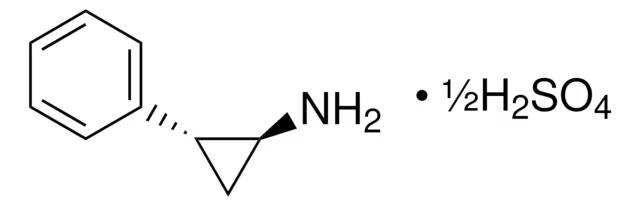
CAS Number13492-01-8
SynonymsTRANS-2-PHENYLCYCLOPROPYLAMINE HEMISULFATE SALT; Tranylcypromine sulfate; Tranylcypromine; Tranylcypromine (hemisulfate)
Molecular FormulaC9H11N · 1/2H2SO4
Molecular Weight182.23
Density1.065g/cm3
Boiling Point218.3ºC at 760mmHg
Symbol
Signal WordWarning
| Chemical & Physical Properties | |
|---|---|
| CAS Number | 13492-01-8 |
| Catalog No. | 2A-9085285 |
| Chinese Name | 反苯环丙胺半硫酸盐 |
| Synonyms | TRANS-2-PHENYLCYCLOPROPYLAMINE HEMISULFATE SALT; Tranylcypromine sulfate; Tranylcypromine; Tranylcypromine (hemisulfate) |
| Molecular Formula | C9H11N · 1/2H2SO4 |
| Molecular Weight | 182.23 |
| Density | 1.065g/cm3 |
| Boiling Point | 218.3ºC at 760mmHg |
| Water Solubility | Soluble in water; very slightly soluble in ethanol |
| Storage Condition | 2-8°C |
| Packaging | III |
| Application | Tranylcypromine hemisulfate is an irreversible, non-selective MAO inhibitor used to treat depression. |
| PubChem ID | 329751364 |
| MDL Number | MFCD00079222 |
| SMILES | OS(O)(=O)=O.N[C@H]1C[C@@H]1c2ccccc2.N[C@H]3C[C@@H]3c4ccccc4 |
| InChI | 1S/2C9H11N.H2O4S/c2*10-9-6-8(9)7-4-2-1-3-5-7;1-5(2,3)4/h2*1-5,8-9H,6,10H2;(H2,1,2,3,4)/t2*8-,9+;/m11./s1 |
| InChI Key | BKPRVQDIOGQWTG-KAVFMPKWSA-N |
| NACRES Code | NA.24 |
| UNSPSC | 41116107 |
| Hazard Symbols | 6.1(b) |
| MSDS | msds/85285_1_13492_01_8.pdf |
| Bioactivity | Tranylcypromine hemisulfate is an irreversible, nonselective MAO inhibitor used in the treatment of depression. Related Catalog Signaling Pathways >> Epigenetics >> Histone Demethylase Signaling Pathways >> Neuronal Signaling >> Monoamine Oxidase Research Areas >> Neurological Disease In Vitro Tranylcypromine (10 nM to 10 µM) exerts neuroprotective effects against toxicity induced by human Aβ(1-42) oligomers independently from the presence of glial cells[1]. Tranylcypromine (100 μM) significantly protects RGCs from glutamate neurotoxicity-induced apoptosis as well as apoptosis induced by oxidative stress. Tranylcypromine promotes mitogen-activated protein kinase 12 (p38 MAPKγ) expression under conditions of glutamate (Glu)-induced stress. Besides, tranylcypromine contributes to RGC survival via alterations of p38 MAPKγ activity[3]. In Vivo Tranylcypromine treatment significantly and substantially reduces the lesion size and improves generalized hyperalgesia in a dose-dependent fashion in mice with induced endometriosis. In addition, tranylcypromine treatment results in reduced immunoreactivity to biomarkers of proliferation, angiogenesis, and H3K4 methylation, leading to arrested EMT and lesion growth[2]. Tranylcypromine (500 mM) injection exerts neuroprotective effects within intracellular apoptotic signaling pathways and suppresses morphologic changes in the retina of the rat, suppresses caspase 3 activity and recovers p38 MAPKγ expression in the retina after NMDA-induced injury, and enhances RGC survival after retinal injury via the attenuation of NMDA neurotoxicity[3]. Tranylcypromine (10 µg/g) causes an approximate and significant doubling of labeled cells in the combined brain regions examined, as detected by BrdU immunohistochemistry. Tranylcypromine causes the greatest increase in cell proliferation in the cerebellum[4]. Animal Admin Briefly, the rats are anesthetized with an intraperitoneal injection of a 1:1 mixture of xylazine hydrochloride (4 mg/kg) and ketamine hydrochloride (10 mg/kg). Then, the pupil is dilated with phenylephrine hydrochloride and tropicamide eye drops, and 20 nmol NMDA with or without tranylcypromine is injected into the vitreous cavity. To assess the inhibitory effect of mitogen-activated protein kinase (MAPK), 100 nmol BIRB796 is intravitreally injected at the same time of NMDA injection. The injections are performed under a microscope using a 33-gauge needle connected to a microsyringe; the needle is inserted approximately 1.0 mm behind the corneal limbus. Next, either PBS (vehicle control) or 500 mM tranylcypromine (1000 nmol) mixed with 10 mM NMDA (20 nmol) in a total volume of 2.0 μL is injected into the vitreous cavity. References [1]. Caraci F, et al. Neuroprotective effects of the monoamine oxidase inhibitor tranylcypromine and its amide derivatives against Aβ(1-42)-induced toxicity. Eur J Pharmacol. 2015 Oct 5;764:256-263. [2]. Sun Q, et al. Tranylcypromine, a lysine-specific demethylase 1 (LSD1) inhibitor, suppresses lesion growth and improves generalized hyperalgesia in mouse with induced endometriosis. Reprod Biol Endocrinol. 2016 Apr 9;14:17. [3]. Tsutsumi T, et al. Potential Neuroprotective Effects of an LSD1 Inhibitor in Retinal Ganglion Cells via p38 MAPK Activity. Invest Ophthalmol Vis Sci. 2016 Nov 1;57(14):6461-6473. [4]. Romanczyk TB, et al. The antidepressant tranylcypromine alters cellular proliferation and migration in the adult goldfish brain. Anat Rec (Hoboken). 2014 Oct;297(10):1919-26. Chemical & Physical Properties Density 1.065g/cm3 Boiling Point 218.3ºC at 760mmHg Molecular Formula C9H12NO2S0.5 Molecular Weight 182.23 Flash Point 90.8ºC PSA 135.02000 LogP 4.83100 Vapour Pressure 0.127mmHg at 25°C InChIKey BKPRVQDIOGQWTG-KAVFMPKWSA-N SMILES NC1CC1c1ccccc1.NC1CC1c1ccccc1.O=S(=O)(O)O Storage condition 2-8°C Water Solubility Soluble in water; very slightly soluble in ethanol (96%) and in ether . |
| Use of | Tranylcypromine hemisulfate is an irreversible, nonselective MAO inhibitor used in the treatment of depression. Properties Name trans-2-Phenylcyclopropylamine hemisulfate salt Synonym More Synonyms Biological Activity Description Tranylcypromine hemisulfate is an irreversible, nonselective MAO inhibitor used in the treatment of depression. Related Catalog Signaling Pathways >> Epigenetics >> Histone Demethylase Signaling Pathways >> Neuronal Signaling >> Monoamine Oxidase Research Areas >> Neurological Disease In Vitro Tranylcypromine (10 nM to 10 µM) exerts neuroprotective effects against toxicity induced by human Aβ(1-42) oligomers independently from the presence of glial cells[1]. Tranylcypromine (100 μM) significantly protects RGCs from glutamate neurotoxicity-induced apoptosis as well as apoptosis induced by oxidative stress. Tranylcypromine promotes mitogen-activated protein kinase 12 (p38 MAPKγ) expression under conditions of glutamate (Glu)-induced stress. Besides, tranylcypromine contributes to RGC survival via alterations of p38 MAPKγ activity[3]. References [1]. Caraci F, et al. Neuroprotective effects of the monoamine oxidase inhibitor tranylcypromine and its amide derivatives against Aβ(1-42)-induced toxicity. Eur J Pharmacol. 2015 Oct 5;764:256-263. [2]. Sun Q, et al. Tranylcypromine, a lysine-specific demethylase 1 (LSD1) inhibitor, suppresses lesion growth and improves generalized hyperalgesia in mouse with induced endometriosis. Reprod Biol Endocrinol. 2016 Apr 9;14:17. [3]. Tsutsumi T, et al. Potential Neuroprotective Effects of an LSD1 Inhibitor in Retinal Ganglion Cells via p38 MAPK Activity. Invest Ophthalmol Vis Sci. 2016 Nov 1;57(14):6461-6473. [4]. Romanczyk TB, et al. The antidepressant tranylcypromine alters cellular proliferation and migration in the adult goldfish brain. Anat Rec (Hoboken). 2014 Oct;297(10):1919-26. Chemical & Physical Properties Molecular Formula C9H12NO2S0.5 PSA 135.02000 LogP 4.83100 InChIKey BKPRVQDIOGQWTG-KAVFMPKWSA-N Water Solubility Soluble in water; very slightly soluble in ethanol (96%) and in ether . |
| Transport Info | Product name: Purity: 99.0% |
| MSDS Transport Info | Module 14. Shipping information 14.1 UN dangerous goods number European Dangerous Regulations for land transport: 2811 International Dangerous Regulations for sea transport: 2811 International Dangerous Regulations for air transport: 2811 14.2 Names specified by the United Nations (UN) European Land Transport Dangerous Regulations: TOXIC SOLID, ORGANIC, N.O.S. (Tranylcypromine sulphate) IMDG: TOXIC SOLID, ORGANIC, N.O.S. (Tranylcypromine sulphate) International air transport hazard regulations: Toxic solid, organic, n.o.s. (Tranylcypromine sulphate) 14.3 Transport hazard categories European Land Transport Danger Regulations: 6.1 International Maritime Transport Danger Regulations: 6.1 International Air Transport Danger Regulations: 6.1 14.4 Package group European Dangerous Regulations for land transport: II International Dangerous Regulations for sea transport: II International Dangerous Regulations for air transport: II 14.5 Environmental hazards European Land Transport Dangerous Regulations: No International Maritime Transport Dangerous Regulations Maritime Pollutants: No International Air Transport Risk Regulations: No 14.6 Special reminder to users No data available |
| Related Products in Specialty Chemicals | ||
|---|---|---|
| 2-Amino-N-methylbenzamide | 4141-08-6 | 2A-9085268 |
| Haematoporphyrin | 14459-29-1 | 2A-9085278 |
| 2,4,6-Trifluorobenzamide | 82019-50-9 | 2A-9085281 |
| 2,3,4-Trifluorobenzamide | 207919-09-3 | 2A-9085282 |
| Amino-(3-chloro-phenyl)aceticacid | 7292-71-9 | 2A-9085283 |
| N-(2-Aminoethyl)-4-chlorobenzamideHydrochloride | 94319-79-6 | 2A-9085287 |
| 3,4,5-Trifluorobenzamide | 78324-75-1 | 2A-9085289 |
| 2-Chloro-3,4-dimethoxybenzamide | 175136-02-4 | 2A-9085290 |
| 4-[5-(Trifuoromethyl)-2-pyridyl]oxy)-1-carbothioamide | 175277-02-8 | 2A-9085291 |
| 2-Chloro-5-nitrobenzamide | 16588-15-1 | 2A-9085292 |
| Browse all Specialty Chemicals products » | ||
Phone:
630-322-8886
630-322-8887
Email:
Office Locations:
Chicago, IL, USA
San Francisco, CA, USA


 EN
EN


 SDS
SDS