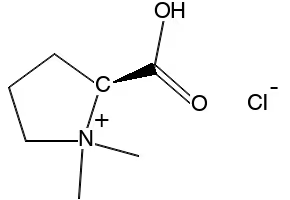
CAS Number4136-37-2
SynonymsEINECS 223-957-8; (2S)-1,1-Dimethylpyrrolidinium-2-carboxylate hydrochloride (1:1); stachydrine HCl; pyrrolidinium, 2-carboxy-1,1-dimethyl-, chloride, (2S)- (1:1); MFCD00060174; (2S)-1,1-Dimethyl-2-pyrrolidiniumcarboxylathydrochlorid; Pyrrolidinium, 2-carboxy-1,1-dimethyl-, inner salt, (2S)-, hydrochloride (1:1); 1,1-Dimethyl-2-pyrrolidiniumcarboxylate hydrochloride (1:1); (2S)-1,1-Diméthyl-2-pyrrolidiniumcarboxylate chlorhydrate; (2S)-1,1-Dimethyl-2-pyrrolidiniumcarboxylate hydrochloride (1:1); (2S)-1,1-Dimethyl-2-pyrrolidiniumcarboxylate hydrochloride; (2S)-2-Carboxy-1,1-dimethylpyrrolidinium chloride; stachydrine hydrochloride; Pyrrolidinium, 2-carboxy-1,1-dimethyl-, inner salt, hydrochloride (1:1); UNII:19Z024IC5E
Molecular FormulaC7H14ClNO2
Molecular Weight179.65
Melting Point225ºC
AppearanceLight yellow paste
| Chemical & Physical Properties | |
|---|---|
| CAS Number | 4136-37-2 |
| Catalog No. | 2A-9083303 |
| Chinese Name | 盐酸水苏碱 |
| Synonyms | EINECS 223-957-8; (2S)-1,1-Dimethylpyrrolidinium-2-carboxylate hydrochloride (1:1); stachydrine HCl; pyrrolidinium, 2-carboxy-1,1-dimethyl-, chloride, (2S)- (1:1); MFCD00060174; (2S)-1,1-Dimethyl-2-pyrrolidiniumcarboxylathydrochlorid; Pyrrolidinium, 2-carboxy-1,1-dimethyl-, inner salt, (2S)-, hydrochloride (1:1); 1,1-Dimethyl-2-pyrrolidiniumcarboxylate hydrochloride (1:1); (2S)-1,1-Diméthyl-2-pyrrolidiniumcarboxylate chlorhydrate; (2S)-1,1-Dimethyl-2-pyrrolidiniumcarboxylate hydrochloride (1:1); (2S)-1,1-Dimethyl-2-pyrrolidiniumcarboxylate hydrochloride; (2S)-2-Carboxy-1,1-dimethylpyrrolidinium chloride; stachydrine hydrochloride; Pyrrolidinium, 2-carboxy-1,1-dimethyl-, inner salt, hydrochloride (1:1); UNII:19Z024IC5E |
| Molecular Formula | C7H14ClNO2 |
| Molecular Weight | 179.65 |
| Melting Point | 225ºC |
| Appearance | Light yellow paste |
| Storage Condition | <0°C; store under inert gas; avoid moisture (hygro |
| Application | Stachydrine hydrochloride is the main active ingredient of Herba Leonuri and can be used to treat cardiovascular diseases [2]. Stachydrine hydrochloride inhibits the NF-κB signaling pathway. It has an |
| HTC | 2933990090 |
| MDL Number | C7H14ClNO2 |
| SMILES | C[N+]1(C)CCCC1C(=O)[O-].Cl |
| InChI Key | DUNMULOWUUIQIL-RGMNGODLSA-N |
| MSDS | msds/83303_1_4136_37_2.pdf |
| Bioactivity | Stachydrine hydrochloride is the major active constituent of Herba Leonuri, which is a potential therapy for cardiovascular diseases[2]. Stachydrine can inhibit the NF-κB signal pathway. Anti-hypertrophic activities[1]. Related Catalog Natural Products >> Alkaloid Research Areas >> Cardiovascular Disease Target p65 In Vitro Intervention of Stachydrine significantly suppresses the level of p-IκB (ser32) protein in the cytosol and NF-κB (p65) protein in the nucleus (P<0.05)[1]. Treatment with Stachydrine hydrochloride (50 µM, 200 µM, 500 µM and 1000 µM) noticeably inhibited MCF-7 and T47D cell proliferation in dose- and time-dependent manner. High concentrations (500 µM and 1000 µM) of Stachydrine significantly increased the frequency of both studied cell lines at the G1 phase of cell cycle, suggesting that Stachydrine hydrochloride could cause cell cycle arrest[2]. Cell Assay Cell Proliferation Assay[2] Cell Cycle Analysis[2] MCF-7 and T47D cells 50 µM, 200 µM, 500 µM and 1000 µM 24 and 48 hours CCK-8 cell counting assay is used to detect proliferation of MCF-7 and T47D cells when treated with Stachydrine hydrochloride at four different concentrations (50 µM, 200 µM, 500 µM and 1000 µM) for 24 and 48 hours. Cell cycle analysis of MCF-7 and T47D cells is determined by flow cytometry. Experiments are performed in triplicates and representative images are presented. Note: Inhibited proliferation and induced G1 phase arrest in MCF-7 and T47D cells. [1] Guo W, et al. Effect of Leonurus Stachydrine on myocardial cell hypertrophy. Zhong Yao Cai. 2012 Jun;35(6):940-3.https://www.ncbi.nlm.nih.gov/pubmed/23236831[2] Am J Transl Res. 2017 Apr 15;9(4):1834-1844. eCollection 2017.Stachydrine hydrochloride inhibits proliferation and induces apoptosis of breast cancer cells via inhibition of Akt and ERK pathways.Wang M1, Shu ZJ1, Wang Y1, Peng W1https://www.ncbi.nlm.nih.gov/pubmed/28469788 References [1]. Guo W, et al. Effect of Leonurus Stachydrine on myocardial cell hypertrophy. Zhong Yao Cai. 2012 Jun;35(6):940-3. [2]. Wang M, et al. Stachydrine hydrochloride inhibits proliferation and induces apoptosis of breast cancer cells via inhibition of Akt and ERK pathways. Am J Transl Res. 2017 Apr 15;9(4):1834-1844. Chemical & Physical Properties Melting Point 225ºC Molecular Formula C7H14ClNO2 Molecular Weight 179.645 Exact Mass 179.071304 PSA 40.13000 InChIKey DUNMULOWUUIQIL-RGMNGODLSA-N SMILES C[N+]1(C)CCCC1C(=O)[O-].Cl |
| Use of | Stachydrine hydrochloride is the major active constituent of Herba Leonuri, which is a potential therapy for cardiovascular diseases[2]. Stachydrine can inhibit the NF-κB signal pathway. Anti-hypertrophic activities[1]. Properties Name Stachydrine hydrochloride Synonym More Synonyms Stachydrine Hydrochloride Biological Activity Description Stachydrine hydrochloride is the major active constituent of Herba Leonuri, which is a potential therapy for cardiovascular diseases[2]. Stachydrine can inhibit the NF-κB signal pathway. Anti-hypertrophic activities[1]. Related Catalog Natural Products >> Alkaloid Research Areas >> Cardiovascular Disease In Vitro Intervention of Stachydrine significantly suppresses the level of p-IκB (ser32) protein in the cytosol and NF-κB (p65) protein in the nucleus (P<0.05)[1]. Treatment with Stachydrine hydrochloride (50 µM, 200 µM, 500 µM and 1000 µM) noticeably inhibited MCF-7 and T47D cell proliferation in dose- and time-dependent manner. High concentrations (500 µM and 1000 µM) of Stachydrine significantly increased the frequency of both studied cell lines at the G1 phase of cell cycle, suggesting that Stachydrine hydrochloride could cause cell cycle arrest[2]. References [1]. Guo W, et al. Effect of Leonurus Stachydrine on myocardial cell hypertrophy. Zhong Yao Cai. 2012 Jun;35(6):940-3. [2]. Wang M, et al. Stachydrine hydrochloride inhibits proliferation and induces apoptosis of breast cancer cells via inhibition of Akt and ERK pathways. Am J Transl Res. 2017 Apr 15;9(4):1834-1844. Chemical & Physical Properties Exact Mass 179.071304 PSA 40.13000 InChIKey DUNMULOWUUIQIL-RGMNGODLSA-N |
| Tax Rebate | 13.0% |
| Supervision | None. MFN tariff: 6.5%. Ordinary tariff: 20.0% |
| Transport Info | Product name: Purity: 98.0% |
| MSDS Transport Info | Module 14. Shipping information United Nations classification: inconsistent with United Nations classification standards UN number: not specified Stachyrine hydrochloride Modification number: 6 |
| Related Products in Specialty Chemicals | ||
|---|---|---|
| S-Benzyl-L-Cysteine-4-nitroaniline | 7436-62-6 | 2A-9083253 |
| 2-O-alpha-D-Glucopyranosyl-D-glucose | 2140-29-6 | 2A-9083254 |
| 1,2,3,4-Tetra-O-acetyl-beta-D-xylopyranose | 4049-33-6 | 2A-9083261 |
| Bromo2,3,4-Tri-O-acetyl-alpha-D-xylopyranoside | 3068-31-3 | 2A-9083262 |
| 2-Acetamido-2-deox-4-O-(alpha-L-fucopyranosyl)-D-glucopyranose | 76211-71-7 | 2A-9083263 |
| 4-(2,5-Dimethylpyrrol-1-yl)benzoicacid | 15898-26-7 | 2A-9083306 |
| 3-Acetyl-4,5-dimethyl-5-hydroxy-1,5-dihydro-2H-pyrrol-2-one | 98593-79-4 | 2A-9083315 |
| 3-Acetyl-2,7-dimethyl-5H-chromeno[2,3-B]pyridin-5-one | 67867-48-5 | 2A-9083316 |
| 4-(2-Pyrrolidin-1-yl-phenylcarbamoyl)butyricacid | 436088-74-3 | 2A-9083318 |
| Beta-L-(-)-Allose | 39392-62-6 | 2A-9083330 |
| Browse all Specialty Chemicals products » | ||
Phone:
630-322-8886
630-322-8887
Email:
Office Locations:
Chicago, IL, USA
San Francisco, CA, USA


 EN
EN


 SDS
SDS