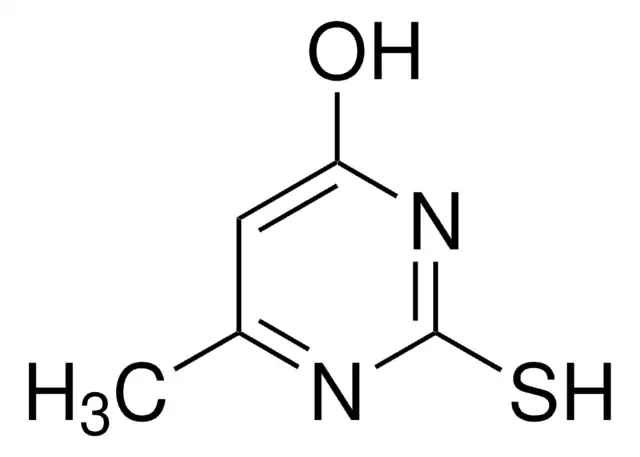
CAS Number56-04-2
Synonyms4-Hydroxy-2-mercapto-6-methylpyrimidine; 6-Methyl-2-thioxo-2,3-dihydro-4(1H)-pyrimidinone; Metiur; 2-Mercapto-4-methyl-6-hydroxypyrimidine; Methiure; 6-Hydroxy-2-mercapto-4-methylpyrimidine; 6-Methyl-2-sulfanylpyrimidin-4(3H)-one; 4-Hydroxy-6-methylpyrimidine-2(1H)-thione; 6-methyl-2-sulfanylpyrimidin-4-ol; methylthiouracil; 6-methyl-2-sulfanylidene-1H-pyrimidin-4-one; 6-Methyl-2-thioxo-2,3-dihydropyrimidin-4(1H)-on; 6-Methyl-4-oxo-2-thioxo-1,2,3,4-tetrahydropyrimidine; MFCD00006040; EINECS 200-252-3; 2-mercapto-6-methylpyrimidin-4-ol; 6-methyl-2-thioxo-2,3-dihydropyrimidin-4(1H)-one
Molecular FormulaC5H6N2OS
Molecular Weight142.18
Purity98%
Density1.4±0.1 g/cm3
Boiling Point342.3ºC at 760 mmHg
Melting Point~330 °C (dec.) (lit.)
Appearancewhite powder
EINECS200-252-3
Symbol
Signal WordWarning
| Chemical & Physical Properties | |
|---|---|
| CAS Number | 56-04-2 |
| Catalog No. | 2A-9008314 |
| Chinese Name | 甲硫尿嘧啶 |
| Synonyms | 4-Hydroxy-2-mercapto-6-methylpyrimidine; 6-Methyl-2-thioxo-2,3-dihydro-4(1H)-pyrimidinone; Metiur; 2-Mercapto-4-methyl-6-hydroxypyrimidine; Methiure; 6-Hydroxy-2-mercapto-4-methylpyrimidine; 6-Methyl-2-sulfanylpyrimidin-4(3H)-one; 4-Hydroxy-6-methylpyrimidine-2(1H)-thione; 6-methyl-2-sulfanylpyrimidin-4-ol; methylthiouracil; 6-methyl-2-sulfanylidene-1H-pyrimidin-4-one; 6-Methyl-2-thioxo-2,3-dihydropyrimidin-4(1H)-on; 6-Methyl-4-oxo-2-thioxo-1,2,3,4-tetrahydropyrimidine; MFCD00006040; EINECS 200-252-3; 2-mercapto-6-methylpyrimidin-4-ol; 6-methyl-2-thioxo-2,3-dihydropyrimidin-4(1H)-one |
| Molecular Formula | C5H6N2OS |
| Molecular Weight | 142.18 |
| Purity | 98 |
| Density | 1.4±0.1 g/cm3 |
| Boiling Point | 342.3ºC at 760 mmHg |
| Melting Point | ~330 °C (dec.) (lit.) |
| Appearance | white powder |
| Water Solubility | INSOLUBLE |
| Storage Condition | Room Temperature |
| Application | Methylthiouracil is an antithyroid agent. Methylthiouracil inhibits the production of TNF-α and IL-6 and the activation of NF-κB and ERK1/2. |
| EINECS | 200-252-3 |
| HTC | 29335995 |
| UN(IATA) | UN3077 |
| PubChem ID | 329757192 |
| MDL Number | MFCD00006040 |
| SMILES | CC1=CC(=O)NC(=S)N1 |
| InChI | 1S/C5H6N2OS/c1-3-2-4(8)7-5(9)6-3/h2H,1H3,(H2,6,7,8,9) |
| InChI Key | HWGBHCRJGXAGEU-UHFFFAOYSA-N |
| Beilstein/REAXYS | 115648 |
| NACRES Code | NA.24 |
| UNSPSC | 41116107 |
| Hazard Symbols | Xn |
| Risk Codes | R22;R40 |
| Safety Description | S36/37;S45 |
| MSDS | msds/8314_1_56_04_2.pdf |
| Bioactivity | Methylthiouracil is an antithyroid agent. Methylthiouracil suppresses the production TNF-α and IL-6, and the activation of NF-κB and ERK1/2. Related Catalog Signaling Pathways >> Immunology/Inflammation >> Interleukin Related Signaling Pathways >> Apoptosis >> TNF Receptor Research Areas >> Inflammation/Immunology Target NF-κB TNF-α IL-6 ERK1 ERK2 In Vitro HUVECs are treated with various concentrations of MTU (0-20 μM) for 6 h after the addition of LPS (100 ng/mL) for 4 h. MTU inhibits LPS-mediated hyperpermeability in endothelial cells, with the optimal effect occurring at a concentration above 5 μM. The effects of MTU are examined on HUVEC actin cytoskeletal arrangement by immunofluorescence staining of HUVEC monolayers with F-actin labeled fluorescein phalloidin. Control HUVECs exhibit a random distribution of F-actin throughout the cells, with some localization of actin filament bundles at the cell boundaries. Barrier disruption by LPS (100 ng/mL) is manifested by the formation of paracellular gaps in HUVECs. In addition, post-treatment with MTU (10 or 20 μM) results in inhibited formation of LPS-induced paracellular gaps with the formation of dense F-actin rings. To test the cytotoxicity of MTU, cellular viability assays are performed in HUVECs treated with MTU for 24 h. At concentrations up to 20 μM, MTU does not affect cell viability[1]. In Vivo MTU treatment results in marked inhibition of the peritoneal leakage of dye induced by LPS. The average circulating blood volume for mice is 72 mL/kg. Because the average mouse weight in this study is 27 g, and the average blood volume is 2 mL, the injected MTU (142 or 284 μg/kg) results in a maximum concentration of 10 or 20 μM in the peripheral blood[1]. Cell Assay MTT is used as an indicator of cell viability. Primary human umbilical vein endothelial cells (HUVECs) are grown in 96-well plates at a density of 5×10³ cells/well. After 24 h, the cells are washed with fresh medium and treated with MTU (0-20 μM). After a 48 h incubation period, the cells are washed, and 100 μL of MTT (1 mg/mL) is added, followed by incubation for 4 h. Finally, DMSO (150 μL) is added to solubilize the formazan salt formed, and the amount of formazan salt is determined by measuring the OD at 540 nm using a microplate reader [1]. Animal Admin Mice[1] Male C57BL/6 mice (6-7 weeks old; average weight, 27 g) are used in this study. Mice are administered LPS (0.3 mg/mouse or 15 mg/kg, intravenously). After 4 h, the mice are intravenously treated with MTU (142 or 284 μg/kg, for 6 h) and injected with 1% Evans blue dye solution in normal saline. Six hours later, the mice are sacrificed and peritoneal exudates are collected by washing cavities with 5 mL of normal saline and by centrifuging at 200× g for 10 min. The absorbance of the supernatant is read at 650 nm. Vascular permeabilities are expressed as μg of dye/mouse that leaked into the peritoneal cavity and are determined using a standard curve. References [1]. Ku SK, et al. Anti-inflammatory effects of methylthiouracil in vitro and in vivo. Toxicol Appl Pharmacol. 2015 Nov 1;288(3):374-86. Chemical & Physical Properties Density 1.4±0.1 g/cm3 Boiling Point 342.3ºC at 760 mmHg Melting Point ~330 °C (dec.)(lit.) Molecular Formula C5H6N2OS Molecular Weight 142.179 Flash Point 160.8ºC Exact Mass 142.020081 PSA 80.74000 LogP 0.31 Index of Refraction 1.638 InChIKey HWGBHCRJGXAGEU-UHFFFAOYSA-N SMILES Cc1cc(=O)[nH]c(=S)[nH]1 Stability Stability Incompatible with strong oxidizing agents, iodine, metals. Water Solubility INSOLUBLE |
| Use of | Properties Articles27 Name 6-Methyl-2-thiouracil Synonym More Synonyms Methylthiouracil Biological Activity Related Catalog Signaling Pathways >> Immunology/Inflammation >> Interleukin Related Signaling Pathways >> Apoptosis >> TNF Receptor Research Areas >> Inflammation/Immunology In Vitro HUVECs are treated with various concentrations of MTU (0-20 μM) for 6 h after the addition of LPS (100 ng/mL) for 4 h. MTU inhibits LPS-mediated hyperpermeability in endothelial cells, with the optimal effect occurring at a concentration above 5 μM. The effects of MTU are examined on HUVEC actin cytoskeletal arrangement by immunofluorescence staining of HUVEC monolayers with F-actin labeled fluorescein phalloidin. Control HUVECs exhibit a random distribution of F-actin throughout the cells, with some localization of actin filament bundles at the cell boundaries. Barrier disruption by LPS (100 ng/mL) is manifested by the formation of paracellular gaps in HUVECs. In addition, post-treatment with MTU (10 or 20 μM) results in inhibited formation of LPS-induced paracellular gaps with the formation of dense F-actin rings. To test the cytotoxicity of MTU, cellular viability assays are performed in HUVECs treated with MTU for 24 h. At concentrations up to 20 μM, MTU does not affect cell viability[1]. References [1]. Ku SK, et al. Anti-inflammatory effects of methylthiouracil in vitro and in vivo. Toxicol Appl Pharmacol. 2015 Nov 1;288(3):374-86. Chemical & Physical Properties Molecular Formula C5H6N2OS Exact Mass 142.020081 PSA 80.74000 Index of Refraction 1.638 InChIKey HWGBHCRJGXAGEU-UHFFFAOYSA-N Stability Stability Incompatible with strong oxidizing agents, iodine, metals. Water Solubility INSOLUBLE |
| Tax Rebate | 13.0% |
| Supervision | None. MFN tariff: 6.5%. Ordinary tariff: 20.0% |
| Transport Info | Product name: Purity: 0.0% |
| MSDS Transport Info | Module 14. Shipping information United Nations classification: inconsistent with United Nations classification standards UN number: not specified |
| Related Products in Specialty Chemicals | ||
|---|---|---|
| Methyleneamino acetamide | 2A-108306 | 2A-9008306 |
| Methylguanidine hydrochloride | 21770-81-0 | 2A-9008307 |
| Methylpyridinium bromide | 2350-76-7 | 2A-9008310 |
| methylsulfinylmethane | 67-68-5 | 2A-0201605 |
| Methylthiomethyl butyrate | 74758-93-3 | 2A-9008313 |
| Metornimdazole disodium phosphate | 2A-108315 | 2A-9008315 |
| Mexiletine hydrochloride | 5370-01-4 | 2A-9008316 |
| Mibolerone | 3704-09-4 | 2A-9008317 |
| MIT hydrochloride | 26172-54-3 | 2A-9008318 |
| m-Nitroacetophenone | 121-89-1 | 2A-9008319 |
| Browse all Specialty Chemicals products » | ||
Phone:
630-322-8886
630-322-8887
Email:
Office Locations:
Chicago, IL, USA
San Francisco, CA, USA


 EN
EN


 SDS
SDS