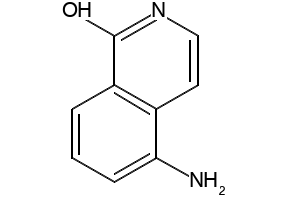
| Chemical & Physical Properties | |
|---|---|
| CAS Number | 93117-08-9 |
| Catalog No. | 2A-9082780 |
| Chinese Name | 5-氨基-2H-异喹啉-1-酮 |
| Synonyms | 5-Amino-1(2H)-isoquinolinone; 5-Amino-2H-isoquinolin-1-one; 5-Aminoisoquinolin-1(2H)-one |
| Molecular Formula | C9H8N2O |
| Molecular Weight | 160.173 |
| Density | 1.3±0.1 g/cm3 |
| Boiling Point | 477.3±45.0 °C at 760 mmHg |
| Storage Condition | room temperature |
| Application | 5-AIQ (5-aminoisoquinolin-1-one) is a water-soluble PARP-1 inhibitor. 5-AIQ is an important functional group in various drugs. 5-AIQ can reduce tissue damage related to liver ischemia and reperfusion |
| HTC | 2933790090 |
| SMILES | Nc1cccc2c(=O)[nH]ccc12 |
| InChI Key | SVASVGVAQIVSEZ-UHFFFAOYSA-N |
| MSDS | msds/82780_1_93117_08_9.pdf |
| Bioactivity | 5-AIQ (5-Aminoisoquinolin-1-one) is a water-soluble PARP-1 inhibitor. 5-AIQ is an important functional group in various drugs. 5-AIQ reduces the tissue injury associated with ischemia-reperfusion of the liver, it can be used for the research of the therapy conditions associated with ischemia-reperfusion of the liver[1][2]. Related Catalog Research Areas >> Cancer Signaling Pathways >> Epigenetics >> PARP Signaling Pathways >> Cell Cycle/DNA Damage >> PARP Target PARP-1 In Vitro 5-AIQ (5000 μg) significantly reduces the number of colonies of TA 98 without metabolic activation, and TA 98 and TA 1537 with metabolic activation[1]. In Vivo 5-AIQ (150 and 250 mg/kg; p.o.; once) possess no significantly genotoxic in vivo system by micronucleus test[1]. 5-AIQ (3 mg/kg; p.o.; 5 min prior to onset of liver ischemia) reduces the tissue injury associated with ischemia-reperfusion of the liver[2]. Animal Model: Male mice[1] Dosage: 150 and 250 mg/kg Administration: Oral gavage; 150 and 250 mg/kg; once Result: Showed no increase of micronucleated polychromatic erythrocytes (MNPCE) in both 24 h and 48 h after both 125 and 250 mg/kg duration exposure as compared to the corresponding control. Animal Model: Anesthetised male Wistar rats with liver ischemia (for 30 minutes) and reperfusion (for 2 hours) [2] Dosage: 3 mg/kg Administration: Intravenous injection; 3 mg/kg; 5 min prior to onset of liver ischemia Result: Reduced PARP activation and showed less staining for ICAM-1. References [1]. Vinod KR, Chandra S, Sharma SK. Evaluation of 5-aminoisoquinoline (5-AIQ), a novel PARP-1 inhibitor for genotoxicity potential in vitro and in vivo. Toxicol Mech Methods. 2010 Feb;20(2):90-5. [2]. Mota-Filipe H, et al. The novel PARP inhibitor 5-aminoisoquinolinone reduces the liver injury caused by ischemia and reperfusion in the rat. Med Sci Monit. 2002 Nov;8(11):BR444-53. Chemical & Physical Properties Density 1.3±0.1 g/cm3 Boiling Point 477.3±45.0 °C at 760 mmHg Molecular Formula C9H8N2O Molecular Weight 160.173 Flash Point 242.4±28.7 °C Exact Mass 160.063660 PSA 58.88000 LogP -0.15 Vapour Pressure 0.0±1.2 mmHg at 25°C Index of Refraction 1.657 InChIKey SVASVGVAQIVSEZ-UHFFFAOYSA-N SMILES Nc1cccc2c(=O)[nH]ccc12 |
| Use of | 5-AIQ (5-Aminoisoquinolin-1-one) is a water-soluble PARP-1 inhibitor. 5-AIQ is an important functional group in various drugs. 5-AIQ reduces the tissue injury associated with ischemia-reperfusion of the liver, it can be used for the research of the therapy conditions associated with ischemia-reperfusion of the liver[1][2]. Properties Name 5-Aminoisoquinolin-1(2H)-one Synonym More Synonyms 5-Aminoisoquinolin-1(2H)-one Biological Activity Description 5-AIQ (5-Aminoisoquinolin-1-one) is a water-soluble PARP-1 inhibitor. 5-AIQ is an important functional group in various drugs. 5-AIQ reduces the tissue injury associated with ischemia-reperfusion of the liver, it can be used for the research of the therapy conditions associated with ischemia-reperfusion of the liver[1][2]. Related Catalog Research Areas >> Cancer Signaling Pathways >> Epigenetics >> PARP Signaling Pathways >> Cell Cycle/DNA Damage >> PARP In Vitro 5-AIQ (5000 μg) significantly reduces the number of colonies of TA 98 without metabolic activation, and TA 98 and TA 1537 with metabolic activation[1]. References [1]. Vinod KR, Chandra S, Sharma SK. Evaluation of 5-aminoisoquinoline (5-AIQ), a novel PARP-1 inhibitor for genotoxicity potential in vitro and in vivo. Toxicol Mech Methods. 2010 Feb;20(2):90-5. [2]. Mota-Filipe H, et al. The novel PARP inhibitor 5-aminoisoquinolinone reduces the liver injury caused by ischemia and reperfusion in the rat. Med Sci Monit. 2002 Nov;8(11):BR444-53. Chemical & Physical Properties Molecular Formula C9H8N2O Exact Mass 160.063660 PSA 58.88000 LogP -0.15 Index of Refraction 1.657 InChIKey SVASVGVAQIVSEZ-UHFFFAOYSA-N |
| Tax Rebate | 9.0% |
| Supervision | None MFN tariff: 9.0% Ordinary tariff: 20.0% |
| Transport Info | Product name: Summary 2933790090. other lactams. VAT:17.0%. Tax rebate rate:9.0%. . MFN tariff:9.0%. General tariff:20.0% |
| Related Products in Specialty Chemicals | ||
|---|---|---|
| 3,4-Dinitro-1,2-benzenedicarboxylicacid | 92971-15-8 | 2A-9082765 |
| 7-(Methoxycarbonyl)-6,7-dihydro-5H-pyrrolizine-1-carboxylicacid | 92992-17-1 | 2A-9082769 |
| 2-(Cyclopropylmethoxy)benzonitrile | 83728-40-9 | 2A-9082774 |
| 4-(Isopropylamino)-3-nitrobenzonitrile | 355022-17-2 | 2A-9082776 |
| 2-Naphthoylmethylthiocyanate | 19339-62-9 | 2A-9082779 |
| 4-Chlorophenacylthiocyanate | 19339-59-4 | 2A-9082782 |
| 4-Bromophenacylthiocyanate | 65679-14-3 | 2A-9082784 |
| p-Xylylenedithiocyanate | 1014-99-9 | 2A-9082788 |
| Ethylene1,2-dithiocyanate | 629-17-4 | 2A-9082790 |
| 4-(6-Methoxy-benzothiazol-2-ylcarbamoyl)-butyricacid | 436086-78-1 | 2A-9082791 |
| Browse all Specialty Chemicals products » | ||
Phone:
630-322-8886
630-322-8887
Email:
Office Locations:
Chicago, IL, USA
San Francisco, CA, USA


 EN
EN


 SDS
SDS