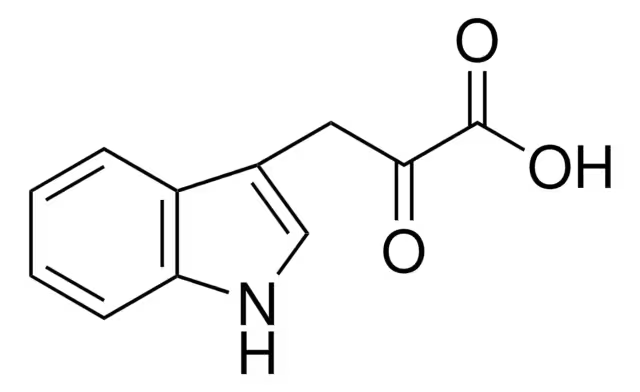
CAS Number392-12-1
SynonymsMFCD00005640; 3-(1H-Indol-3-yl)-2-oxopropanoic acid; Indole pyruvic acid; EINECS 206-874-1; Indole-3-pyrubate; Indole-3-pyruvic acid; INDOLE-3-PYRUVATE
Molecular FormulaC11H9NO3
Molecular Weight203.19
Purity≥97%
Density1.4±0.1 g/cm3
Boiling Point445.2±28.0 °C at 760 mmHg
Melting Point215 °C (dec.) (lit.)
Appearanceoff-white crystal
EINECS206-874-1
Symbol
Signal WordWarning
| Chemical & Physical Properties | |
|---|---|
| CAS Number | 392-12-1 |
| Catalog No. | 2A-9008040 |
| Chinese Name | 吲哚-3-丙酮酸 |
| Synonyms | MFCD00005640; 3-(1H-Indol-3-yl)-2-oxopropanoic acid; Indole pyruvic acid; EINECS 206-874-1; Indole-3-pyrubate; Indole-3-pyruvic acid; INDOLE-3-PYRUVATE |
| Molecular Formula | C11H9NO3 |
| Molecular Weight | 203.19 |
| Purity | ≥97 |
| Density | 1.4±0.1 g/cm3 |
| Boiling Point | 445.2±28.0 °C at 760 mmHg |
| Melting Point | 215 °C (dec.) (lit.) |
| Appearance | off-white crystal |
| Storage Condition | Store airtight in a cool, dry warehouse. Avoid moi |
| Application | Indole-3-pyruvate is a ketone analog of tryptophan and an orally active AHR agonist. Indole-3-pyruvate has antioxidant properties and can be used in research on inflammation and anxiety [1][2][3]. |
| EINECS | 206-874-1 |
| HTC | 2918300090 |
| PubChem ID | 57654306 |
| MDL Number | MFCD00005640 |
| SMILES | OC(=O)C(=O)Cc1c[nH]c2ccccc12 |
| InChI | 1S/C11H9NO3/c13-10(11(14)15)5-7-6-12-9-4-2-1-3-8(7)9/h1-4,6,12H,5H2,(H,14,15) |
| InChI Key | RSTKLPZEZYGQPY-UHFFFAOYSA-N |
| Beilstein/REAXYS | 172966 |
| NACRES Code | NA.22 |
| UNSPSC | 12352100 |
| Hazard Symbols | Transport |
| MSDS | msds/8040_1_392_12_1.pdf |
| Bioactivity | Indole-3-pyruvic acid, a keto analogue of tryptophan, is an orally active AHR agonist. Indole-3-pyruvic acid has antioxidant properties, and can be used in the research of inflammation, anxiety[1][2][3]. Related Catalog Signaling Pathways >> Immunology/Inflammation >> Aryl Hydrocarbon Receptor Research Areas >> Inflammation/Immunology Research Areas >> Neurological Disease Target Microbial Metabolite In Vitro Indole-3-pyruvic acid (50 and 250 μM, 24 h) activates AHR in HepG2 cells[1]. Indole-3-pyruvic acid (50 μM, 4 days) does not inhibit Th1 cell differentiation but promotes Tr1 differentiation[1]. Indole-3-pyruvic acid (1 mM, 24 h) reduces UVB-induced cytotoxicity in HaCaT cells[1]. Indole-3-pyruvic acid (25 mM, 6 h) reduces the levels of COX-2 in HaCaT cells[2]. RT-PCR[2] Cell Line: HaCaT cells Concentration: 5-25 mM Incubation Time: 6 h Result: Inhibited UVB-stimulated mRNA expression of IL-1β, IL-6, and cyclooxygenase 2 (Cox-2). In Vivo Indole-3-pyruvic acid (oral administration, fed in MF chow (0.1%) for 5 d) activates AHR in BALB/c mice[1]. Indole-3-pyruvic acid (oral administration, fed in MF chow (0.1%) for 5 wk) abrogates chronic inflammation in a T cell-mediated colitis model[1]. Indole-3-pyruvic acid (100 μM, dose at skin) protects against UVB-induced skin damage in HR-1 hairless mice[2]. Indole-3-pyruvic acid (intraperitoneal injection, 100-200 mg/kg) increases the time spent in the open arms of the elevated plus maze in mice[3]. Animal Model: BALB/c mice[1] Dosage: Fed in MF chow.0.1% for 5 d Administration: Oral administration Result: Up-regulated the expression of Cyp1a1 (a biomarker for AHR activation) in the colon. Animal Model: T cell-mediated colitis model of SCID mice[1] Dosage: Fed in MF chow.0.1% for 5 wk Administration: Oral administration Result: Suppressed diarrhea and improved colon inflammation. Down-regulated the expression of Th1 and proinflammatory cytokines and upregulated the expression of IL-10 in the colon. Animal Model: HR-1 Hairless Mice[2] Dosage: 100 μM Administration: Dose at skin Result: Enhanced the epidermal thickness. Attenuated UVB-induced necrosis observed in upper layer of dermis. References [1]. Reiji Aoki, et al. Indole-3-Pyruvic Acid, an Aryl Hydrocarbon Receptor Activator, Suppresses Experimental Colitis in Mice. J Immunol. 2018 Dec 15;201(12):3683-3693. [2]. Reiji Aoki, et al. Protective effect of indole-3-pyruvate against ultraviolet b-induced damage to cultured HaCaT keratinocytes and the skin of hairless mice. PLoS One. 2014 May 8;9(5):e96804. [3]. I P Lapin, et al. Anxiolytic effect of indole-3-pyruvic acid (IPA) in mice. Pharmacol Res. 1993 Sep;28(2):129-34. Chemical & Physical Properties Density 1.4±0.1 g/cm3 Boiling Point 445.2±28.0 °C at 760 mmHg Melting Point 215 °C (dec.)(lit.) Molecular Formula C11H9NO3 Molecular Weight 203.194 Flash Point 223.0±24.0 °C Exact Mass 203.058243 PSA 70.16000 LogP 0.46 Vapour Pressure 0.0±1.1 mmHg at 25°C Index of Refraction 1.685 InChIKey RSTKLPZEZYGQPY-UHFFFAOYSA-N SMILES O=C(O)C(=O)Cc1c[nH]c2ccccc12 Storage condition 2-8°C |
| Use of | Indole-3-pyruvic acid, a keto analogue of tryptophan, is an orally active AHR agonist. Indole-3-pyruvic acid has antioxidant properties, and can be used in the research of inflammation, anxiety[1][2][3]. Properties Articles32 Name 3-(indol-3-yl)pyruvic acid Synonym More Synonyms Indole-3-pyrubate Biological Activity Description Indole-3-pyruvic acid, a keto analogue of tryptophan, is an orally active AHR agonist. Indole-3-pyruvic acid has antioxidant properties, and can be used in the research of inflammation, anxiety[1][2][3]. Related Catalog Signaling Pathways >> Immunology/Inflammation >> Aryl Hydrocarbon Receptor Research Areas >> Inflammation/Immunology Research Areas >> Neurological Disease Microbial Metabolite References [1]. Reiji Aoki, et al. Indole-3-Pyruvic Acid, an Aryl Hydrocarbon Receptor Activator, Suppresses Experimental Colitis in Mice. J Immunol. 2018 Dec 15;201(12):3683-3693. [2]. Reiji Aoki, et al. Protective effect of indole-3-pyruvate against ultraviolet b-induced damage to cultured HaCaT keratinocytes and the skin of hairless mice. PLoS One. 2014 May 8;9(5):e96804. [3]. I P Lapin, et al. Anxiolytic effect of indole-3-pyruvic acid (IPA) in mice. Pharmacol Res. 1993 Sep;28(2):129-34. Chemical & Physical Properties Molecular Formula C11H9NO3 Exact Mass 203.058243 PSA 70.16000 Index of Refraction 1.685 InChIKey RSTKLPZEZYGQPY-UHFFFAOYSA-N |
| Tax Rebate | 9.0% |
| Supervision | None MFN tariff: 6.5% Ordinary tariff: 30.0% |
| Transport Info | Product name: Purity: 95.0% |
| MSDS Transport Info | Module 14. Shipping information 14.1 UN dangerous goods number European Land Transport Dangerous Regulations: -International Maritime Dangerous Regulations: -International Air Transport Dangerous Regulations: - 14.2 Names specified by the United Nations (UN) European Land Transport Dangerous Regulations: Non-dangerous goods IMDG Code: Non-dangerous goods International air transport dangerous goods regulations: non-dangerous goods 14.3 Transport hazard categories European Land Transport Dangerous Regulations: -International Maritime Dangerous Regulations: -International Air Transport Dangerous Regulations: - 14.4 Package group European Land Transport Dangerous Regulations: -International Maritime Dangerous Regulations: -International Air Transport Dangerous Regulations: - 14.5 Environmental hazards European Land Transport Dangerous Regulations: No International Maritime Transport Dangerous Regulations Maritime Pollutants: No International Air Transport Risk Regulations: No 14.6 Special reminder to users No data available |
| Related Products in Heterocyclic Building Blocks | ||
|---|---|---|
| Indole-3-acrylic acid | 1204-06-4 | 2A-9008034 |
| Indole-3-carbinol | 700-06-1 | 2A-9008036 |
| Indole-3-carboxaldehyde | 487-89-8 | 2A-9008037 |
| Indole-3-carboxylic acid | 771-50-6 | 2A-9008038 |
| Indole-3-carboxylic acid ethyl ester | 776-41-0 | 2A-9008039 |
| Indole-4-carboxaldehyde | 1074-86-8 | 2A-9008041 |
| Indole-4-carboxylic acid | 2124-55-2 | 2A-9008042 |
| Indole-4-carboxylic acid methyl ester | 39830-66-5 | 2A-9008043 |
| Indole-5-carboxaldehyde | 1196-69-6 | 2A-9008044 |
| Indole-5-carboxylic acid | 1670-81-1 | 2A-9008045 |
| Browse all Heterocyclic Building Blocks products » | ||
Phone:
630-322-8886
630-322-8887
Email:
Office Locations:
Chicago, IL, USA
San Francisco, CA, USA


 EN
EN


 SDS
SDS