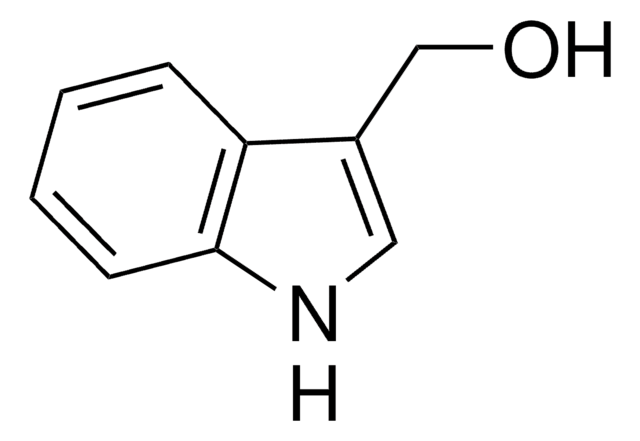
CAS Number700-06-1
SynonymsIndole-3-carbidol; MFCD02683932; 3-INDOLAMETHANOL; 3-indolemethanol; Indole-3-carbinol; EINECS 211-836-2; 3-IndoleCarbinol; 1H-Indol-3-ylmethanol; 1H-Indole-3-methanol; (1H-indol-3-yl)-methanol; (1H-indole-3-yl)-methanol; indole-3-methanol; 3-hydroxymethyl-1H-indole; 3-INDOLYLMETHANOL; 3-indolylcarbinol
Molecular FormulaC9H9NO
Molecular Weight147.17
Purity99%
Density1.3±0.1 g/cm3
Boiling Point360.6±17.0 °C at 760 mmHg
Melting Point96-99 °C (lit.)
AppearanceWhite to off-white crystals
EINECS211-836-2
Symbol
Signal WordWarning
| Chemical & Physical Properties | |
|---|---|
| CAS Number | 700-06-1 |
| Catalog No. | 2A-9008036 |
| Chinese Name | 3-吲哚甲醇 |
| Synonyms | Indole-3-carbidol; MFCD02683932; 3-INDOLAMETHANOL; 3-indolemethanol; Indole-3-carbinol; EINECS 211-836-2; 3-IndoleCarbinol; 1H-Indol-3-ylmethanol; 1H-Indole-3-methanol; (1H-indol-3-yl)-methanol; (1H-indole-3-yl)-methanol; indole-3-methanol; 3-hydroxymethyl-1H-indole; 3-INDOLYLMETHANOL; 3-indolylcarbinol |
| Molecular Formula | C9H9NO |
| Molecular Weight | 147.17 |
| Purity | 99 |
| Density | 1.3±0.1 g/cm3 |
| Boiling Point | 360.6±17.0 °C at 760 mmHg |
| Melting Point | 96-99 °C (lit.) |
| Appearance | White to off-white crystals |
| Water Solubility | Soluble in: methanol |
| Storage Condition | Store in a sealed container in a cool, dry place. |
| Packaging | 1kg/foil bag |
| Application | Indole-3-carbinol is an agonist of the aryl hydrocarbon receptor (AhR). |
| EINECS | 211-836-2 |
| HTC | 2933990090 |
| PubChem ID | 24896113 |
| MDL Number | MFCD00005632 |
| SMILES | OCc1c[nH]c2ccccc12 |
| InChI | 1S/C9H9NO/c11-6-7-5-10-9-4-2-1-3-8(7)9/h1-5,10-11H,6H2 |
| InChI Key | IVYPNXXAYMYVSP-UHFFFAOYSA-N |
| NACRES Code | NA.25 |
| UNSPSC | 12352005 |
| Hazard Symbols | Transport |
| MSDS | msds/8036_1_700_06_1.pdf |
| Bioactivity | Indole-3-carbinol suppresses NF-κB activity and also is an Aryl hydrocarbon receptor (AhR) agonist. Related Catalog Signaling Pathways >> Immunology/Inflammation >> Aryl Hydrocarbon Receptor Natural Products >> Alkaloid Research Areas >> Cancer Target NF-κB AhR In Vitro It is found that Indole-3-carbinol (I3C) inhibits the proliferation of THP-1 cells in a dose- and time dependent manner with minimal toxicity over normal monocytes. The AhR target genes (CYP1A1, IL1β) are overexpressed upon Indole-3-carbinol treatment (p<0.05 to p<0.001). The antiproliferative effects of Indole-3-carbinol are in association with programing cell death. Indole-3-carbinol downregulates BCL2 and upregulates FasR in THP-1 cells (p<0.05 to p<0.001). G1 cell cycle arrest is also observed using flow cytometry. G1-acting cell cycle genes (P21, P27 and P53) are overexpressed (p<0.05 to p<0.001), while CDK2 is downregulated upon Indole-3-carbinol treatment (p<0.01 to p<0.001)[1].Indole-3-carbinol suppresses NF-κB activity and stimulates the p53 pathway in pre-B acute lymphoblastic leukemia cells[2]. Cell Assay THP-1 cells are cultured in RPMI 1640 supplemented with 10% FBS, 100 U/mL penicillin, 100 mg/mL streptomycin and 2 mM Glutamax in a fully humidified atmosphere with 5% CO2. Cells (2-5×10⁵ mL-1) are seeded in six well plates followed by resuspension in complete growth media. THP-1 monocyte cells are then treated with 10 ng/mL phorbol 12-myristate 13-acetate as a tumor promoter to induce stable differentiation into attaching macrophage-like cells and overexpression of AhR. The cells are then treated with varying concentrations of Indole-3-carbinol (1, 10 and 100 μM, and 1 mM). THP-1 cells and enriching normal monocytes are seeded at 5×10⁴ cells/well in 24-well plate with different concentrations of Indole-3-carbinol and observed for 24 and 48 h followed by MTT assay. The cells are incubated in triplicates in a final volume of 200 mL of Phenol Red free RPMI 1640 for 20 h . An aliquot of 20 mL of MTT solution (5 mg/mL) is added to each well and incubated for 4 h. Formazan crystals are formed. An amount of 300 mL DMSO is then added to each well as a cell lysis solution. Percentage of cell viability is assessed by spectrophotometry at 570 nm[1]. References [1]. Mohammadi S, et al. Indole-3-carbinol induces G1 cell cycle arrest and apoptosis through aryl hydrocarbon receptor in THP-1 monocytic cell line.J Recept Signal Transduct Res. 2017 Oct;37(5):506-514. [2]. Safa M, et al. Indole-3-carbinol suppresses NF-κB activity and stimulates the p53 pathway in pre-B acute lymphoblastic leukemia cells. Tumour Biol. 2015 May;36(5):3919-30. Chemical & Physical Properties Density 1.3±0.1 g/cm3 Boiling Point 360.6±17.0 °C at 760 mmHg Melting Point 96-99 °C(lit.) Molecular Formula C9H9NO Molecular Weight 147.174 Flash Point 171.9±20.9 °C Exact Mass 147.068420 PSA 36.02000 LogP 0.96 Vapour Pressure 0.0±0.8 mmHg at 25°C Index of Refraction 1.705 InChIKey IVYPNXXAYMYVSP-UHFFFAOYSA-N SMILES OCc1c[nH]c2ccccc12 Storage condition 2-8°C Stability 2-80C |
| Use of | Indole-3-carbinol suppresses NF-κB activity and also is an Aryl hydrocarbon receptor (AhR) agonist. Properties Articles55 Name indole-3-methanol Synonym More Synonyms Indole-3-carbinol Biological Activity Description Indole-3-carbinol suppresses NF-κB activity and also is an Aryl hydrocarbon receptor (AhR) agonist. Related Catalog Signaling Pathways >> Immunology/Inflammation >> Aryl Hydrocarbon Receptor Natural Products >> Alkaloid Research Areas >> Cancer References [2]. Safa M, et al. Indole-3-carbinol suppresses NF-κB activity and stimulates the p53 pathway in pre-B acute lymphoblastic leukemia cells. Tumour Biol. 2015 May;36(5):3919-30. Chemical & Physical Properties Molecular Formula C9H9NO Exact Mass 147.068420 PSA 36.02000 Index of Refraction 1.705 InChIKey IVYPNXXAYMYVSP-UHFFFAOYSA-N |
| Tax Rebate | 13.0% |
| Supervision | None. MFN tariff: 6.5%. Ordinary tariff: 20.0% |
| Transport Info | Product name: Purity: 96.0% |
| MSDS Transport Info | Module 14. Shipping information 14.1 UN dangerous goods number European Land Transport Dangerous Regulations: -International Maritime Dangerous Regulations: -International Air Transport Dangerous Regulations: - 14.2 Names specified by the United Nations (UN) European Land Transport Dangerous Regulations: Non-dangerous goods IMDG Code: Non-dangerous goods International air transport dangerous goods regulations: non-dangerous goods 14.3 Transport hazard categories European Land Transport Dangerous Regulations: -International Maritime Dangerous Regulations: -International Air Transport Dangerous Regulations: - 14.4 Package group European Land Transport Dangerous Regulations: -International Maritime Dangerous Regulations: -International Air Transport Dangerous Regulations: - 14.5 Environmental hazards European Land Transport Dangerous Regulations: No International Maritime Transport Dangerous Regulations Maritime Pollutants: No International Air Transport Risk Regulations: No 14.6 Special reminder to users No data available |
| Related Products in Heterocyclic Building Blocks | ||
|---|---|---|
| Indazole-3-carboxylic acid | 4498-67-3 | 2A-9008027 |
| Indole-2,5-dicarboxylic acid | 117140-77-9 | 2A-9008029 |
| Indole-2,5-dicarboxylic acid 2-ethyl ester 5-methyl ester | 884494-66-0 | 2A-9008030 |
| Indole-2-carboxylic acid ethyl ester | 3770-50-1 | 2A-9008031 |
| Indole-3-acrylic acid | 1204-06-4 | 2A-9008034 |
| Indole-3-carboxaldehyde | 487-89-8 | 2A-9008037 |
| Indole-3-carboxylic acid | 771-50-6 | 2A-9008038 |
| Indole-3-carboxylic acid ethyl ester | 776-41-0 | 2A-9008039 |
| Indole-3-pyruvic acid | 392-12-1 | 2A-9008040 |
| Indole-4-carboxaldehyde | 1074-86-8 | 2A-9008041 |
| Browse all Heterocyclic Building Blocks products » | ||
Phone:
630-322-8886
630-322-8887
Email:
Office Locations:
Chicago, IL, USA
San Francisco, CA, USA


 EN
EN


 SDS
SDS