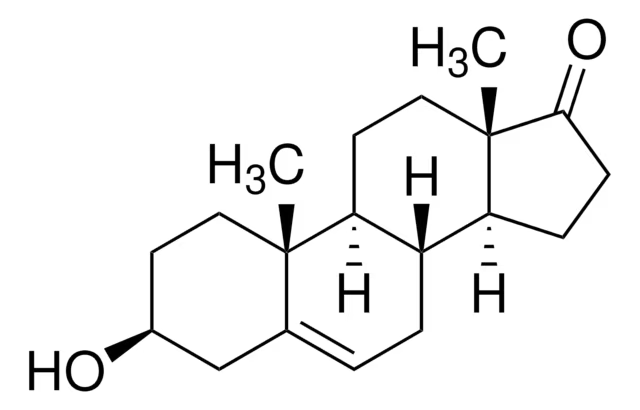
CAS Number53-43-0
Synonyms3β-Hydroxy-androst-5-ene-17-one; DHEA; 17-Hormoforin; 3-β-hydroxyandrost-5-en-17-one; 3b-hydroxy-Androst-5-en-17-one; (3b)-3-Hydroxyandrost-5-en-17-one; 3β-hydroxy-androst-5-en-17-one; (3β)-3-hydroxy-Androst-5-en-17-one; D5-Androsten-3b-ol-17-one; (3β)-3-Hydroxyandrost-5-en-17-one; MFCD00003613; Psicosterone; Prasterone; trans-Dehydroandrosterone; 3b-Hydroxyandrost-5-ene-17-one; 3b-Hydroxyandrost-5-en-17-one; Prestara; 3β-Hydroxy-5-androsten-17-one; Intrarosa; Deandros; dehydroisoandrosterone; (3β)-3-Hydroxyandrost-5-ene-17-one; Androst-5-ene-3b-ol-17-one; Androst-5-ene-3β-ol-17-one; 5-Androsten-3β-ol-17-one; Dehydro-epi-androsterone; 17-Chetovis; Dehydroepiandrosterone; didehydroepiandrosterone; 3β-Hydroxyandrost-5-ene-17-one
Molecular FormulaC19H28O2
Molecular Weight288.42
Purity≥99%
Density1.1±0.1 g/cm3
Boiling Point426.7±45.0 °C at 760 mmHg
Melting Point149-151 °C (lit.)
Appearancecrystalline powder
EINECS200-175-5
Symbol
Signal WordWarning
| Chemical & Physical Properties | |
|---|---|
| CAS Number | 53-43-0 |
| Catalog No. | 2A-9007524 |
| Chinese Name | 去氢表雄酮 |
| Synonyms | 3β-Hydroxy-androst-5-ene-17-one; DHEA; 17-Hormoforin; 3-β-hydroxyandrost-5-en-17-one; 3b-hydroxy-Androst-5-en-17-one; (3b)-3-Hydroxyandrost-5-en-17-one; 3β-hydroxy-androst-5-en-17-one; (3β)-3-hydroxy-Androst-5-en-17-one; D5-Androsten-3b-ol-17-one; (3β)-3-Hydroxyandrost-5-en-17-one; MFCD00003613; Psicosterone; Prasterone; trans-Dehydroandrosterone; 3b-Hydroxyandrost-5-ene-17-one; 3b-Hydroxyandrost-5-en-17-one; Prestara; 3β-Hydroxy-5-androsten-17-one; Intrarosa; Deandros; dehydroisoandrosterone; (3β)-3-Hydroxyandrost-5-ene-17-one; Androst-5-ene-3b-ol-17-one; Androst-5-ene-3β-ol-17-one; 5-Androsten-3β-ol-17-one; Dehydro-epi-androsterone; 17-Chetovis; Dehydroepiandrosterone; didehydroepiandrosterone; 3β-Hydroxyandrost-5-ene-17-one |
| Molecular Formula | C19H28O2 |
| Molecular Weight | 288.42 |
| Purity | ≥99 |
| Density | 1.1±0.1 g/cm3 |
| Boiling Point | 426.7±45.0 °C at 760 mmHg |
| Melting Point | 149-151 °C (lit.) |
| Appearance | crystalline powder |
| Storage Condition | Seal and store in a cool place away from light. |
| Application | DHEA is one of the most abundant steroid hormones. DHEA mediates its effects through multiple signaling pathways and acts through its specific receptors through conversion into androgen and estrogen d |
| EINECS | 200-175-5 |
| HTC | 2937290090 |
| PubChem ID | 24278369 |
| MDL Number | MFCD00003613 |
| SMILES | C[C@]12CC[C@H]3[C@@H](CC=C4C[C@@H](O)CC[C@]34C)[C@@H]1CCC2=O |
| InChI | 1S/C19H28O2/c1-18-9-7-13(20)11-12(18)3-4-14-15-5-6-17(21)19(15,2)10-8-16(14)18/h3,13-16,20H,4-11H2,1-2H3/t13-,14-,15-,16-,18-,19-/m0/s1 |
| InChI Key | FMGSKLZLMKYGDP-USOAJAOKSA-N |
| Beilstein/REAXYS | 2058110 |
| NACRES Code | NA.77 |
| UNSPSC | 51111800 |
| Hazard Symbols | Transport |
| Risk Codes | R36/37/38 |
| Safety Description | S24/25 |
| MSDS | msds/7524_1_53_43_0.pdf |
| Bioactivity | DHEA is one of the most abundant steroid hormones. DHEA mediates its action via multiple signaling pathways involving specific membrane receptors and via transformation into androgen and estrogen derivatives (e.g., androgens, estrogens, 7α and 7β DHEA, and 7α and 7β epiandrosterone derivatives) acting through their specific receptors. Related Catalog Signaling Pathways >> Others >> Androgen Receptor Natural Products >> Steroids Research Areas >> Endocrinology Target Human Endogenous Metabolite In Vitro DHEA is an effective antiapoptotic factor, reversing the serum deprivation-induced apoptosis in prostate cancer cells (DU145 and LNCaP cell lines) as well as in colon cancer cells (Caco2 cell line). DHEA significantly reduces serum deprivation-induced apoptosis in all 3 cancer cell types, quantitated with the APOPercentage assay (apoptosis is reduced from 0.587±0.053 to 0.142±0.0016 or 0.059±0.002 after treatment for 12 hours with DHEA or NGF, respectively; n=3, P<0.01), and by flow cytometry analysis (FACS) for DU145 cells. The antiapoptotic effect of DHEA is dose dependent with an EC50 at nanomolar concentrations (EC50: 11.2±3.6 nM and 12.4±2.2 nM in DU145 and Caco2 cells, respectively)[1]. DHEA is the principal sex steroid precursor in humans and can be converted directly to androgens. DHEA (≥1 μM) causes a dose-dependent inhibition of Chub-S7 proliferation, as assessed by thymidine incorporation assays. DHEA treatment inhibits expression of the key glucocorticoid-regulating genes H6PDH (≥100 nM) and HSD11B1 (≥1 μM) in differentiating preadipocytes in a dose-dependent manner. In keeping with this finding, DHEA treatment (≥1 μM) results in a marked reduction in 11β-HSD1 oxoreductase activity (≥1 μM) and a concurrent increase in dehydrogenase activity at the highest DHEA dose used (25 μM DHEA) in differentiated adipocytes[2]. In Vivo DHEA in the diet (0.45 % w/w) of male B6 mice (groups of five mice) treated for 8 weeks led to significant decreases in body temperature compared with mice fed the control AIN-76A diet. A similar comparison indicated that control and pair-fed mice are also significantly different. Animals fed DHEA have significantly lower temperatures than mice fed the control diet 26/29 times tested; mice pair fed to those on the DHEA diet are less affected, with 8/29 values significantly lower than in mice fed AIN-76A ad libitum. The temperatures of mice fed DHEA or pair fed to DHEA are significantly different 21/29 times tested. Body weights are significantly greater in mice fed the control diet than in mice fed DHEA or pair fed to DHEA. Food intake (grams per day) from cages are averaged for each week (n=7), except for Week 9 (n=3). The amount of food intake is significantly decreased in mice fed DHEA. By design, mice pair fed to DHEA ate about the same amount. Thus, it appears that DHEA reduces body temperature by food restriction and by a separate mechanism[3]. Kinase Assay Chub-S7 cells are incubated in DMEM containing cold DHEA (20 nM) and tritiated DHEA (0.2 μCi/well) for 48 h. Following incubation, steroids are extracted using dichloromethane separated by thin-layer chromatography using n-hexane/1-hexanol (75:25) as the mobile phase system. Metabolites are identified by comigration with unlabeled reference steroids that are visualized by exposure to Lieberman-Burchard reagent (ethanol-acetic anhydride-sulfuric acid). Steroid conversion is quantified using a LabLogic AR-200 scanner. Protein concentration is measured using a colorimetric 96-well plate assay and used to normalize conversion. Activity is expressed as percent conversion[2]. Cell Assay Chub-S7 preadipocytes and human primary preadipocytes are seeded into a 24-well plate at densities 1×10⁵ and 2.5×10⁵ respectively. Following overnight culture, medium is supplemented with DHEA, androstenediol, or DHEAS (0-100 μM). Following 24-, 48-, or 72 h incubation, cell proliferation is assessed by incubation with radiolabeled thymidine (0.2 μCi/well) for the final 6 h of culture. Proteins are precipitated with TCA, and cells are scraped in NaOH. The respective content of radiolabeled nuclear material in the resulting lysates is analyzed by scintillation counting. Data are expressed as percentage of control[2]. Animal Admin Mice[3] Mice are fed Purina Lab Chow until the start of experiments (Day 0). Groups of five mice are then fed pelleted AIN-76A diet containing either no additive or DHEA (0.45% w/w) between 0900 and 1000 hr. Diets are stored at 4°C for no longer than six months to maintain optimal activity. Mice are given the diets ad libitum, except for mice that are pair fed to mice treated with DHEA. The amounts of AIN-76A diet the pair-fed mice received are determined by the weight of food consumed by the DHEA-fed mice on a daily basis. Body weights (grams) are measured at different time points starting at Day 1 and ending at Day 59. Daily food intakes (grams per day) are determined by weighing the food consumed per cage of five mice. The mean±SEM values are calculated for weeks 1 to 8 (n=7); week 9 had only 3 days. References [1]. Anagnostopoulou V, et al. Differential effects of dehydroepiandrosterone and testosterone in prostate and colon cancer cell apoptosis: the role of nerve growth factor (NGF) receptors. Endocrinology. 2013 Jul;154(7):2446-56. [2]. McNelis JC, et al. Dehydroepiandrosterone exerts anti-glucocorticoid action on human preadipocyte proliferation, differentiation and glucose uptake. Am J Physiol Endocrinol Metab. 2013 Nov 1;305(9):E1134-44. [3]. Catalina F, et al. Decrease of core body temperature in mice by dehydroepiandrosterone. Exp Biol Med (Maywood). 2002 Jun;227(6):382-8. Chemical & Physical Properties Density 1.1±0.1 g/cm3 Boiling Point 426.7±45.0 °C at 760 mmHg Melting Point 146-151ºC Molecular Formula C19H28O2 Molecular Weight 288.424 Flash Point 182.1±21.3 °C Exact Mass 288.208923 PSA 37.30000 LogP 3.42 Vapour Pressure 0.0±2.3 mmHg at 25°C Index of Refraction 1.560 InChIKey FMGSKLZLMKYGDP-USOAJAOKSA-N SMILES CC12CCC3C(CC=C4CC(O)CCC43C)C1CCC2=O |
| Use of | DHEA is one of the most abundant steroid hormones. DHEA mediates its action via multiple signaling pathways involving specific membrane receptors and via transformation into androgen and estrogen derivatives (e.g., androgens, estrogens, 7α and 7β DHEA, and 7α and 7β epiandrosterone derivatives) acting through their specific receptors. Properties Articles196 Name dehydroepiandrosterone Synonym More Synonyms Dehydroepiandrosterone Biological Activity Description DHEA is one of the most abundant steroid hormones. DHEA mediates its action via multiple signaling pathways involving specific membrane receptors and via transformation into androgen and estrogen derivatives (e.g., androgens, estrogens, 7α and 7β DHEA, and 7α and 7β epiandrosterone derivatives) acting through their specific receptors. Related Catalog Signaling Pathways >> Others >> Androgen Receptor Natural Products >> Steroids Research Areas >> Endocrinology Human Endogenous Metabolite Cell Assay Chub-S7 preadipocytes and human primary preadipocytes are seeded into a 24-well plate at densities 1×10⁵ and 2.5×10⁵ respectively. Following overnight culture, medium is supplemented with DHEA, androstenediol, or DHEAS (0-100 μM). Following 24-, 48-, or 72 h incubation, cell proliferation is assessed by incubation with radiolabeled thymidine (0.2 μCi/well) for the final 6 h of culture. Proteins are precipitated with TCA, and cells are scraped in NaOH. The respective content of radiolabeled nuclear material in the resulting lysates is analyzed by scintillation counting. Data are expressed as percentage of control[2]. References [1]. Anagnostopoulou V, et al. Differential effects of dehydroepiandrosterone and testosterone in prostate and colon cancer cell apoptosis: the role of nerve growth factor (NGF) receptors. Endocrinology. 2013 Jul;154(7):2446-56. [2]. McNelis JC, et al. Dehydroepiandrosterone exerts anti-glucocorticoid action on human preadipocyte proliferation, differentiation and glucose uptake. Am J Physiol Endocrinol Metab. 2013 Nov 1;305(9):E1134-44. [3]. Catalina F, et al. Decrease of core body temperature in mice by dehydroepiandrosterone. Exp Biol Med (Maywood). 2002 Jun;227(6):382-8. Chemical & Physical Properties Molecular Formula C19H28O2 Exact Mass 288.208923 PSA 37.30000 Index of Refraction 1.560 InChIKey FMGSKLZLMKYGDP-USOAJAOKSA-N |
| Tax Rebate | 9.0% |
| Supervision | L.Drug import and export license |
| Transport Info | Product name: Purity: 98.0% |
| MSDS Transport Info | Module 14. Shipping information 14.1 UN dangerous goods number European Land Transport Dangerous Regulations: -International Maritime Dangerous Regulations: -International Air Transport Dangerous Regulations: - 14.2 Names specified by the United Nations (UN) European Land Transport Dangerous Regulations: Non-dangerous goods IMDG Code: Non-dangerous goods International air transport dangerous goods regulations: non-dangerous goods 14.3 Transport hazard categories European Land Transport Dangerous Regulations: -International Maritime Dangerous Regulations: -International Air Transport Dangerous Regulations: - 14.4 Package group European Land Transport Dangerous Regulations: -International Maritime Dangerous Regulations: -International Air Transport Dangerous Regulations: - 14.5 Environmental hazards European Land Transport Dangerous Regulations: No International Maritime Transport Dangerous Regulations Maritime Pollutants: No International Air Transport Risk Regulations: No 14.6 Special reminder to users No data available |
| Related Products in Specialty Chemicals | ||
|---|---|---|
| D-Cysteine hydrochloride monohydrate | 32443-99-5 | 2A-9007517 |
| Decafluorobenzophenone | 853-39-4 | 2A-9007519 |
| Decafluorodiphenyl sulphide | 1043-50-1 | 2A-9007521 |
| Decafluoropent-2-ene | 72804-49-0 | 2A-9007522 |
| Decanedioic acid bis(1,2,2,6,6-pentamethylpiperidin-4-yl)ester | 41556-26-7 | 2A-9007523 |
| Denatonium benzoate | 3734-33-6 | 2A-9007525 |
| Denatonium saccharide | 90823-38-4 | 2A-9007526 |
| D-Erythronolactone | 15667-21-7 | 2A-9007527 |
| Dess-martin periodinane | 87413-09-0 | 2A-9007529 |
| D-Galactosamine hydrochloride | 1772-03-8 | 2A-9007531 |
| Browse all Specialty Chemicals products » | ||
Phone:
630-322-8886
630-322-8887
Email:
Office Locations:
Chicago, IL, USA
San Francisco, CA, USA


 EN
EN


 SDS
SDS