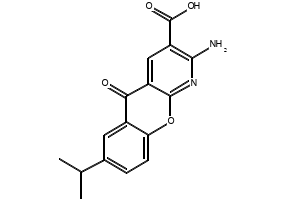
CAS Number68302-57-8
Synonyms2-amino-7-(1-methylethyl)-5-oxo-5H-chromeno[2,3-b]pyridine-3-carboxylic acid; Amlexanoxum; 2-Amino-7-isopropyl-5-oxo-5H-[1]benzopyrano[2,3-b]pyridine-3-carboxylic Acid; Amlenanox; Amlexanox; Amlexanoxo; Elics; Amoxanox; Solfa; MFCD00864790; 2-Amino-7-(1-methylethyl)-5-oxo-5H-[1]benzopyrano[2,3-b]pyridine-3-carboxylicAcid; amlexanoxum [INN_la]; Aphthasol; 2-Amino-7-isopropyl-1-azaxanthone-3-carboxylic Acid; Amlexanoxum [Latin]; 2-Amino-7-isopropyl-5-oxo-5H-chromeno[2,3-b]pyridine-3-carboxylic acid; 2-amino-5-oxo-7-(propan-2-yl)-5H-chromeno[2,3-b]pyridine-3-carboxylic acid
Molecular FormulaC16H14O4N2
Molecular Weight298.3
Purity98%
Density1.4±0.1 g/cm3
Boiling Point570.0±50.0 °C at 760 mmHg
Melting Point>3000C
AppearanceWhite crystalline solid
| Chemical & Physical Properties | |
|---|---|
| CAS Number | 68302-57-8 |
| Catalog No. | 2A-9007109 |
| Chinese Name | 氨来呫诺 |
| Synonyms | 2-amino-7-(1-methylethyl)-5-oxo-5H-chromeno[2,3-b]pyridine-3-carboxylic acid; Amlexanoxum; 2-Amino-7-isopropyl-5-oxo-5H-[1]benzopyrano[2,3-b]pyridine-3-carboxylic Acid; Amlenanox; Amlexanox; Amlexanoxo; Elics; Amoxanox; Solfa; MFCD00864790; 2-Amino-7-(1-methylethyl)-5-oxo-5H-[1]benzopyrano[2,3-b]pyridine-3-carboxylicAcid; amlexanoxum [INN_la]; Aphthasol; 2-Amino-7-isopropyl-1-azaxanthone-3-carboxylic Acid; Amlexanoxum [Latin]; 2-Amino-7-isopropyl-5-oxo-5H-chromeno[2,3-b]pyridine-3-carboxylic acid; 2-amino-5-oxo-7-(propan-2-yl)-5H-chromeno[2,3-b]pyridine-3-carboxylic acid |
| Molecular Formula | C16H14O4N2 |
| Molecular Weight | 298.3 |
| Purity | 98 |
| Density | 1.4±0.1 g/cm3 |
| Boiling Point | 570.0±50.0 °C at 760 mmHg |
| Melting Point | >3000C |
| Appearance | White crystalline solid |
| Storage Condition | -20°C Freezer |
| Application | AmLexanox is a specific inhibitor of IKKε and TBK1 with IC50 value of 1-2 μM. |
| HTC | 2934999090 |
| MDL Number | MFCD00864790 |
| SMILES | CC(C)c1ccc2oc3nc(N)c(C(=O)O)cc3c(=O)c2c1 |
| InChI | InChI=1S/C16H14N2O4/c1-7(2)8-3-4-12-9(5-8)13(19)10-6-11(16(20)21)14(17)18-15(10)22-12/h3-7H,1-2H3,(H2,17,18)(H,20,21) |
| InChI Key | SGRYPYWGNKJSDL-UHFFFAOYSA-N |
| MSDS | msds/7109_1_68302_57_8.pdf |
| Bioactivity | AmLexanox is a specific inhibitor of IKKε and TBK1, and inhibits the IKKε and TBK1 activity determined by MBP phosphorylation with an IC50 of approximately 1-2 μM. Related Catalog Signaling Pathways >> NF-κB >> IKK Research Areas >> Metabolic Disease Target IKKε:1-2 μM (IC50) TBK1:1-2 μM (IC50) In Vitro AmLexanox increases phosphorylation of TBK1 on Ser172 in 3T3-L1 adipocytes, and blocks polyinosinic:polycytidylic acid (poly I:C)-stimulated phosphorylation of interferon responsive factor-3 (IRF3), a presumed substrate of IKKε and TBK1[1]. AmLexanox potently inhibits the release of histamine and leukotrienes from mast cells, basophils and neutrophils in in vitro settings, possibly through increasing intracellular cyclic AMP content in inflammatory cells, a mem-brane-stabilising effect or inhibition of calcium influx[2]. In primary bone marrow derived macrophages (BMMs), amLexanox inhibits osteoclast formation and bone resorption. At the molecular level, amLexanox suppresses RANKL-induced activation of nuclear factor-κB (NF-κB), mitogen-activated protein kinase (MAPKs), c-Fos and NFATc1. AmLexanox decreases the expression of osteoclast-specific genes, including TRAP, MMP9, Cathepsin K and NFATc1[3]. In Vivo AmLexanox (100 mg/kg, p.o.) prevents and reverses diet-induced or genetic obesity, and produces reversible weight loss in obese mice. AmLexanox also causes a significant decrease in adipose tissue mass in these mice, and an increase in circulating adiponectin. AmLexanox (25 mg/kg) significantly improves insulin sensitivity in mice with established DIO,and after four weeks of treatment, amLexanox produces marked improvements in glucose[1]. AmLexanox before the first application of the paste and at each has been shown to suppress both immediate and evaluation thereafter. A categorical scale is also delayed-type hypersensitivity reactions[2]. AmLexanox (20 mg/kg) enhances osteoblast differentiation of BMSCs. In ovariectomized (OVX) mouse model, amLexanox prevents OVX-induced bone loss by suppressing osteoclast activity[3]. Kinase Assay The in vitro kinase assays is performed by incubating purified kinase (IKKε or TBK1) in kinase buffer containing 25 mM Tris (pH7.5), 10 mM MgCl2, 1 mM DTT, and 10 µM ATP for 30 minutes at 30°C in the presence of 0.5 µCi γ-[32P]-ATP and 1 µg MBP per sample as a substrate. The kinase reaction is stopped by adding 4x sodium dodecyl sulfate (SDS) sample buffer and boiling for 5 minutes at 95°C. Supernatants are resolved by SDS-polyacrylamide gel electrophoresis, transferred to nitrocellulose, and analyzed by autoradiography using a Typhoon 9410 phosphorimager. Cell Assay To examine cell proliferation, a Cell Counting Kit-8 is used according to the manufacturer's instructions. BMMs are seeded at a density of 5×10³ cells/well in 96-well plates. After 24 hours, cells are treated with different concentrations of AmLexanox (0, 1.5, 3, 6, 12, 25 μM) every 2 days in the presence of M-CSF (30 ng/mL) for 7 days. After 1, 3, 5 and 7 days, the culture medium is replaced by the medium containing 10% CCK-8 and cells are incubated at 37°C for an additional 2 h. The absorbance is then measured at a wavelength of 450 nm on an ELX800 absorbance microplate reader. Animal Admin Wildtype male C57BL/6 mice are fed with a HFD consisting of 45% of calories from fat starting at eight weeks of age for 12-24 weeks, while ND C57BL/6 controls are maintained on normal chow diet consisting of 4.5% fat. C57BL/6 diets are fed containing ω-3 fatty acids. Rosiglitazone treatment is administered for three weeks by addition of the compound to the diet in mice that have been on HFD for 16 weeks. Each mouse consumes on average 3.5 mg per kg rosiglitazone per day. AmLexanox is administered by daily oral gavage. For the prevention groups, amLexanox (25 mg per kg or 100 mg per kg) administration is begun concurrently with HFD feeding at eight weeks of age. For the treatment groups, 25 mg per kg amLexanox treatment is begun at 20 weeks of age after 12 weeks of HFD. To test the effect of amLexanox withdrawal, mice in the treatment group are switched from amLexanox gavage to vehicle control after eight weeks of amLexanox treatment. Control and ob/ob mice are fed with a normal chow diet and gavaged with 100 mg per kg amLexanox or vehicle control beginning at ten weeks of age. Animals are housed in a specific pathogen-free facility with a 12-hour light/12-hour dark cycle and given free access to food and water. References [1]. Reilly SM, et al. An inhibitor of the protein kinases TBK1 and IKK-e improves obesity-related metabolic dysfunctions in mice. Nat Med. 2013 Mar;19(3):313-21. [2]. Bell, J. AmLexanox for the treatment of recurrent aphthous ulcers. Clin Drug Investig, 2005. 25(9): p. 555-66. [3]. Zhang Y, et al. AmLexanox Suppresses Osteoclastogenesis and Prevents Ovariectomy-Induced Bone Loss. Sci Rep. 2015 Sep 4;5:13575. Chemical & Physical Properties Density 1.4±0.1 g/cm3 Boiling Point 570.0±50.0 °C at 760 mmHg Melting Point >3000C Molecular Formula C16H14N2O4 Molecular Weight 298.293 Flash Point 298.5±30.1 °C Exact Mass 298.095367 PSA 106.42000 LogP 3.74 Vapour Pressure 0.0±1.6 mmHg at 25°C Index of Refraction 1.669 InChIKey SGRYPYWGNKJSDL-UHFFFAOYSA-N SMILES CC(C)c1ccc2oc3nc(N)c(C(=O)O)cc3c(=O)c2c1 Storage condition -20°C Freezer |
| Use of | AmLexanox is a specific inhibitor of IKKε and TBK1, and inhibits the IKKε and TBK1 activity determined by MBP phosphorylation with an IC50 of approximately 1-2 μM. Properties Articles32 Name 2-amino-5-oxo-7-propan-2-ylchromeno[2,3-b]pyridine-3-carboxylic acid Synonym More Synonyms Amlexanox Biological Activity Description AmLexanox is a specific inhibitor of IKKε and TBK1, and inhibits the IKKε and TBK1 activity determined by MBP phosphorylation with an IC50 of approximately 1-2 μM. Related Catalog Signaling Pathways >> NF-κB >> IKK Research Areas >> Metabolic Disease IKKε:1-2 μM (IC50) TBK1:1-2 μM (IC50) In Vitro AmLexanox increases phosphorylation of TBK1 on Ser172 in 3T3-L1 adipocytes, and blocks polyinosinic:polycytidylic acid (poly I:C)-stimulated phosphorylation of interferon responsive factor-3 (IRF3), a presumed substrate of IKKε and TBK1[1]. AmLexanox potently inhibits the release of histamine and leukotrienes from mast cells, basophils and neutrophils in in vitro settings, possibly through increasing intracellular cyclic AMP content in inflammatory cells, a mem-brane-stabilising effect or inhibition of calcium influx[2]. In primary bone marrow derived macrophages (BMMs), amLexanox inhibits osteoclast formation and bone resorption. At the molecular level, amLexanox suppresses RANKL-induced activation of nuclear factor-κB (NF-κB), mitogen-activated protein kinase (MAPKs), c-Fos and NFATc1. AmLexanox decreases the expression of osteoclast-specific genes, including TRAP, MMP9, Cathepsin K and NFATc1[3]. References [1]. Reilly SM, et al. An inhibitor of the protein kinases TBK1 and IKK-e improves obesity-related metabolic dysfunctions in mice. Nat Med. 2013 Mar;19(3):313-21. [2]. Bell, J. AmLexanox for the treatment of recurrent aphthous ulcers. Clin Drug Investig, 2005. 25(9): p. 555-66. [3]. Zhang Y, et al. AmLexanox Suppresses Osteoclastogenesis and Prevents Ovariectomy-Induced Bone Loss. Sci Rep. 2015 Sep 4;5:13575. Chemical & Physical Properties Molecular Formula C16H14N2O4 Exact Mass 298.095367 PSA 106.42000 Index of Refraction 1.669 InChIKey SGRYPYWGNKJSDL-UHFFFAOYSA-N |
| Tax Rebate | 13.0% |
| Supervision | None. MFN tariff: 6.5%. Ordinary tariff: 20.0% |
| Transport Info | Product name: Purity: 98.0% |
| MSDS Transport Info | Module 14. Shipping information United Nations classification: inconsistent with United Nations classification standards UN number: not specified |
| Related Products in Specialty Chemicals | ||
|---|---|---|
| Aminodiphenylmethane | 91-00-9 | 2A-9007104 |
| Aminodiphenylmethane hydrochloride | 5267-34-5 | 2A-9007105 |
| Aminomalonic acid diethyl ester hydrochloride | 13433-00-6 | 2A-9007106 |
| Aminomethanesulfonic acid | 13881-91-9 | 2A-9007107 |
| Aminomux | 57248-88-1 | 2A-9007108 |
| Ammonium bromide | 12124-97-9 | 2A-9007110 |
| AMPS | 40623-75-4 | 2A-9007111 |
| Amylmethylamine | 25419-06-1 | 2A-9007112 |
| Androst-4-aza-3-one-17beta-butylcarboxamide | 2A-107113 | 2A-9007113 |
| Androstadiendione | 897-06-3 | 2A-9007114 |
| Browse all Specialty Chemicals products » | ||
Phone:
630-322-8886
630-322-8887
Email:
Office Locations:
Chicago, IL, USA
San Francisco, CA, USA


 EN
EN


 SDS
SDS