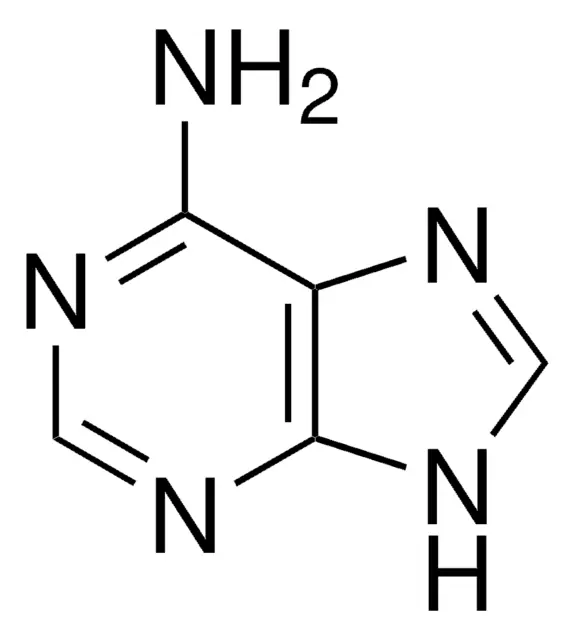
CAS Number73-24-5
Synonyms7(9)H-purin-6-ylamine; Ade; 1H-Purine-6-amine; Vitamin- B4; Adenin; 1,9-Dihydro-6H-purin-6-imine; 9H-Purine-6-amine; EINECS 200-796-1; adensoine; Crytidine; 1H-Purin-6-amine; 9H-Purin-6-yl-amin; 9H-Purin-6-amin; 9H-Adenine; T56 BM DN FN HNJ IZ; Leuco-4; 9H-Purin-6-amine; MFCD00041790; Adenine; ADENINE(P); usafcb-18; 6-aminopurine; 6-amino-Purine; Vitamin B4
Molecular FormulaC5H5N5
Molecular Weight135.13
Purity≥99%
Density1.9±0.1 g/cm3
Boiling Point243.2±50.0 °C at 760 mmHg
Melting Point>360 °C (lit.)
Appearancepowder
EINECS200-796-1
Symbol
Signal WordWarning
| Chemical & Physical Properties | |
|---|---|
| CAS Number | 73-24-5 |
| Catalog No. | 2A-9007070 |
| Chinese Name | 腺嘌呤 |
| Synonyms | 7(9)H-purin-6-ylamine; Ade; 1H-Purine-6-amine; Vitamin- B4; Adenin; 1,9-Dihydro-6H-purin-6-imine; 9H-Purine-6-amine; EINECS 200-796-1; adensoine; Crytidine; 1H-Purin-6-amine; 9H-Purin-6-yl-amin; 9H-Purin-6-amin; 9H-Adenine; T56 BM DN FN HNJ IZ; Leuco-4; 9H-Purin-6-amine; MFCD00041790; Adenine; ADENINE(P); usafcb-18; 6-aminopurine; 6-amino-Purine; Vitamin B4 |
| Molecular Formula | C5H5N5 |
| Molecular Weight | 135.13 |
| Purity | ≥99 |
| Density | 1.9±0.1 g/cm3 |
| Boiling Point | 243.2±50.0 °C at 760 mmHg |
| Melting Point | >360 °C (lit.) |
| Appearance | powder |
| Water Solubility | 0.5 g/L (20 ºC) |
| Storage Condition | Store in a sealed, cool, dry and dark place. Packe |
| Packaging | III |
| Application | Adenine is a purine derivative and an antimetabolite nucleoside analogue. |
| EINECS | 200-796-1 |
| HTC | 2936290090 |
| PubChem ID | 24891349 |
| MDL Number | MFCD00041790 |
| SMILES | Nc1ncnc2[nH]cnc12 |
| InChI | 1S/C5H5N5/c6-4-3-5(9-1-7-3)10-2-8-4/h1-2H,(H3,6,7,8,9,10) |
| InChI Key | GFFGJBXGBJISGV-UHFFFAOYSA-N |
| Beilstein/REAXYS | 5777 |
| NACRES Code | NA.51 |
| UNSPSC | 41106305 |
| Hazard Symbols | 6.1 |
| Risk Codes | R22 |
| Safety Description | S26;S36 |
| MSDS | msds/7070_1_73_24_5.pdf |
| Bioactivity | Adenine is a purine derivative and a nucleobase with a variety of roles in biochemistry. Target: Nucleoside antimetabolite/analogAdenine is a nucleobase with a variety of roles in biochemistry including cellular respiration, in the form of both the energy-rich adenosine triphosphate (ATP) and the cofactors nicotinamide adenine dinucleotide (NAD) and flavin adenine dinucleotide (FAD), andprotein synthesis, as a chemical component of DNA and RNA. The shape of adenine is complementary to either thymine in DNA or uracil in RNA.In older literature, adenine was sometimes called Vitamin B4. It is no longer considered a true vitamin or part of the Vitamin B complex. However, two B vitamins, niacin and riboflavin, bind with adenine to form the essential cofactors nicotinamide adenine dinucleotide (NAD) and flavin adenine dinucleotide (FAD), respectively. Hermann Emil Fischer was one of the early scientists to study adenine. Experiments performed in 1961 by Joan Oró have shown that a large quantity of adenine can be synthesized from the polymerization of ammonia with fivehydrogen cyanide (HCN) molecules in aqueous solution, whether this has implications for the origin of life on Earth is under debate. Related Catalog Signaling Pathways >> Cell Cycle/DNA Damage >> DNA/RNA Synthesis Natural Products >> Saccharides and Glycosides Research Areas >> Cancer Target Human Endogenous Metabolite References [1]. Reader V. The assay of vitamin B(4). Biochem J. 1930;24(6):1827-31. [2]. ORO J, et al. Synthesis of purines under possible primitive earth conditions. I. Adenine from hydrogen cyanide. Arch Biochem Biophys. 1961 Aug;94:217-27. Chemical & Physical Properties Density 1.9±0.1 g/cm3 Boiling Point 243.2±50.0 °C at 760 mmHg Melting Point 360-365ºC Molecular Formula C5H5N5 Molecular Weight 135.127 Flash Point 100.9±30.1 °C Exact Mass 135.054489 PSA 80.48000 LogP -2.12 Vapour Pressure 0.0±0.5 mmHg at 25°C Index of Refraction 1.954 InChIKey GFFGJBXGBJISGV-UHFFFAOYSA-N SMILES Nc1ncnc2nc[nH]c12 Water Solubility 0.5 g/L (20 ºC) |
| Use of | Adenine is a purine derivative and a nucleobase with a variety of roles in biochemistry. Target: Nucleoside antimetabolite/analogAdenine is a nucleobase with a variety of roles in biochemistry including cellular respiration, in the form of both the energy-rich adenosine triphosphate (ATP) and the cofactors nicotinamide adenine dinucleotide (NAD) and flavin adenine dinucleotide (FAD), andprotein synthesis, as a chemical component of DNA and RNA. The shape of adenine is complementary to either thymine in DNA or uracil in RNA.In older literature, adenine was sometimes called Vitamin B4. It is no longer considered a true vitamin or part of the Vitamin B complex. However, two B vitamins, niacin and riboflavin, bind with adenine to form the essential cofactors nicotinamide adenine dinucleotide (NAD) and flavin adenine dinucleotide (FAD), respectively. Hermann Emil Fischer was one of the early scientists to study adenine. Experiments performed in 1961 by Joan Oró have shown that a large quantity of adenine can be synthesized from the polymerization of ammonia with fivehydrogen cyanide (HCN) molecules in aqueous solution, whether this has implications for the origin of life on Earth is under debate. Properties Articles400 Name adenine Synonym More Synonyms Adenine Biological Activity Description Adenine is a purine derivative and a nucleobase with a variety of roles in biochemistry. Target: Nucleoside antimetabolite/analogAdenine is a nucleobase with a variety of roles in biochemistry including cellular respiration, in the form of both the energy-rich adenosine triphosphate (ATP) and the cofactors nicotinamide adenine dinucleotide (NAD) and flavin adenine dinucleotide (FAD), andprotein synthesis, as a chemical component of DNA and RNA. The shape of adenine is complementary to either thymine in DNA or uracil in RNA.In older literature, adenine was sometimes called Vitamin B4. It is no longer considered a true vitamin or part of the Vitamin B complex. However, two B vitamins, niacin and riboflavin, bind with adenine to form the essential cofactors nicotinamide adenine dinucleotide (NAD) and flavin adenine dinucleotide (FAD), respectively. Hermann Emil Fischer was one of the early scientists to study adenine. Experiments performed in 1961 by Joan Oró have shown that a large quantity of adenine can be synthesized from the polymerization of ammonia with fivehydrogen cyanide (HCN) molecules in aqueous solution, whether this has implications for the origin of life on Earth is under debate. Related Catalog Signaling Pathways >> Cell Cycle/DNA Damage >> DNA/RNA Synthesis Natural Products >> Saccharides and Glycosides Research Areas >> Cancer Human Endogenous Metabolite References [1]. Reader V. The assay of vitamin B(4). Biochem J. 1930;24(6):1827-31. [2]. ORO J, et al. Synthesis of purines under possible primitive earth conditions. I. Adenine from hydrogen cyanide. Arch Biochem Biophys. 1961 Aug;94:217-27. Chemical & Physical Properties Molecular Formula C5H5N5 Exact Mass 135.054489 PSA 80.48000 LogP -2.12 Index of Refraction 1.954 InChIKey GFFGJBXGBJISGV-UHFFFAOYSA-N SMILES Nc1ncnc2nc[nH]c12 |
| Tax Rebate | 13.0% |
| Supervision | None. MFN tariff: 6.5%. Ordinary tariff: 20.0% |
| Transport Info | Product name: Purity: 98.0% |
| MSDS Transport Info | Module 14. Shipping information 14.1 UN dangerous goods number European Dangerous Regulations for land transport: 2811 International Dangerous Regulations for sea transport: 2811 International Dangerous Regulations for air transport: 2811 14.2 Names specified by the United Nations (UN) European Land Transport Dangerous Regulations: TOXIC SOLID, ORGANIC, N.O.S. (Adenine) IMDG Code: TOXIC SOLID, ORGANIC, N.O.S. (Adenine) International air transport hazard regulations: Toxic solid, organic, n.o.s. (Adenine) 14.3 Transport hazard categories European Land Transport Danger Regulations: 6.1 International Maritime Transport Danger Regulations: 6.1 International Air Transport Danger Regulations: 6.1 14.4 Package group European Land Transport Danger Regulations: III International Maritime Transport Danger Regulations: III International Air Transport Danger Regulations: III 14.5 Environmental hazards European Land Transport Dangerous Regulations: No International Maritime Transport Dangerous Regulations Maritime Pollutants: No International Air Transport Risk Regulations: No 14.6 Special reminder to users No data available |
| Related Products in Heterocyclic Building Blocks | ||
|---|---|---|
| 8-Quinolinecarboxylic acid | 86-59-9 | 2A-9007029 |
| 9-(4-Acetoxymethylbut-1-yl)-2-amino-6-chloropurine | 2A-107031 | 2A-9007031 |
| 9,10-Difluoro-2,3-dihydro-3-methyl-7-oxo-7H-pyrido[1,2,3-de]-1,4-benzoxazine-6-carboxylic acid; Oxygen-fluorine acid | 82419-35-0 | 2A-9007033 |
| 9-[2-(Diethylphosphonomethoxy)ethyl]adenine | 116384-53-3 | 2A-9007036 |
| 9-beta-D-Arabinosyladenine | 5536-17-4 | 2A-9007038 |
| Adenine hydrochloride | 2922-28-3 | 2A-9007071 |
| Adenine hydrochloride hydrate | 6055-72-7 | 2A-9007072 |
| Adenine phosphate | 52175-10-7 | 2A-9007073 |
| Adenine sulfate | 321-30-2 | 2A-9007074 |
| alpha,alpha-Diphenyl-4-piperidinemethanol | 115-46-8 | 2A-9007092 |
| Browse all Heterocyclic Building Blocks products » | ||
Phone:
630-322-8886
630-322-8887
Email:
Office Locations:
Chicago, IL, USA
San Francisco, CA, USA


 EN
EN


 SDS
SDS