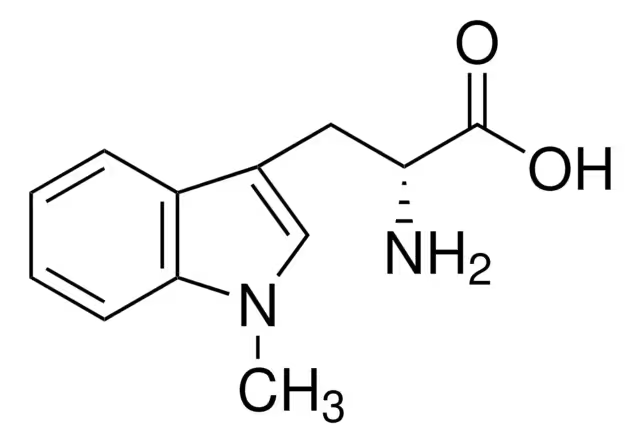
CAS Number110117-83-4
Synonyms(2R)-2-amino-3-(1-methyl-1H-indol-3-yl)propanoic acid; MFCD00274271; (2R)-2-amino-3-(1-methylindol-3-yl)propanoic acid; (R)-2-Amino-3-(1-methyl-1H-indol-3-yl)propanoic acid; Indoximod; NLG-8189
Molecular FormulaC12H14N2O2
Molecular Weight218.25
Purity95%
Density1.3±0.1 g/cm3
Boiling Point429.3±35.0 °C at 760 mmHg
Melting Point242-245 °C (lit.)
Appearancelumps and powder
Symbol
Signal WordWarning
| Chemical & Physical Properties | |
|---|---|
| CAS Number | 110117-83-4 |
| Catalog No. | 2A-9068772 |
| Chinese Name | 吲哚莫德 |
| Synonyms | (2R)-2-amino-3-(1-methyl-1H-indol-3-yl)propanoic acid; MFCD00274271; (2R)-2-amino-3-(1-methylindol-3-yl)propanoic acid; (R)-2-Amino-3-(1-methyl-1H-indol-3-yl)propanoic acid; Indoximod; NLG-8189 |
| Molecular Formula | C12H14N2O2 |
| Molecular Weight | 218.25 |
| Purity | 95 |
| Density | 1.3±0.1 g/cm3 |
| Boiling Point | 429.3±35.0 °C at 760 mmHg |
| Melting Point | 242-245 °C (lit.) |
| Appearance | lumps and powder |
| Storage Condition | Keep the container sealed and stored in a cool, dr |
| Application | Indoximod (D-1MT, NLG8189) is an indoleamine 2,3-dioxygenase (IDO) pathway inhibitor with a Ki of 19 μM. |
| HTC | 2933990090 |
| PubChem ID | 24868706 |
| MDL Number | MFCD00274271 |
| SMILES | Cn1cc(C[C@@H](N)C(O)=O)c2ccccc12 |
| InChI | 1S/C12H14N2O2/c1-14-7-8(6-10(13)12(15)16)9-4-2-3-5-11(9)14/h2-5,7,10H,6,13H2,1H3,(H,15,16)/t10-/m1/s1 |
| InChI Key | ZADWXFSZEAPBJS-SNVBAGLBSA-N |
| NACRES Code | NA.22 |
| UNSPSC | 12352209 |
| Hazard Symbols | transportation |
| MSDS | msds/68772_2_110117_83_4.pdf |
| Bioactivity | Indoximod (D-1MT, NLG8189) is an indoleamine 2,3-dioxygenase (IDO) pathway inhibitor with a Ki of 19 μM. Related Catalog Signaling Pathways >> Metabolic Enzyme/Protease >> Indoleamine 2,3-Dioxygenase (IDO) Research Areas >> Cancer Target IDO:19 μM (Ki) In Vitro The IDO inhibitor 1-methyl-tryptophan exists in two stereoisomers with potentially different biological properties. The L isomer is the more potent inhibitor of IDO activity using the purified enzyme and in HeLa cell-based assays. However, the D isomer is significantly more effective in reversing the suppression of T cells created by IDO-expressing dendritic cells. The L isomer of 1-methyl-tryptophan functioned as a competitive inhibitor (Ki=19 μM), whereas the d isomer is much less effective. The DL mixture is intermediate, with a Ki of 35 μM[1]. In Vivo The D isomer is more efficacious as an anticancer agent in chemo-immunotherapy regimens using cyclophosphamide, paclitaxel, or gemcitabine, when tested in mouse models of transplantable melanoma and transplantable and autochthonous breast cancer. The D isomer of 1-methyl-tryptophan specifically targets the IDO gene because the antitumor effect of d-1-methyl-tryptophan is completely lost in mice with a disruption of the IDO gene (IDO-knockout mice). Oral administration of dl-1-methyl-tryptophan in combination with paclitaxel can elicit regression of autochthonous breast tumors[1]. Kinase Assay 1MT enantiomers are solubilized in DMSO containing 0.1N HCl and added at concentrations of 100, 50, and 0 µM to wells containing the reaction mixture with tryptophan (0-200 µM) followed by addition of IDO enzyme. Plates are sealed and incubated 1 hr in a humidified 37°C incubator, after which the reactions are terminated by addition of 12.5 µl 30% TCA per well. Plates are then resealed in plastic wrap, incubated 30 min at 50°C to hydrolyze the reaction product N-formylkynurenine to kynurenine, and centrifuged. Supernatants are transferred to a flat-bottom 96-well plate, mixed with 100 µl Ehrlich reagent and incubated 10 min at room temperature. Absorbance at 490 nm is read[1]. Animal Admin Mice: B16F10 melanoma are established in B6 mice. For administration in drinking water, D-1MT is prepared at 2 mg/mL in water supplemented with a small amount of aspartame (2 envelopes per liter) to improve acceptance by the mice, and filter sterilized. The solution is delivered in standard autoclaved drinking-water bottles. Mice drink 4.5-5.0 mL/day (similar to consumption of water without drug)[1]. References [1]. Hou DY, et al. Inhibition of indoleamine 2,3-dioxygenase in dendritic cells by stereoisomers of 1-methyl-tryptophancorrelates with antitumor responses. Cancer Res. 2007 Jan 15;67(2):792-801. Chemical & Physical Properties Density 1.3±0.1 g/cm3 Boiling Point 429.3±35.0 °C at 760 mmHg Melting Point 242-245 ℃(lit.) Molecular Formula C12H14N2O2 Molecular Weight 218.252 Flash Point 213.4±25.9 °C Exact Mass 218.105530 PSA 68.25000 LogP 1.43 Vapour Pressure 0.0±1.1 mmHg at 25°C Index of Refraction 1.625 InChIKey ZADWXFSZEAPBJS-SNVBAGLBSA-N SMILES Cn1cc(CC(N)C(=O)O)c2ccccc21 |
| Use of | Indoximod (D-1MT, NLG8189) is an indoleamine 2,3-dioxygenase (IDO) pathway inhibitor with a Ki of 19 μM. Properties Articles16 Name 1-Methyl-D-tryptophan Synonym More Synonyms Indoximod Biological Activity Description Indoximod (D-1MT, NLG8189) is an indoleamine 2,3-dioxygenase (IDO) pathway inhibitor with a Ki of 19 μM. Related Catalog Signaling Pathways >> Metabolic Enzyme/Protease >> Indoleamine 2,3-Dioxygenase (IDO) Research Areas >> Cancer IDO:19 μM (Ki) In Vitro The IDO inhibitor 1-methyl-tryptophan exists in two stereoisomers with potentially different biological properties. The L isomer is the more potent inhibitor of IDO activity using the purified enzyme and in HeLa cell-based assays. However, the D isomer is significantly more effective in reversing the suppression of T cells created by IDO-expressing dendritic cells. The L isomer of 1-methyl-tryptophan functioned as a competitive inhibitor (Ki=19 μM), whereas the d isomer is much less effective. The DL mixture is intermediate, with a Ki of 35 μM[1]. In Vivo The D isomer is more efficacious as an anticancer agent in chemo-immunotherapy regimens using cyclophosphamide, paclitaxel, or gemcitabine, when tested in mouse models of transplantable melanoma and transplantable and autochthonous breast cancer. The D isomer of 1-methyl-tryptophan specifically targets the IDO gene because the antitumor effect of d-1-methyl-tryptophan is completely lost in mice with a disruption of the IDO gene (IDO-knockout mice). Oral administration of dl-1-methyl-tryptophan in combination with paclitaxel can elicit regression of autochthonous breast tumors[1]. References [1]. Hou DY, et al. Inhibition of indoleamine 2,3-dioxygenase in dendritic cells by stereoisomers of 1-methyl-tryptophancorrelates with antitumor responses. Cancer Res. 2007 Jan 15;67(2):792-801. Chemical & Physical Properties Molecular Formula C12H14N2O2 Exact Mass 218.105530 PSA 68.25000 Index of Refraction 1.625 InChIKey ZADWXFSZEAPBJS-SNVBAGLBSA-N |
| Tax Rebate | 13.0% |
| Supervision | None. MFN tariff: 6.5%. Ordinary tariff: 20.0% |
| Transport Info | Product name: Purity: 96.0% |
| MSDS Transport Info | Module 14. Shipping information 14.1 UN dangerous goods number European Land Transport Dangerous Regulations: -International Maritime Dangerous Regulations: -International Air Transport Dangerous Regulations: - 14.2 Names specified by the United Nations (UN) European Land Transport Dangerous Regulations: Non-dangerous goods IMDG Code: Non-dangerous goods International air transport dangerous goods regulations: non-dangerous goods 14.3 Transport hazard categories European Land Transport Dangerous Regulations: -International Maritime Dangerous Regulations: -International Air Transport Dangerous Regulations: - 14.4 Package group European Land Transport Dangerous Regulations: -International Maritime Dangerous Regulations: -International Air Transport Dangerous Regulations: - 14.5 Environmental hazards European Land Transport Dangerous Regulations: No International Maritime Transport Dangerous Regulations Maritime Pollutants: No International Air Transport Risk Regulations: No 14.6 Special reminder to users No data available |
| Related Products in Specialty Chemicals | ||
|---|---|---|
| 2-aminoethylbenzenesulfonate | 771582-62-8 | 2A-9068764 |
| 2-Fluoro-5-chloronicotinicacid | 884494-57-9 | 2A-9068766 |
| 2,6-Difluoro-4-methoxyaniline | 151414-47-0 | 2A-9068767 |
| 8-Methoxy-3,4-dihydronaphthalen-1(2H)-one | 13185-18-7 | 2A-9068769 |
| 3-bromo-2-chlorobenzonitrile | 914250-82-1 | 2A-9068770 |
| 3-bromo-2-ethylbenzonitrile | 1253790-62-3 | 2A-9068773 |
| 2,6-Difluoro-4-methoxybenzonitrile | 123843-66-3 | 2A-9068775 |
| 2,5-Dichlorobenzenesulfonylchloride | 5402-73-3 | 2A-9068776 |
| 2-(4-Hydroxy-3-methylphenyl)aceticacidmethylester | 64360-47-0 | 2A-9068780 |
| 3-bromo-2-methoxybenzonitrile | 874472-98-7 | 2A-9068781 |
| Browse all Specialty Chemicals products » | ||
Phone:
630-322-8886
630-322-8887
Email:
Office Locations:
Chicago, IL, USA
San Francisco, CA, USA


 EN
EN


 SDS
SDS