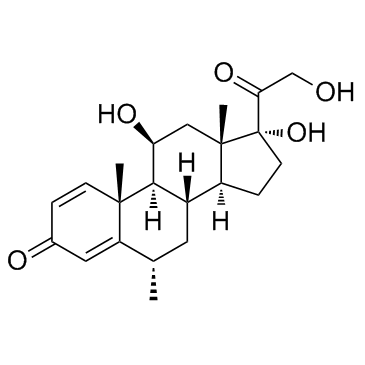
CAS Number83-43-2
SynonymsMFCD00010591; EINECS 201-476-4; Methylprednisolone; 6alpha-methylprednisolone
Molecular FormulaC22H30O5
Molecular Weight374.471
Purity98%
Density1.3±0.1 g/cm3
Boiling Point571.8±50.0 °C at 760 mmHg
Melting Point228-237°C (dec.)
AppearanceWhite to off-white crystalline powder
| Chemical & Physical Properties | |
|---|---|
| CAS Number | 83-43-2 |
| Catalog No. | 2A-9006681 |
| Chinese Name | 甲基泼尼松龙 |
| Synonyms | MFCD00010591; EINECS 201-476-4; Methylprednisolone; 6alpha-methylprednisolone |
| Molecular Formula | C22H30O5 |
| Molecular Weight | 374.471 |
| Purity | 98 |
| Density | 1.3±0.1 g/cm3 |
| Boiling Point | 571.8±50.0 °C at 760 mmHg |
| Melting Point | 228-237°C (dec.) |
| Appearance | White to off-white crystalline powder |
| Water Solubility | chloroform/methanol (9:1): 50 mg/mL, clear, faintl |
| Storage Condition | This product should be kept sealed and dry. |
| Application | Methylprednisolone is a corticosteroid that acts on glucocorticoid receptors. |
| SMILES | CC1CC2C(C(O)CC3(C)C2CCC3(O)C(=O)CO)C2(C)C=CC(=O)C=C12 |
| InChI | InChI=1S/C22H30O5/c1-12-8-14-15-5-7-22(27,18(26)11-23)21(15,3)10-17(25)19(14)20(2)6-4-13(24)9-16(12)20/h4,6,9,12,14-15,17,19,23,25,27H,5,7-8,10-11H2,1-3H3/t12-,14-,15-,17-,19+,20-,21-,22-/m0/s1 |
| InChI Key | VHRSUDSXCMQTMA-PJHHCJLFSA-N |
| Bioactivity | Methylprednisolone is a synthetic corticosteroid with anti-inflammatory and immunomodulating properties.Target: Glucocorticoid ReceptorMethylprednisolone is typically used for its anti-inflammatory effects. Common uses include arthritis therapy and short-term treatment of bronchial inflammation or acute bronchitis due to various respiratory diseases. Methylprednisolone is used both in the treatment of acute periods and long-term management of autoimmune diseases, most notably systemic lupus erythematosus. It is also used for vestibular neuritis [1].After six months the patients who were treated with methylprednisolone within eight hours of their injury had significant improvement as compared with those given placebo in motor function (neurologic change scores of 16.0 and 11.2, respectively; P = 0.03) and sensation to pinprick (change scores of 11.4 and 6.6; P = 0.02) and touch (change scores, 8.9 and 4.3; P = 0.03). Benefit from methylprednisolone was seen in patients whose injuries were initially evaluated as neurologically complete, as well as in those believed to have incomplete lesions [2]. Related Catalog Signaling Pathways >> Autophagy >> Autophagy Signaling Pathways >> GPCR/G Protein >> Glucocorticoid Receptor Research Areas >> Inflammation/Immunology References [1]. Strupp, M., et al., Methylprednisolone, valacyclovir, or the combination for vestibular neuritis. N Engl J Med, 2004. 351(4): p. 354-61. [2]. Bracken, M.B., et al., A randomized, controlled trial of methylprednisolone or naloxone in the treatment of acute spinal-cord injury. Results of the Second National Acute Spinal Cord Injury Study. N Engl J Med, 1990. 322(20): p. 1405-11. Chemical & Physical Properties Density 1.3±0.1 g/cm3 Boiling Point 571.8±50.0 °C at 760 mmHg Melting Point 228-237°C (dec.) Molecular Formula C22H30O5 Molecular Weight 374.471 Flash Point 313.7±26.6 °C Exact Mass 374.209320 PSA 94.83000 LogP 1.99 Vapour Pressure 0.0±3.6 mmHg at 25°C Index of Refraction 1.603 InChIKey VHRSUDSXCMQTMA-PJHHCJLFSA-N SMILES CC1CC2C(C(O)CC3(C)C2CCC3(O)C(=O)CO)C2(C)C=CC(=O)C=C12 Storage condition 0-6°C Water Solubility chloroform/methanol (9:1): 50 mg/mL, clear, faintly yellow |
| Use of | Methylprednisolone is a synthetic corticosteroid with anti-inflammatory and immunomodulating properties.Target: Glucocorticoid ReceptorMethylprednisolone is typically used for its anti-inflammatory effects. Common uses include arthritis therapy and short-term treatment of bronchial inflammation or acute bronchitis due to various respiratory diseases. Methylprednisolone is used both in the treatment of acute periods and long-term management of autoimmune diseases, most notably systemic lupus erythematosus. It is also used for vestibular neuritis [1].After six months the patients who were treated with methylprednisolone within eight hours of their injury had significant improvement as compared with those given placebo in motor function (neurologic change scores of 16.0 and 11.2, respectively; P = 0.03) and sensation to pinprick (change scores of 11.4 and 6.6; P = 0.02) and touch (change scores, 8.9 and 4.3; P = 0.03). Benefit from methylprednisolone was seen in patients whose injuries were initially evaluated as neurologically complete, as well as in those believed to have incomplete lesions [2]. Properties Articles217 Name 6α-methylprednisolone Synonym More Synonyms Methylprednisolone Biological Activity Description Methylprednisolone is a synthetic corticosteroid with anti-inflammatory and immunomodulating properties.Target: Glucocorticoid ReceptorMethylprednisolone is typically used for its anti-inflammatory effects. Common uses include arthritis therapy and short-term treatment of bronchial inflammation or acute bronchitis due to various respiratory diseases. Methylprednisolone is used both in the treatment of acute periods and long-term management of autoimmune diseases, most notably systemic lupus erythematosus. It is also used for vestibular neuritis [1].After six months the patients who were treated with methylprednisolone within eight hours of their injury had significant improvement as compared with those given placebo in motor function (neurologic change scores of 16.0 and 11.2, respectively; P = 0.03) and sensation to pinprick (change scores of 11.4 and 6.6; P = 0.02) and touch (change scores, 8.9 and 4.3; P = 0.03). Benefit from methylprednisolone was seen in patients whose injuries were initially evaluated as neurologically complete, as well as in those believed to have incomplete lesions [2]. Related Catalog Signaling Pathways >> Autophagy >> Autophagy Signaling Pathways >> GPCR/G Protein >> Glucocorticoid Receptor Research Areas >> Inflammation/Immunology References [1]. Strupp, M., et al., Methylprednisolone, valacyclovir, or the combination for vestibular neuritis. N Engl J Med, 2004. 351(4): p. 354-61. [2]. Bracken, M.B., et al., A randomized, controlled trial of methylprednisolone or naloxone in the treatment of acute spinal-cord injury. Results of the Second National Acute Spinal Cord Injury Study. N Engl J Med, 1990. 322(20): p. 1405-11. Chemical & Physical Properties Molecular Formula C22H30O5 Exact Mass 374.209320 PSA 94.83000 Index of Refraction 1.603 InChIKey VHRSUDSXCMQTMA-PJHHCJLFSA-N |
| Transport Info | Product name: Methylprednisolone standard solution |
| Related Products in API & Advanced Intermediates | ||
|---|---|---|
| 4-Hydroxytestosterone cypionate | 2A-105899 | 2A-9005899 |
| 4-Hydroxytestosterone decanoate | 2A-105900 | 2A-9005900 |
| 4-Hydroxywarfarin | 24579-14-4 | 2A-9005903 |
| 5-Fluorouracil | 51-21-8 | 2A-9006550 |
| 5-Methoxysulfadiazine | 651-06-9 | 2A-9006586 |
| 6alpha-Methylprednisolone hemisuccinate | 2921-57-5 | 2A-9006682 |
| 6-Dehydronandrolone acetate | 2590-41-2 | 2A-9006818 |
| 6-Hydroxywarfarin | 17834-02-5 | 2A-9006856 |
| 6-Mercaptopurine monohydrate | 6112-76-1 | 2A-9006863 |
| 7-Hydroxywarfarin | 17834-03-6 | 2A-9006980 |
| Browse all API & Advanced Intermediates products » | ||
Phone:
630-322-8886
630-322-8887
Email:
Office Locations:
Chicago, IL, USA
San Francisco, CA, USA


 EN
EN


 SDS
SDS