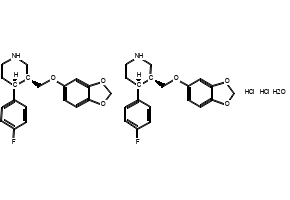
CAS Number110429-35-1
SynonymsParoxetine Hydrochloride HeMihydrate; Paroxetine hydrochl; Paroxetine hydrochloride; Paroxetine hydrochloride hydrate; Paroxetine (hydrochloride hemihydrate)
Molecular FormulaC38H44O7N2Cl2F2
Molecular Weight749.68
Purity98%
Density1.213g/cm3
Boiling Point451.7ºC at 760mmHg
Melting Point121-131ºC
Appearancewhite
Symbol
Signal WordWarning
| Chemical & Physical Properties | |
|---|---|
| CAS Number | 110429-35-1 |
| Catalog No. | 2A-9061521 |
| Chinese Name | 盐酸帕罗西汀半水合物 |
| Synonyms | Paroxetine Hydrochloride HeMihydrate; Paroxetine hydrochl; Paroxetine hydrochloride; Paroxetine hydrochloride hydrate; Paroxetine (hydrochloride hemihydrate) |
| Molecular Formula | C38H44O7N2Cl2F2 |
| Molecular Weight | 749.68 |
| Purity | 98 |
| Density | 1.213g/cm3 |
| Boiling Point | 451.7ºC at 760mmHg |
| Melting Point | 121-131ºC |
| Appearance | white |
| Water Solubility | Slightly soluble in water, freely soluble in metha |
| Storage Condition | room temperature, dry |
| Application | Paroxetine hydrochloride hemihydrate is an antidepressant and a highly effective serotonin reuptake inhibitor, which can inhibit GRK2 activity with an IC50 value of 14 μM. |
| HTC | 2934999090 |
| MDL Number | MFCD23843784 |
| SMILES | Cl.Fc1ccc(C2CCNCC2COc2ccc3c(c2)OCO3)cc1.O |
| InChI | InChI=1S/C19H20FNO3/c20-15-3-1-13(2-4-15)17-7-8-21-10-14(17)11-22-16-5-6-18-19(9-16)24-12-23-18/h1-6,9,14,17,21H,7-8,10-12H2/t14-,17-/m0/s1 |
| InChI Key | QRQSGFFISBKLMZ-YHOFXEKLSA-N |
| Hazard Symbols | transportation |
| MSDS | msds/61521_1_110429_35_1.pdf |
| Bioactivity | Paroxetine hydrochloride hemihydrate is a potent selective serotonin-reuptake inhibitor, commonly prescribed as an antidepressant and has GRK2 inhibitory ability with IC50 of 14 μM. Related Catalog Signaling Pathways >> Autophagy >> Autophagy Signaling Pathways >> Neuronal Signaling >> Serotonin Transporter Research Areas >> Neurological Disease Target IC50: 14 μM (GRK2)[3] In Vitro Paroxetine (1 μM and 10 μM) distinctly restrains T cell migration induced by CX3CL1 through inhibiting GRK2. Paroxetine inhibits GRK2 induced activation of ERK[1]. Paroxetine (10 μM) reduces pro-inflammatory cytokines in LPS-stimulated BV2 cells. Paroxetine (0-5 μM) leads to a dose-dependent inhibition on LPS-induced production of TNF-α and IL-1β in BV2 cells. Paroxetine also inhibits lipopolysaccharide (LPS)-induced nitric oxide (NO) production and inducible nitric oxide synthase (iNOS) expression in BV2 cells. Paroxetine (5 μM) blocks LPS-induced JNK activation and attenuates baseline ERK1/2 activity in BV2 cells. Paroxetine relieves microglia-mediated neurotoxicity, and suppresses LPS-stimulated pro-inflammatory cytokines and NO in primary microglial cells[4]. In Vivo Paroxetine treatment obviously attenuates the symptoms of CIA rats. Paroxetine treatment clearly prevents the histological damage of joints and alleviates T cells infiltration into synovial tissue. Paroxetine reveals a strong effect on inhibiting CX3CL1 production in synovial tissues[1]. Paroxetine (20 mg/kg/day) reduces the myocyte cross-sectional area in rat and ROS formation in the remote myocardium. Paroxetine reduces the susceptibility to ventricular tachycardia. Paroxetine treatment following MI decreases LV remodeling and susceptibility to arrhythmias, probably by reducing ROS formation[2]. In CCI paroxetine-treated group, paroxetine (10 mg/kg, i.p.) produces hyperalgesia at days 7 and 10 (P<0.01), but a decrease in pain behavior is seen at day 14. Moreover, paroxetine (10 mg/kg) significantly attenuates tactile hypersensitivity when compared to CCI vehicle-treated group[5]. Cell Assay Cell viability is determined by the tetrazolium salt 3-[4,5-dimethylthiazol-2-yl]-2,5-diphenyltetrazolium bromide (MTT) assay. BV2 and primary microglial cells are initially seeded into 96-well plates at a density of 1×10⁴ cells/well and 5×10⁴ cells/well, respectively. Following treatment, MTT (5 mg/mL in PBS) is added to each well and incubated at 37°C for four hours. The resulting formazan crystals are dissolved in dimethylsulfoxide (DMSO). The optical density is measured at 570 nm, and results are expressed as a percentage of surviving cells compared with the control. Animal Admin Animals are divided into two main groups: 1) pre-emptive and 2) post-injury group. Each main group is divided into three different subgroups: I) CCI vehicle-treated group, II) sham group, and III) CCI paroxetine-treated group. Vehicle is injected i.p. to CCI and sham-operated animals. In the pre-emptive study, paroxetine (10 mg/kg) is injected 1 h before surgery and continued daily until day 14 post surgery. In the post-injury group, paroxetine (10 mg/kg) is administered at day 7 post injury and continued daily until day 14. All behavioral tests are recorded on day 0 (control day) before surgery and on days 1, 3, 5, 7, 10, and 14 post-nerve injury. References [1]. Wang Q, et al. Paroxetine alleviates T lymphocyte activation and infiltration to joints of collagen-induced arthritis. Sci Rep. 2017 Mar 28;7:45364. [2]. Lassen TR, et al. Effect of paroxetine on left ventricular remodeling in an in vivo rat model of myocardial infarction. Basic Res Cardiol. 2017 May;112(3):26. [3]. Waldschmidt HV, et al. Structure-Based Design of Highly Selective and Potent G Protein-Coupled Receptor Kinase 2 Inhibitors Based on Paroxetine. J Med Chem. 2017 Apr 13;60(7):3052-3069. [4]. Liu RP, et al. Paroxetine ameliorates lipopolysaccharide-induced microglia activation via differential regulation of MAPK signaling. J Neuroinflammation. 2014 Mar 12;11:47. Chemical & Physical Properties Density 1.213g/cm3 Boiling Point 451.7ºC at 760mmHg Melting Point 121-131ºC Molecular Formula C19H22ClFNO3.5 Molecular Weight 374.83 Flash Point 227ºC PSA 39.72000 LogP 4.45730 Appearance of Characters white InChIKey QRQSGFFISBKLMZ-YHOFXEKLSA-N SMILES Cl.Fc1ccc(C2CCNCC2COc2ccc3c(c2)OCO3)cc1.O Water Solubility Slightly soluble in water, freely soluble in methanol, sparingly soluble in ethanol (96 per cent) and in methylene chloride. |
| Use of | Paroxetine hydrochloride hemihydrate is a potent selective serotonin-reuptake inhibitor, commonly prescribed as an antidepressant and has GRK2 inhibitory ability with IC50 of 14 μM. Properties Articles37 Name Paroxetine hydrochloride hemihydrate Synonym More Synonyms Paroxetine hydrochloride hydrate Biological Activity Description Paroxetine hydrochloride hemihydrate is a potent selective serotonin-reuptake inhibitor, commonly prescribed as an antidepressant and has GRK2 inhibitory ability with IC50 of 14 μM. Related Catalog Signaling Pathways >> Autophagy >> Autophagy Signaling Pathways >> Neuronal Signaling >> Serotonin Transporter Research Areas >> Neurological Disease IC50: 14 μM (GRK2)[3] References [1]. Wang Q, et al. Paroxetine alleviates T lymphocyte activation and infiltration to joints of collagen-induced arthritis. Sci Rep. 2017 Mar 28;7:45364. [2]. Lassen TR, et al. Effect of paroxetine on left ventricular remodeling in an in vivo rat model of myocardial infarction. Basic Res Cardiol. 2017 May;112(3):26. [3]. Waldschmidt HV, et al. Structure-Based Design of Highly Selective and Potent G Protein-Coupled Receptor Kinase 2 Inhibitors Based on Paroxetine. J Med Chem. 2017 Apr 13;60(7):3052-3069. [4]. Liu RP, et al. Paroxetine ameliorates lipopolysaccharide-induced microglia activation via differential regulation of MAPK signaling. J Neuroinflammation. 2014 Mar 12;11:47. Chemical & Physical Properties PSA 39.72000 LogP 4.45730 Appearance of Characters white InChIKey QRQSGFFISBKLMZ-YHOFXEKLSA-N Water Solubility Slightly soluble in water, freely soluble in methanol, sparingly soluble in ethanol (96 per cent) and in methylene chloride. |
| Tax Rebate | 13.0% |
| Supervision | None. MFN tariff: 6.5%. Ordinary tariff: 20.0% |
| Transport Info | Shipping Name: UN |
| MSDS Transport Info | Module 14. Shipping information 14.1 UN dangerous goods number European Land Transport Dangerous Regulations: -International Maritime Dangerous Regulations: -International Air Transport Dangerous Regulations: - 14.2 United Nations shipping name European Land Transport Dangerous Regulations: Non-dangerous goods IMDG Code: Non-dangerous goods International air transport dangerous goods regulations: non-dangerous goods 14.3 Transport hazard categories European Land Transport Dangerous Regulations: -International Maritime Dangerous Regulations: -International Air Transport Dangerous Regulations: - 14.4 Package group European Land Transport Dangerous Regulations: -International Maritime Dangerous Regulations: -International Air Transport Dangerous Regulations: - 14.5 Environmental hazards European Land Transport Danger Regulations: No International Maritime Danger Regulations International Air Transport Danger Regulations: No Marine pollutants (yes/no): No 14.6 Special reminder to users No data available The above information is believed to be correct, but is not all-inclusive and should be used as a guide only. The information in this document is based on our current knowledge and is Correct safety instructions apply to this product. This information does not represent a warranty as to the properties of this product. See reverse side of invoice or packing slip. |
| Related Products in API & Advanced Intermediates | ||
|---|---|---|
| 4'6-di-O-Methylerythromycin A | 123967-58-8 | 2A-9061468 |
| 7-epi-Clindamycin | 16684-06-3 | 2A-9061469 |
| Clindamycin B | 18323-43-8 | 2A-9061470 |
| BETA-ESTRADIOL-WATER SOLUBLE | 2A-152986 | 2A-9061487 |
| QUINAPRILAT HYDRATE | 82768-85-2 | 2A-9061518 |
| 6-EPI PRAVASTATIN, SODIUM SALT | 81176-41-2 | 2A-9061522 |
| 3-A-HYDROXY PRAVASTATIN SODIUM SALT | 81093-43-8 | 2A-9061523 |
| MORPHINE SULPHATE | 2A-153023 | 2A-9061524 |
| MORPHINE SULPHATE | 2A-153024 | 2A-9061525 |
| 3'-O-(5'-Deoxy-α-D-ribofuranosyl) Capecitabine | 1262133-64-1 | 2A-9061535 |
| Browse all API & Advanced Intermediates products » | ||
Phone:
630-322-8886
630-322-8887
Email:
Office Locations:
Chicago, IL, USA
San Francisco, CA, USA


 EN
EN


 SDS
SDS