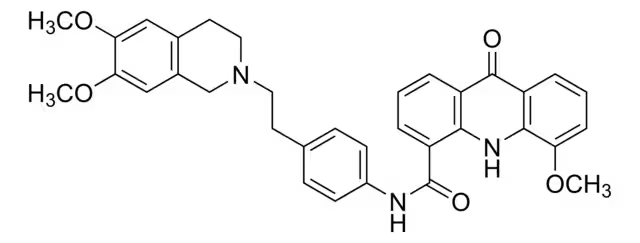
| Chemical & Physical Properties | |
|---|---|
| CAS Number | 143664-11-3 |
| Catalog No. | 2A-9060030 |
| Chinese Name | 依克立达 |
| Synonyms | elacridar; GG918 |
| Molecular Formula | C34H33N3O5 |
| Molecular Weight | 563.64 |
| Purity | ≥98 (HPLC) |
| Density | 1.3±0.1 g/cm3 |
| Boiling Point | 701.6±60.0 °C at 760 mmHg |
| Melting Point | 216-218℃ |
| Appearance | powder |
| Storage Condition | -20°C Freezer |
| Application | Elacridar is a potent inhibitor of P-glycoprotein and BCRP. |
| PubChem ID | 329825437 |
| MDL Number | MFCD00912604 |
| SMILES | COc1cccc2C(=O)c3cccc(C(=O)Nc4ccc(CCN5CCc6cc(OC)c(OC)cc6C5)cc4)c3Nc12 |
| InChI | 1S/C34H33N3O5/c1-40-28-9-5-7-26-32(28)36-31-25(33(26)38)6-4-8-27(31)34(39)35-24-12-10-21(11-13-24)14-16-37-17-15-22-18-29(41-2)30(42-3)19-23(22)20-37/h4-13,18-19H,14-17,20H2,1-3H3,(H,35,39)(H,36,38) |
| InChI Key | OSFCMRGOZNQUSW-UHFFFAOYSA-N |
| NACRES Code | NA.77 |
| UNSPSC | 12161501 |
| Hazard Symbols | transportation |
| MSDS | msds/60030_1_143664_11_3.pdf |
| Bioactivity | Elacridar is a potent P-glycoprotein (Pgp) and BCRP inhibitor. Related Catalog Signaling Pathways >> Membrane Transporter/Ion Channel >> BCRP Signaling Pathways >> Membrane Transporter/Ion Channel >> P-glycoprotein Research Areas >> Cancer Target P-glycoprotein (Pgp), BCRP[1] In Vitro Elacridar inhibits P-glycoprotein (P-gp) labeling by [3H]azidopine with a IC50 of 0.16 μM[2]. In Caki-1 and ACHN cells, elacridar (2.5 μM) significantly ihibits the cell growth. The P-glycoprotein activity is found to be inhibited by elacridar. The combination of elacridar and sunitinib lead to a significant reduction in ABC Sub-family B Member 2 (ABCG2) expression in 786-O cells[3]. In Vivo Oral co-administration of elacridar (100 mg/kg, p.o.) and crizotinib increases the plasma and brain concentrations and brain-to-plasma ratios of crizotinib in wild-type mice, equaling the levels in Abcb1a/1b; Abcg2-/- mice[1]. In friend leukemia virus stain B mice, the brain-to-plasm partition coefficient (Kp, brain) of elacridar is 0.82, 0.43, and 4.31 after intravenous (2.5 mg/kg), intraperitoneal (100 mg/kg), and oral (100 mg/kg) treatment, respectively[4]. In Mrp4(-/-) mice, elacridar fully inhibits P-gp mediated transport of topotecan, without siginificant effects on Bcrp1-mediated transport[5]. Kinase Assay 10 μL of unlabeled cell membrane suspension (at 0.4 mg of protein/mL) are aliquoted into each well in 96-well plates. 5 μL of GF120918 are then added to each well. The plate is incubated 25 min at 25°C in the dark. 5 μL of tritiated azidopine (1.8 TBq/mmol) (0.6 μM in HCI 0.2 mM) are added to each well. After 25 min of incubation at 25°C in the dark, samples are simultaneously irradiated for 2 min at 254 nm at 0°C with a thin layer chromatography-designed UV lamp directly in contact with the plate. Samples are solubilized in sodium dodecyl sulfate-polyacrylamide gel electrophoresis sample buffer but not heated. After separation on a 7.5% polyacrylamide gel, the gel is treated for fluorography with Amplify and exposed during 3 days onto a photosensitive film. The fluorography is analysed using a Camag thin layer chromatography Scanner II densitometer. Cell Assay 3.0×10³ cells per well are seeded in a 96-well plate. After 24 h incubation, an optimum concentration gradient of elacridar is added to each well. After culturing for 48 h, cell viability is assessed using the proliferation reagent, MTT. Control cells are treated with the vehicle only, 0.1% DMSO. After this final incubation, the medium is aspirated and precipitated formazan crystals are dissolved in DMSO (100 μL/well). The absorbance of each well is measured at 540 nm, and a reference wavelength of 650 nm is read with a multiskan JX microplate reader. Cell viability is calculated as percentage of the control value[3]. Animal Admin Mice are fasted for 3 hr before oral administration of either elacridar (100 mg/kg) or elacridar vehicle. Two hours later, crizotinib (5 mg/kg) is administered to mice orally. Blood and brains are isolated 4 hr after crizotinib oral administration, and processed as described above. The brain concentrations are corrected for the amount of drug in the brain vasculature. Elacridar hydrochloride is dissolved in dimethyl sulfoxide (106 mg/mL) in order to get 100 mg pure elacridar per 1 mL of dimethyl sulfoxide. The stock solution is further diluted with a mixture of Polysorbate 80, ethanol and water [20:13:67 (v/v/v)] to yield a concentration of 10 mg/mL pure elacridar. References [1]. Tang SC, et al. Increased oral availability and brain accumulation of the ALK inhibitor crizotinib by coadministration of the P-glycoprotein (ABCB1) and breast cancer resistance protein (ABCG2) inhibitor elacridar. Int J Cancer. 2014 Mar 15;134(6):1484-94 [2]. Hyafil F, et al. In vitro and in vivo reversal of multidrug resistance by GF120918, an acridonecarboxamide derivative. Cancer Res. 1993 Oct 1;53(19):4595-602. [3]. Sato H, et al. Elacridar enhances the cytotoxic effects of sunitinib and prevents multidrug resistance in renal carcinoma cells. Eur J Pharmacol. 2015 Jan 5;746:258-66. [4]. Sane R, et al. Brain distribution and bioavailability of elacridar after different routes of administration in the mouse. Drug Metab Dispos. 2012 Aug;40(8):1612-9. [5]. de Vries NA, et al. P-glycoprotein and breast cancer resistance protein: two dominant transporters working together in limiting the brain penetration of topotecan. Clin Cancer Res. 2007 Nov 1;13(21):6440-9. Chemical & Physical Properties Density 1.3±0.1 g/cm3 Boiling Point 701.6±60.0 °C at 760 mmHg Melting Point 216-218℃ Molecular Formula C34H33N3O5 Molecular Weight 563.643 Flash Point 378.1±32.9 °C Exact Mass 563.242004 PSA 92.89000 LogP 5.55 Vapour Pressure 0.0±2.2 mmHg at 25°C Index of Refraction 1.644 InChIKey OSFCMRGOZNQUSW-UHFFFAOYSA-N SMILES COc1cc2c(cc1OC)CN(CCc1ccc(NC(=O)c3cccc4c(=O)c5cccc(OC)c5[nH]c34)cc1)CC2 Storage condition -20°C Freezer |
| Use of | Elacridar is a potent P-glycoprotein (Pgp) and BCRP inhibitor. Properties Articles38 Name N-[4-[2-(6,7-dimethoxy-3,4-dihydro-1H-isoquinolin-2-yl)ethyl]phenyl]-5-methoxy-9-oxo-10H-acridine-4-carboxamide Synonym More Synonyms elacridar Biological Activity Description Elacridar is a potent P-glycoprotein (Pgp) and BCRP inhibitor. Related Catalog Signaling Pathways >> Membrane Transporter/Ion Channel >> BCRP Signaling Pathways >> Membrane Transporter/Ion Channel >> P-glycoprotein Research Areas >> Cancer P-glycoprotein (Pgp), BCRP[1] In Vitro Elacridar inhibits P-glycoprotein (P-gp) labeling by [3H]azidopine with a IC50 of 0.16 μM[2]. In Caki-1 and ACHN cells, elacridar (2.5 μM) significantly ihibits the cell growth. The P-glycoprotein activity is found to be inhibited by elacridar. The combination of elacridar and sunitinib lead to a significant reduction in ABC Sub-family B Member 2 (ABCG2) expression in 786-O cells[3]. References [1]. Tang SC, et al. Increased oral availability and brain accumulation of the ALK inhibitor crizotinib by coadministration of the P-glycoprotein (ABCB1) and breast cancer resistance protein (ABCG2) inhibitor elacridar. Int J Cancer. 2014 Mar 15;134(6):1484-94 [2]. Hyafil F, et al. In vitro and in vivo reversal of multidrug resistance by GF120918, an acridonecarboxamide derivative. Cancer Res. 1993 Oct 1;53(19):4595-602. [3]. Sato H, et al. Elacridar enhances the cytotoxic effects of sunitinib and prevents multidrug resistance in renal carcinoma cells. Eur J Pharmacol. 2015 Jan 5;746:258-66. [4]. Sane R, et al. Brain distribution and bioavailability of elacridar after different routes of administration in the mouse. Drug Metab Dispos. 2012 Aug;40(8):1612-9. [5]. de Vries NA, et al. P-glycoprotein and breast cancer resistance protein: two dominant transporters working together in limiting the brain penetration of topotecan. Clin Cancer Res. 2007 Nov 1;13(21):6440-9. Chemical & Physical Properties Molecular Formula C34H33N3O5 Exact Mass 563.242004 PSA 92.89000 Index of Refraction 1.644 InChIKey OSFCMRGOZNQUSW-UHFFFAOYSA-N |
| Transport Info | Product name: Purity: 98.0% |
| MSDS Transport Info | Module 14. Shipping information 14.1 UN dangerous goods number European Land Transport Dangerous Regulations: -International Maritime Dangerous Regulations: -International Air Transport Dangerous Regulations: - 14.2 Names specified by the United Nations (UN) European Land Transport Dangerous Regulations: Non-dangerous goods IMDG Code: Non-dangerous goods International air transport dangerous goods regulations: non-dangerous goods 14.3 Transport hazard categories European Land Transport Dangerous Regulations: -International Maritime Dangerous Regulations: -International Air Transport Dangerous Regulations: - 14.4 Package group European Land Transport Dangerous Regulations: -International Maritime Dangerous Regulations: -International Air Transport Dangerous Regulations: - 14.5 Environmental hazards European Land Transport Dangerous Regulations: No International Maritime Transport Dangerous Regulations Maritime Pollutants: No International Air Transport Risk Regulations: No 14.6 Special reminder to users No data available The above information is believed to be correct, but is not all-inclusive and should be used as a guide only. The information in this document is based on our current knowledge and is Correct safety instructions apply to this product. This information does not represent a warranty as to the properties of this product. See reverse side of invoice or packing slip. |
| Related Products in Specialty Chemicals | ||
|---|---|---|
| 2-FLUORO-2-METHYL-PROPAN-1-OL | 3109-99-7 | 2A-9060019 |
| 5-CHOLESTEN-3-ONE | 601-54-7 | 2A-9060022 |
| (4-FORMYL-PHENYL)-CARBAMIC ACID TERT-BUTYL ESTER | 144072-30-0 | 2A-9060024 |
| LITHOCHOLIC ACID | 434-13-9 | 2A-9060025 |
| PARAMETHASONE ACETATE (200 MG) | 1597-82-6 | 2A-9060026 |
| N-HENEICOSYL BROMIDE | 4276-50-0 | 2A-9060032 |
| 1-AMINO-10-UNDECENE | 62595-52-2 | 2A-9060033 |
| LF163892 MONOHYDRATE | 76470-66-1 | 2A-9060037 |
| 4-(4-Fluorophenyl)-6-isopropyl-2-[(N-methyl-N-methylsulfonyl)amino]pyrimidinyl-5-yl-formyl | 147118-37-4 | 2A-9060041 |
| FERROUS ASCORBATE | 24808-52-4 | 2A-9060043 |
| Browse all Specialty Chemicals products » | ||
Phone:
630-322-8886
630-322-8887
Email:
Office Locations:
Chicago, IL, USA
San Francisco, CA, USA


 EN
EN


 SDS
SDS