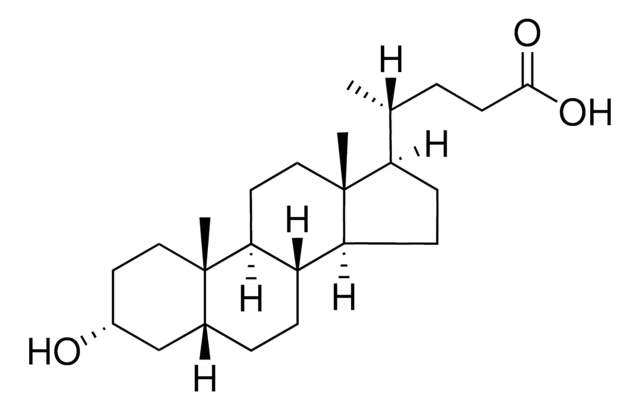
CAS Number434-13-9
Synonyms17b-(1-Methyl-3-carboxypropyl)etiocholan-3a-ol; (3α,5β)-3-Hydroxycholan-24-oic acid; 3-α-Hydroxy-5-β-cholanic acid; EINECS 207-099-1; 4-10-00-00785 (Beilstein Handbook Reference); 5β-Cholanic Acid-3α-ol; Lithocholic acid; Lithocolic acid; 3α-Hydroxy-5β-cholanic Acid; MFCD00003682; (3a,5b)-3-hydroxycholan-24-oic acid; 3a-Hydroxycholanic Acid; (3a,5b)-3-hydroxy-cholan-24-oic acid; 3a-Hydroxy-5b-cholan-24-oic Acid; 3α-hydroxy-5β-cholan-24-oic acid
Molecular FormulaC24H40O3
Molecular Weight376.57
Purity≥95%
Density1.1±0.1 g/cm3
Boiling Point511.0±23.0 °C at 760 mmHg
Melting Point183-188 °C (lit.)
AppearanceSolid;White to Almost white powder to crystaline
EINECS207-099-1
Symbol
Signal WordWarning
| Chemical & Physical Properties | |
|---|---|
| CAS Number | 434-13-9 |
| Catalog No. | 2A-9060025 |
| Chinese Name | 石胆酸 |
| Synonyms | 17b-(1-Methyl-3-carboxypropyl)etiocholan-3a-ol; (3α,5β)-3-Hydroxycholan-24-oic acid; 3-α-Hydroxy-5-β-cholanic acid; EINECS 207-099-1; 4-10-00-00785 (Beilstein Handbook Reference); 5β-Cholanic Acid-3α-ol; Lithocholic acid; Lithocolic acid; 3α-Hydroxy-5β-cholanic Acid; MFCD00003682; (3a,5b)-3-hydroxycholan-24-oic acid; 3a-Hydroxycholanic Acid; (3a,5b)-3-hydroxy-cholan-24-oic acid; 3a-Hydroxy-5b-cholan-24-oic Acid; 3α-hydroxy-5β-cholan-24-oic acid |
| Molecular Formula | C24H40O3 |
| Molecular Weight | 376.57 |
| Purity | ≥95 |
| Density | 1.1±0.1 g/cm3 |
| Boiling Point | 511.0±23.0 °C at 760 mmHg |
| Melting Point | 183-188 °C (lit.) |
| Appearance | Solid;White to Almost white powder to crystaline |
| Water Solubility | Water solubility: insoluble; water solubility: 0.3 |
| Storage Condition | Refrigerator |
| Application | Lithocholic acid is a toxic secondary bile acid that can promote intrahepatic cholestasis and promote tumorigenesis. |
| EINECS | 207-099-1 |
| PubChem ID | 24896429 |
| MDL Number | MFCD00003682 |
| SMILES | [H][C@]12CC[C@@]3([H])[C@]4([H])CC[C@H]([C@H](C)CCC(O)=O)[C@@]4(C)CC[C@]3([H])[C@@]1(C)CC[C@@H](O)C2 |
| InChI | 1S/C24H40O3/c1-15(4-9-22(26)27)19-7-8-20-18-6-5-16-14-17(25)10-12-23(16,2)21(18)11-13-24(19,20)3/h15-21,25H,4-14H2,1-3H3,(H,26,27)/t15-,16-,17-,18+,19-,20+,21+,23+,24-/m1/s1 |
| InChI Key | SMEROWZSTRWXGI-HVATVPOCSA-N |
| Beilstein/REAXYS | 3217757 |
| NACRES Code | NA.25 |
| UNSPSC | 12352106 |
| Hazard Symbols | transportation |
| MSDS | msds/60025_1_434_13_9.pdf |
| Bioactivity | Lithocholic acid is a toxic secondary bile acid, causes intrahepatic cholestasis, has tumor-promoting activity.Target: OthersLithocholic acid has been used in a study to assess cholestasis and its action on several organs and tissues in rats. It has also been used in a study to investigate the regulation of hepatic phospholipid and bile acid homeostasis through SMAD3 activation by TGFβ. It has been implicated in human and experimental animal carcinogenesis. Preliminary in vitro research suggests that LCA selectively kills neuroblastoma cells, while sparing normal neuronal cells and is cytotoxic to numerous other malignant cell types at physiologically relevant concentrations. Related Catalog Signaling Pathways >> Autophagy >> Autophagy Natural Products >> Acids and Aldehydes Research Areas >> Metabolic Disease Target Human Endogenous Metabolite References [1]. Jenkins, D.J., et al., Effect on blood lipids of very high intakes of fiber in diets low in saturated fat and cholesterol. N Engl J Med, 1993. 329(1): p. 21-6. [2]. Goldberg, A.A., et al., Lithocholic bile acid selectively kills neuroblastoma cells, while sparing normal neuronal cells. Oncotarget, 2011. 2(10): p. 761-82. [3]. Matsubara, T., et al., TGF-beta-SMAD3 signaling mediates hepatic bile acid and phospholipid metabolism following lithocholic acid-induced liver injury. J Lipid Res, 2012. 53(12): p. 2698-707. [4]. Yang R, et al. Metabolomic analysis of cholestatic liver damage in mice. Food Chem Toxicol. 2018 Jul 14;120:253-260. Chemical & Physical Properties Density 1.1±0.1 g/cm3 Boiling Point 511.0±23.0 °C at 760 mmHg Melting Point 183-188 °C(lit.) Molecular Formula C24H40O3 Molecular Weight 376.573 Flash Point 276.9±19.1 °C Exact Mass 376.297760 PSA 57.53000 LogP 6.70 Vapour Pressure 0.0±3.0 mmHg at 25°C Index of Refraction 1.528 InChIKey SMEROWZSTRWXGI-HVATVPOCSA-N SMILES CC(CCC(=O)O)C1CCC2C3CCC4CC(O)CCC4(C)C3CCC12C Storage condition Refrigerator |
| Use of | Lithocholic acid is a toxic secondary bile acid, causes intrahepatic cholestasis, has tumor-promoting activity.Target: OthersLithocholic acid has been used in a study to assess cholestasis and its action on several organs and tissues in rats. It has also been used in a study to investigate the regulation of hepatic phospholipid and bile acid homeostasis through SMAD3 activation by TGFβ. It has been implicated in human and experimental animal carcinogenesis. Preliminary in vitro research suggests that LCA selectively kills neuroblastoma cells, while sparing normal neuronal cells and is cytotoxic to numerous other malignant cell types at physiologically relevant concentrations. Properties Articles49 Name lithocholic acid Synonym More Synonyms Lithocholic acid Biological Activity Description Lithocholic acid is a toxic secondary bile acid, causes intrahepatic cholestasis, has tumor-promoting activity.Target: OthersLithocholic acid has been used in a study to assess cholestasis and its action on several organs and tissues in rats. It has also been used in a study to investigate the regulation of hepatic phospholipid and bile acid homeostasis through SMAD3 activation by TGFβ. It has been implicated in human and experimental animal carcinogenesis. Preliminary in vitro research suggests that LCA selectively kills neuroblastoma cells, while sparing normal neuronal cells and is cytotoxic to numerous other malignant cell types at physiologically relevant concentrations. Related Catalog Signaling Pathways >> Autophagy >> Autophagy Natural Products >> Acids and Aldehydes Research Areas >> Metabolic Disease Human Endogenous Metabolite References [1]. Jenkins, D.J., et al., Effect on blood lipids of very high intakes of fiber in diets low in saturated fat and cholesterol. N Engl J Med, 1993. 329(1): p. 21-6. [2]. Goldberg, A.A., et al., Lithocholic bile acid selectively kills neuroblastoma cells, while sparing normal neuronal cells. Oncotarget, 2011. 2(10): p. 761-82. [3]. Matsubara, T., et al., TGF-beta-SMAD3 signaling mediates hepatic bile acid and phospholipid metabolism following lithocholic acid-induced liver injury. J Lipid Res, 2012. 53(12): p. 2698-707. [4]. Yang R, et al. Metabolomic analysis of cholestatic liver damage in mice. Food Chem Toxicol. 2018 Jul 14;120:253-260. Chemical & Physical Properties Molecular Formula C24H40O3 Exact Mass 376.297760 PSA 57.53000 Index of Refraction 1.528 InChIKey SMEROWZSTRWXGI-HVATVPOCSA-N Storage condition Refrigerator |
| Transport Info | Shipping Name: UN |
| MSDS Transport Info | Module 14. Shipping information 14.1 UN dangerous goods number European Land Transport Dangerous Regulations: -International Maritime Dangerous Regulations: -International Air Transport Dangerous Regulations: - 14.2 United Nations shipping name European Land Transport Dangerous Regulations: Non-dangerous goods IMDG Code: Non-dangerous goods International air transport dangerous goods regulations: non-dangerous goods 14.3 Transport hazard categories European Land Transport Dangerous Regulations: -International Maritime Dangerous Regulations: -International Air Transport Dangerous Regulations: - 14.4 Package group European Land Transport Dangerous Regulations: -International Maritime Dangerous Regulations: -International Air Transport Dangerous Regulations: - 14.5 Environmental hazards European Land Transport Danger Regulations: No International Maritime Danger Regulations International Air Transport Danger Regulations: No Marine pollutants (yes/no): No 14.6 Special reminder to users No data available |
| Related Products in Specialty Chemicals | ||
|---|---|---|
| TELITHROMYCIN | 191114-48-4 | 2A-9060008 |
| 1-FLUOROANTHRACENE | 7651-80-1 | 2A-9060014 |
| 2-FLUORO-2-METHYL-PROPAN-1-OL | 3109-99-7 | 2A-9060019 |
| 5-CHOLESTEN-3-ONE | 601-54-7 | 2A-9060022 |
| (4-FORMYL-PHENYL)-CARBAMIC ACID TERT-BUTYL ESTER | 144072-30-0 | 2A-9060024 |
| PARAMETHASONE ACETATE (200 MG) | 1597-82-6 | 2A-9060026 |
| Elacridar | 143664-11-3 | 2A-9060030 |
| N-HENEICOSYL BROMIDE | 4276-50-0 | 2A-9060032 |
| 1-AMINO-10-UNDECENE | 62595-52-2 | 2A-9060033 |
| LF163892 MONOHYDRATE | 76470-66-1 | 2A-9060037 |
| Browse all Specialty Chemicals products » | ||
Phone:
630-322-8886
630-322-8887
Email:
Office Locations:
Chicago, IL, USA
San Francisco, CA, USA


 EN
EN


 SDS
SDS