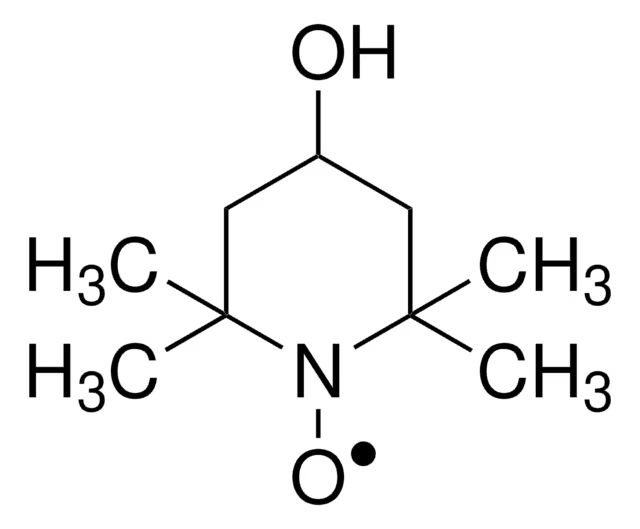
CAS Number2226-96-2
Synonyms4-Hydroxy-2,2,6,6-tetramethylpiperidine 1-oxyl,TEMPOL; HYDROXY-TEMPO; (4-Hydroxy-2,2,6,6-tetramethyl-1-piperidinyl)oxidanyl; 4-Hydroxy-TEMPO Free Radical; EINECS 218-761-4; Tempol; (4-Hydroxy-2,2,6,6-tetramethylpiperidin-1-yl)oxidanyl; 4-Oxypiperidol; Tetramethylpiperidino-N-oxyl; TMPN; 4-Hydroxy-2,2,6,6-tetramethylpiperidine N-oxide; 4-Hydroxy-2,2,6,6-tetramethyl-1-piperidin-1-yloxy, free radical; Tanol; 4-Hydroxy-TEMPO; 4-Hydroxy-2,2,6,6-tetramethylpiperidinoxyl; 4-Hydroxy-2,2,6,6-tetramethylpiperidine 1-oxyl free radical; 4-Hydroxy-2,2,6,6-te; NR-I; 4-hydroxy-2,2,6,6-tetramethyl piperidinyloxy,free radical; 4-hydroxy-2,2,6,6-tetramethylpiperidinoxy radical; nr1; 2,2,6,6-Tetramethyl-4-piperidinol 1-oxyl; 2,2,6,6-Tetramethyl-4-hydroxypiperidinooxy; 4-Hydroxy-2,2,6,6-tetramethylpiperidinoo
Molecular FormulaC9H18NO2*
Molecular Weight172.24
Purity95%
Density1.187 g/cm3
Boiling Point269ºC
Melting Point69-71 °C (lit.)
Appearancesolid
EINECS218-760-9
Symbol
Signal WordWarning
| Chemical & Physical Properties | |
|---|---|
| CAS Number | 2226-96-2 |
| Catalog No. | 2A-9005834 |
| Chinese Name | 阻聚剂701 |
| Synonyms | 4-Hydroxy-2,2,6,6-tetramethylpiperidine 1-oxyl,TEMPOL; HYDROXY-TEMPO; (4-Hydroxy-2,2,6,6-tetramethyl-1-piperidinyl)oxidanyl; 4-Hydroxy-TEMPO Free Radical; EINECS 218-761-4; Tempol; (4-Hydroxy-2,2,6,6-tetramethylpiperidin-1-yl)oxidanyl; 4-Oxypiperidol; Tetramethylpiperidino-N-oxyl; TMPN; 4-Hydroxy-2,2,6,6-tetramethylpiperidine N-oxide; 4-Hydroxy-2,2,6,6-tetramethyl-1-piperidin-1-yloxy, free radical; Tanol; 4-Hydroxy-TEMPO; 4-Hydroxy-2,2,6,6-tetramethylpiperidinoxyl; 4-Hydroxy-2,2,6,6-tetramethylpiperidine 1-oxyl free radical; 4-Hydroxy-2,2,6,6-te; NR-I; 4-hydroxy-2,2,6,6-tetramethyl piperidinyloxy,free radical; 4-hydroxy-2,2,6,6-tetramethylpiperidinoxy radical; nr1; 2,2,6,6-Tetramethyl-4-piperidinol 1-oxyl; 2,2,6,6-Tetramethyl-4-hydroxypiperidinooxy; 4-Hydroxy-2,2,6,6-tetramethylpiperidinoo |
| Molecular Formula | C9H18NO2* |
| Molecular Weight | 172.24 |
| Purity | 95 |
| Density | 1.187 g/cm3 |
| Boiling Point | 269ºC |
| Melting Point | 69-71 °C (lit.) |
| Appearance | solid |
| Water Solubility | soluble |
| Storage Condition | Keep container tightly closed and stored in a cool |
| Application | Tempol is a superoxide dismutase (SOD) analog that effectively neutralizes reactive oxygen species (ROS). |
| EINECS | 218-760-9 |
| HTC | 29333999 |
| PubChem ID | 24850555 |
| MDL Number | MFCD00006478 |
| SMILES | CC1(C)CC(O)CC(C)(C)N1[O] |
| InChI | 1S/C9H18NO2/c1-8(2)5-7(11)6-9(3,4)10(8)12/h7,11H,5-6H2,1-4H3 |
| InChI Key | UZFMOKQJFYMBGY-UHFFFAOYSA-N |
| Beilstein/REAXYS | 1422990 |
| NACRES Code | NA.22 |
| UNSPSC | 12352119 |
| Hazard Symbols | Transport |
| Risk Codes | R22;R36/38 |
| Safety Description | S26;S37/39 |
| MSDS | msds/5834_1_2226_96_2.pdf |
| Bioactivity | Tempol is a general superoxide dismutase (SOD)-mimetic drug that efficiently neutralizes reactive oxygen species (ROS). Related Catalog Signaling Pathways >> Autophagy >> Autophagy Research Areas >> Cancer Target ROS[1] In Vitro Tempol significantly attenuates H2O2-mediated decrease in mitochondrial respiration and increase in LDH release from rat PT cells, indicating a reduction in cell injury and death. The beneficial actions of Tempol are similar to those obtained using the Fe2+ chelator DEF. However, coadministration of DEF and Tempol does not produce any additional beneficial actions against renal ischemia/reperfusion injury or against oxidative stress-mediated PT cell injury/death[2]. In Vivo SOD-mimetic Tempol is able to mimic resveratrol's effects on heart function. Tempol is administered daily by gavage. Mice treated with Met or Tmp had decreased PR and QTc intervals and increased heart rates compared to peroral vehicle (VEH). These results are similar to that obtained by treatment with RSV. Pre- and post-treatment profiles of individual mice are illustrated[1]. Tempol, a membrane-permeable radical scavenger, reduces oxidant stress-mediated renal dysfunction and injury in the rat. Tempol significantly reduces the increase in urea, creatinine, γGT, AST, NAG, and FENa produced by renal ischemia/reperfusion, suggesting an improvement in both renal function and injury. Tempol also significantly reduces kidney MPO activity and MDA levels, indicating a reduction in PMN infiltration and lipid peroxidation, respectively. Tempol reduces the histologic evidence of renal damage associated with ischemia/reperfusion and caused a substantial reduction in the staining for nitrotyrosine and PARS, suggesting reduced nitrosative and oxidative stress[2]. Cell Assay To investigate the effect of Tempol, DEF, and DEF coadministered with Tempol on H2O2-mediated cell injury and death, confluent cultures of PT cells are preincubated (10 min at 37°C) with Tempol (0.03 to 10 mM), DEF (0.03 to 10 mM), or DEF (3 mM) in combination with Tempol (3 mM). The ranges of concentrations of Tempol and DEF are based on those previously shown in this laboratory to reduce on H2O2-mediated cell injury and death in (1) cultured rat cardiac myoblasts (Tempol) and (2) primary cultures of rat PT cells (DEF ). PT cell cultures are then incubated with H2O2 (1 mM) for four hours, after which cellular injury and death are assessed. Upon completion of incubations, cellular injury and death are assessed using the spectrophotometric assays described later in this article[2]. Animal Admin Mice[1] Female or male BALB/c mice (5-7 weeks of age) are used. Mice are infected intraperitoneally (i.p.) with 102 blood trypomastigote forms of the type I Colombian strain of T. cruzi. Treatments are performed daily for 30 days from the establishment of CCC (60 dpi) by i.p. injection of 15 mg/kg trans-resveratrol (10% ethanol/PBS), vehicle (10% ethanol/PBS), 5 mg/Kg EX527 (0.1% DMSO), or peroral administration of 40 mg/Kg Resveratrol (10%ethanol-PBS), 500 mg/kg Metformin (dissolved in water), 100 mg/kg Tempol (dissolved in water), Benznidazole (25 mg/Kg, dissolved in water) and vehicle (water or 10%ethanol-PBS). Rats[2] 83 male Wistar rats weighing 230 to 320 g are used.Upon completion of surgical procedures, the animals are randomly allocated to the eight groups. At one minute before commencement of reperfusion, animals received a bolus injection of either vehicle (saline, 4 mL/kg, IV), Tempol (30 mg/kg in saline, IV), DEF (40 mg/kg in saline, IV), or DEF (40 mg/kg in saline, IV) in combination with Tempol (30 mg/kg in saline, IV). The corresponding groups then received a continuous infusion of one of the following throughout the reperfusion period: vehicle (saline, 4 mL/kg/h, IV), Tempol (30 mg/kg/h in saline, IV), DEF (40 mg/kg/h in saline, IV), or Tempol and DEF in combination (30 and 40 mg/kg/h, respectively, in saline, IV). To elucidate the effects of Tempol or DEF on cardiovascular hemodynamics and organ function in sham-operated rats, respective groups of animals received the treatments described previously in this article and as outlined. The concentration of Tempol administered in vivo is based on those previously demonstrated by us to provide significant protection against myocardial ischemia/reperfusion injury in an in vivo rat model. Similarly, the concentration of DEF used is identical to that which we have previously used to provide significant protection against hepatic ischemia/reperfusion injury in in vivo rat and rabbit models. References [1]. Vilar-Pereira G, et al. Resveratrol Reverses Functional Chagas Heart Disease in Mice. PLoS Pathog. 2016 Oct 27;12(10):e1005947. [2]. Chatterjee PK, et al. Tempol, a membrane-permeable radical scavenger, reduces oxidant stress-mediated renal dysfunction and injury in the rat. Kidney Int. 2000 Aug;58(2):658-73. Chemical & Physical Properties Density 1.187 g/cm3 Boiling Point 269ºC Melting Point 69-71 °C(lit.) Molecular Formula C9H18NO2* Molecular Weight 172.24 PSA 23.47000 LogP 1.28370 Storage condition 2-8°C Stability Stable. Incompatible with strong oxidizing agents. Water Solubility soluble |
| Use of | Tempol is a general superoxide dismutase (SOD)-mimetic drug that efficiently neutralizes reactive oxygen species (ROS). Properties Articles69 Name 4-Hydroxy-2,2,6,6-tetramethyl-piperidinooxy Synonym More Synonyms Tempol Biological Activity Description Tempol is a general superoxide dismutase (SOD)-mimetic drug that efficiently neutralizes reactive oxygen species (ROS). Related Catalog Signaling Pathways >> Autophagy >> Autophagy Research Areas >> Cancer In Vitro Tempol significantly attenuates H2O2-mediated decrease in mitochondrial respiration and increase in LDH release from rat PT cells, indicating a reduction in cell injury and death. The beneficial actions of Tempol are similar to those obtained using the Fe2+ chelator DEF. However, coadministration of DEF and Tempol does not produce any additional beneficial actions against renal ischemia/reperfusion injury or against oxidative stress-mediated PT cell injury/death[2]. In Vivo SOD-mimetic Tempol is able to mimic resveratrol's effects on heart function. Tempol is administered daily by gavage. Mice treated with Met or Tmp had decreased PR and QTc intervals and increased heart rates compared to peroral vehicle (VEH). These results are similar to that obtained by treatment with RSV. Pre- and post-treatment profiles of individual mice are illustrated[1]. Tempol, a membrane-permeable radical scavenger, reduces oxidant stress-mediated renal dysfunction and injury in the rat. Tempol significantly reduces the increase in urea, creatinine, γGT, AST, NAG, and FENa produced by renal ischemia/reperfusion, suggesting an improvement in both renal function and injury. Tempol also significantly reduces kidney MPO activity and MDA levels, indicating a reduction in PMN infiltration and lipid peroxidation, respectively. Tempol reduces the histologic evidence of renal damage associated with ischemia/reperfusion and caused a substantial reduction in the staining for nitrotyrosine and PARS, suggesting reduced nitrosative and oxidative stress[2]. References [1]. Vilar-Pereira G, et al. Resveratrol Reverses Functional Chagas Heart Disease in Mice. PLoS Pathog. 2016 Oct 27;12(10):e1005947. [2]. Chatterjee PK, et al. Tempol, a membrane-permeable radical scavenger, reduces oxidant stress-mediated renal dysfunction and injury in the rat. Kidney Int. 2000 Aug;58(2):658-73. Chemical & Physical Properties Molecular Formula C9H18NO2* PSA 23.47000 LogP 1.28370 Stability Stable. Incompatible with strong oxidizing agents. Water Solubility soluble |
| Transport Info | Shipping Name: UN |
| MSDS Transport Info | Module 14. Shipping information 14.1 UN dangerous goods number European Land Transport Dangerous Regulations: -International Maritime Dangerous Regulations: -International Air Transport Dangerous Regulations: - 14.2 United Nations shipping name European Land Transport Dangerous Regulations: Non-dangerous goods IMDG Code: Non-dangerous goods International air transport dangerous goods regulations: non-dangerous goods 14.3 Transport hazard categories European Land Transport Dangerous Regulations: -International Maritime Dangerous Regulations: -International Air Transport Dangerous Regulations: - 14.4 Package group European Land Transport Dangerous Regulations: -International Maritime Dangerous Regulations: -International Air Transport Dangerous Regulations: - 14.5 Environmental hazards European Land Transport Danger Regulations: No International Maritime Danger Regulations International Air Transport Danger Regulations: No Marine pollutants (yes/no): No 14.6 Special reminder to users No data available |
| Related Products in Pharmaceutical Intermediates | ||
|---|---|---|
| 4-Chlorophenyl isocyanate | 104-21-1 | 2A-9005675 |
| 4-Cyanophenyl isocyanate | 40465-45-0 | 2A-9005702 |
| 4-Dimethlaminophenyl isocyanate | 16315-59-6 | 2A-9005709 |
| 4-Ethoxycarbonylphenyl isothiocyanate | 1205-06-7 | 2A-9005716 |
| 4-Ethoxyphenyl isothiocyanate | 3460-49-9 | 2A-9005718 |
| 4-Iodobenzenesulfonyl chloride | 98-61-3 | 2A-9005904 |
| 4-Isopropylphenyl isocyanate | 31027-31-3 | 2A-9005919 |
| 4-Methoxybenzyl isocyanate | 56651-60-6 | 2A-9005932 |
| 4-Methyl-2-nitrophenylisothiocyanate | 17614-74-3 | 2A-9005948 |
| 4-Methylbenzyl isocyanate | 56651-57-1 | 2A-9005961 |
| Browse all Pharmaceutical Intermediates products » | ||
Phone:
630-322-8886
630-322-8887
Email:
Office Locations:
Chicago, IL, USA
San Francisco, CA, USA


 EN
EN


 SDS
SDS