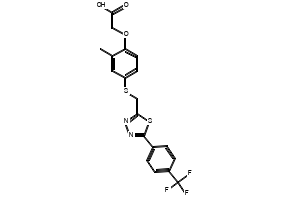
CAS Number317318-70-0
SynonymsGW 501516; 2-(4-((2-(4-(Trifluoromethyl)phenyl)-5-methylthiazol-4-yl)methylthio)-2-methylphenoxy)acetic acid; 2-methyl-4-(((4-methyl-2-(4-(trifluoromethyl)phenyl)-5-(thiazolyl)methyl)thio)phenoxy)acetic acid; Endurobol; {2-Methyl-4-{{4-methyl-2-[4-(trifluoromethyl)phenyl]-5-thiazolyl}methylthio}phenoxy}acetic acid; UNII-7I2HA1NU22; GSK-516; Cardarine; GW-501516; GW501516
Molecular FormulaC21H18F3NO3S2
Molecular Weight453.498
Purity98.00%
Density1.4±0.1 g/cm3
Boiling Point584.5±60.0 °C at 760 mmHg
Melting Point134-136°C
Appearancewhite solid
Symbol
Signal WordWarning
| Chemical & Physical Properties | |
|---|---|
| CAS Number | 317318-70-0 |
| Catalog No. | 2A-9056519 |
| Chinese Name | GW-501516 |
| Synonyms | GW 501516; 2-(4-((2-(4-(Trifluoromethyl)phenyl)-5-methylthiazol-4-yl)methylthio)-2-methylphenoxy)acetic acid; 2-methyl-4-(((4-methyl-2-(4-(trifluoromethyl)phenyl)-5-(thiazolyl)methyl)thio)phenoxy)acetic acid; Endurobol; {2-Methyl-4-{{4-methyl-2-[4-(trifluoromethyl)phenyl]-5-thiazolyl}methylthio}phenoxy}acetic acid; UNII-7I2HA1NU22; GSK-516; Cardarine; GW-501516; GW501516 |
| Molecular Formula | C21H18F3NO3S2 |
| Molecular Weight | 453.498 |
| Purity | 98.00 |
| Density | 1.4±0.1 g/cm3 |
| Boiling Point | 584.5±60.0 °C at 760 mmHg |
| Melting Point | 134-136°C |
| Appearance | white solid |
| Water Solubility | DMSO: soluble20mg/mL, clear |
| Storage Condition | Refrigerator |
| Application | GW 501516 is a PPARδ agonist with an EC50 value of 1.1 nM. |
| SMILES | Cc1cc(SCc2sc(-c3ccc(C(F)(F)F)cc3)nc2C)ccc1OCC(=O)O |
| InChI Key | YDBLKRPLXZNVNB-UHFFFAOYSA-N |
| Hazard Symbols | transportation |
| MSDS | msds/56519_1_317318_70_0.pdf |
| Bioactivity | GW 501516 is a PPARδ agonist with an EC50 of 1.1 nM. Related Catalog Signaling Pathways >> Autophagy >> Autophagy Signaling Pathways >> Cell Cycle/DNA Damage >> PPAR Research Areas >> Metabolic Disease Target PPARδ:1.1 nM (EC50) In Vitro GW 501516 is shown to be the most potent and selective PPARα agonists known with an EC50 of 1.1 nM against PPARα and 1000-fold selectivity over the other human subtypes, PPARα and-γ[1]. GW 501516 exerts anti-inflammatory effects in mouse cultured proximal tubular (mProx) cells. GW 501516 inhibits palmitate- and TNFα-induced increases in MCP-1 mRNA expression in a dose-dependent manner[3]. In Vivo GW 501516 causes impaired bone formation, leading to decreased BMD and deterioration of bone properties in OVX rats[2]. GW 501516 attenuates interstitial inflammation and proximal tubular cell damage in a protein-overload mouse nephropathy model[3]. GW 501516 treatment enhances running endurance and the proportion of succinate dehydrogenase (SDH)-positive muscle fibres in both trained and untrained mice[4]. Cell Assay GW 501516 is dissolved in DMSO. Cells are starved by incubation in 0.2% FCS DMEM for 9 h, then pre-incubated with GW 501516, at a final concentration of 2.5 and 5 µM, or 0.05% DMSO as control for 3 hours, followed by stimulation with 150 µM palmitate bound to 8.0% BSA for 12 h[3]. Animal Admin Rats: Female Sprague Dawley rats, 12 weeks of age, are allocated to a sham-operated group and 3 OVX groups; high-dose GW 501516 (OVX-GW5), low-dose GW 501516 (OVX-GW1), and a control group (OVX-CTR), respectively. Animals receive GW 501516 or vehicle (methylcellulose) daily for 4 months by gavage. Bone mineral density (BMD) is assessed by dual x-ray absorptiometry at the femur, spine, and whole body[2]. Mice: Mice are randomly allocated to different groups and receive therapeutic diet and treatment. The GW 501516-containing rodent diet is made by evenly adding GW 501516 to the control diet to a final concentration of 0.04% w/w. In the control diet, 10% of the total calories are from fat (5.5% from soybean oil and 4.5% from lard)[3]. References [1]. Wei ZL, et al. A short and efficient synthesis of the pharmacological research tool GW501516 for the peroxisome proliferator-activated receptor delta. J Org Chem. 2003 Nov 14;68(23):9116-8. [2]. Mosti MP, et al. Effects of the peroxisome proliferator-activated receptor (PPAR)-δ agonist GW 501516 on bone and muscle in ovariectomized rats. Endocrinology. 2014 Jun;155(6):2178-89. [3]. Yang X, et al. GW 501516, a PPARδ agonist, ameliorates tubulointerstitial inflammation in proteinuric kidney disease via inhibition of TAK1-NFκB pathway in mice. PLoS One. 2011;6(9):e25271. [4]. Chen W, et al. A metabolomic study of the PPARδ agonist GW 501516 for enhancing running endurance in Kunming mice. Sci Rep. 2015 May 6;5:9884. [5]. Ji Y, et al. PPARβ/δ Agonist GW501516 Inhibits Tumorigenicity of Undifferentiated Nasopharyngeal Carcinoma in C666-1 Cells by Promoting Apoptosis. Front Pharmacol. 2018 Jun 28;9:648. Chemical & Physical Properties Density 1.4±0.1 g/cm3 Boiling Point 584.5±60.0 °C at 760 mmHg Melting Point 134-136°C Molecular Formula C21H18F3NO3S2 Molecular Weight 453.498 Flash Point 307.3±32.9 °C Exact Mass 453.068024 PSA 112.96000 LogP 6.29 Vapour Pressure 0.0±1.7 mmHg at 25°C Index of Refraction 1.619 InChIKey YDBLKRPLXZNVNB-UHFFFAOYSA-N SMILES Cc1cc(SCc2sc(-c3ccc(C(F)(F)F)cc3)nc2C)ccc1OCC(=O)O Storage condition Refrigerator Stability Light Sensitive Water Solubility DMSO: soluble20mg/mL, clear |
| Use of | GW 501516 is a PPARδ agonist with an EC50 of 1.1 nM. Properties Name 2-[2-methyl-4-[[4-methyl-2-[4-(trifluoromethyl)phenyl]-1,3-thiazol-5-yl]methylsulfanyl]phenoxy]acetic acid Synonym More Synonyms GW501516 Biological Activity Description GW 501516 is a PPARδ agonist with an EC50 of 1.1 nM. Related Catalog Signaling Pathways >> Autophagy >> Autophagy Signaling Pathways >> Cell Cycle/DNA Damage >> PPAR Research Areas >> Metabolic Disease PPARδ:1.1 nM (EC50) Cell Assay GW 501516 is dissolved in DMSO. Cells are starved by incubation in 0.2% FCS DMEM for 9 h, then pre-incubated with GW 501516, at a final concentration of 2.5 and 5 µM, or 0.05% DMSO as control for 3 hours, followed by stimulation with 150 µM palmitate bound to 8.0% BSA for 12 h[3]. References [1]. Wei ZL, et al. A short and efficient synthesis of the pharmacological research tool GW501516 for the peroxisome proliferator-activated receptor delta. J Org Chem. 2003 Nov 14;68(23):9116-8. [2]. Mosti MP, et al. Effects of the peroxisome proliferator-activated receptor (PPAR)-δ agonist GW 501516 on bone and muscle in ovariectomized rats. Endocrinology. 2014 Jun;155(6):2178-89. [3]. Yang X, et al. GW 501516, a PPARδ agonist, ameliorates tubulointerstitial inflammation in proteinuric kidney disease via inhibition of TAK1-NFκB pathway in mice. PLoS One. 2011;6(9):e25271. [4]. Chen W, et al. A metabolomic study of the PPARδ agonist GW 501516 for enhancing running endurance in Kunming mice. Sci Rep. 2015 May 6;5:9884. Chemical & Physical Properties Molecular Formula C21H18F3NO3S2 Exact Mass 453.068024 PSA 112.96000 Index of Refraction 1.619 InChIKey YDBLKRPLXZNVNB-UHFFFAOYSA-N Storage condition Refrigerator Stability Light Sensitive |
| Transport Info | Shipping Name: UN |
| MSDS Transport Info | Module 14. Shipping information 14.1 UN dangerous goods number European Land Transport Dangerous Regulations: -International Maritime Dangerous Regulations: -International Air Transport Dangerous Regulations: - 14.2 United Nations shipping name European Land Transport Dangerous Regulations: Non-dangerous goods IMDG Code: Non-dangerous goods International air transport dangerous goods regulations: non-dangerous goods 14.3 Transport hazard categories European Land Transport Dangerous Regulations: -International Maritime Dangerous Regulations: -International Air Transport Dangerous Regulations: - 14.4 Package group European Land Transport Dangerous Regulations: -International Maritime Dangerous Regulations: -International Air Transport Dangerous Regulations: - 14.5 Environmental hazards European Land Transport Danger Regulations: No International Maritime Danger Regulations International Air Transport Danger Regulations: No Marine pollutants (yes/no): No 14.6 Special reminder to users No data available See reverse side of invoice or packing slip. |
| Related Products in Functional Building Blocks | ||
|---|---|---|
| 2-Acetylphenylboronic acid | 308103-40-4 | 2A-9056466 |
| Bis(diethyl-D-tartrate glycolato)diboron | 312693-46-2 | 2A-9056481 |
| 2-Chloro-4-(trifluoromethyl)phenylboronic acid | 313545-41-4 | 2A-9056498 |
| [4-(4-Butylcyclohexyl)phenyl]boronic acid | 315220-11-2 | 2A-9056511 |
| Methyl indolizine-1-carboxylate | 316375-85-6 | 2A-9056517 |
| [4-Methyl-2-(4-(trifluoromethyl)phenyl)-1,3-thiazol-5-yl]methanol | 317318-96-0 | 2A-9056520 |
| 2-Fluoro-4-(trifluoromethyl)thiobenzamide | 317319-34-9 | 2A-9056522 |
| 2,3,6,7-Tetrahydroazepine-1-carboxylic acid tert-butyl ester | 317336-73-5 | 2A-9056524 |
| Pyrimidine-5-boronic acid pinacol ester | 321724-19-0 | 2A-9056554 |
| Triethylsulfonium bis(trifluoromethylsulfonyl)imide | 321746-49-0 | 2A-9056555 |
| Browse all Functional Building Blocks products » | ||
Phone:
630-322-8886
630-322-8887
Email:
Office Locations:
Chicago, IL, USA
San Francisco, CA, USA


 EN
EN


 SDS
SDS