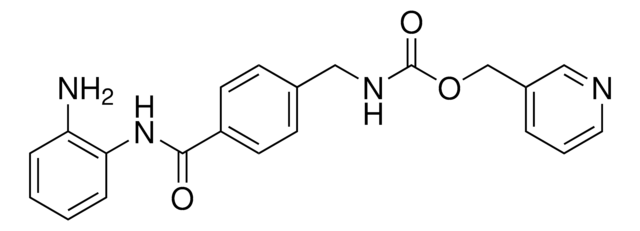
CAS Number209783-80-2
SynonymsEntinostat (MS-275); MS-275; SNDX-275; Entinostat; pyridin-3-ylmethyl 4-((2-aminophenyl)carbamoyl)benzylcarbamate; Entinostat (MS-275,SNDX-275); 3-Pyridinylmethyl {4-[(2-aminophenyl)carbamoyl]benzyl}carbamate; Pyridin-3-ylmethyl {4-[(2-aminophenyl)carbamoyl]benzyl}carbamate; Carbamic acid, N-[[4-[[(2-aminophenyl)amino]carbonyl]phenyl]methyl]-, 3-pyridinylmethyl ester; N-(2-Aminophenyl)-4-[N-(pyridine-3-ylmethoxycarbonyl)aminomethyl]benzamide; MS 275-27; ((4-(((2-Aminophenyl)amino)carbonyl)phenyl)methyl)carbamic Acid 3-Pyridinylmethyl Ester
Molecular FormulaC21H20N4O3
Molecular Weight376.41
Purity≥98 (HPLC)%
Density1.3±0.1 g/cm3
Boiling Point566.7±50.0 °C at 760 mmHg
Melting Point159-160ºC
Appearancepowder
Symbol
Signal WordWarning
| Chemical & Physical Properties | |
|---|---|
| CAS Number | 209783-80-2 |
| Catalog No. | 2A-9055475 |
| Chinese Name | 恩替诺特 |
| Synonyms | Entinostat (MS-275); MS-275; SNDX-275; Entinostat; pyridin-3-ylmethyl 4-((2-aminophenyl)carbamoyl)benzylcarbamate; Entinostat (MS-275,SNDX-275); 3-Pyridinylmethyl {4-[(2-aminophenyl)carbamoyl]benzyl}carbamate; Pyridin-3-ylmethyl {4-[(2-aminophenyl)carbamoyl]benzyl}carbamate; Carbamic acid, N-[[4-[[(2-aminophenyl)amino]carbonyl]phenyl]methyl]-, 3-pyridinylmethyl ester; N-(2-Aminophenyl)-4-[N-(pyridine-3-ylmethoxycarbonyl)aminomethyl]benzamide; MS 275-27; ((4-(((2-Aminophenyl)amino)carbonyl)phenyl)methyl)carbamic Acid 3-Pyridinylmethyl Ester |
| Molecular Formula | C21H20N4O3 |
| Molecular Weight | 376.41 |
| Purity | ≥98 (HPLC) |
| Density | 1.3±0.1 g/cm3 |
| Boiling Point | 566.7±50.0 °C at 760 mmHg |
| Melting Point | 159-160ºC |
| Appearance | powder |
| Water Solubility | DMSO: 38 mg/mL, soluble |
| Storage Condition | −20°C |
| Application | Entinostat is a selective, orally available HDAC class I inhibitor with IC50s of 243 nM, 453 nM and 248 nM for HDAC1, HDAC2 and HDAC3 inhibition respectively. |
| HTC | 29333990 |
| MDL Number | MFCD08272435 |
| SMILES | Nc1ccccc1NC(=O)c1ccc(CNC(=O)OCc2cccnc2)cc1 |
| InChI | InChI=1S/C21H20N4O3/c22-18-5-1-2-6-19(18)25-20(26)17-9-7-15(8-10-17)13-24-21(27)28-14-16-4-3-11-23-12-16/h1-12H,13-14,22H2,(H,24,27)(H,25,26) |
| InChI Key | INVTYAOGFAGBOE-UHFFFAOYSA-N |
| Hazard Symbols | transportation |
| MSDS | msds/55475_1_209783_80_2.pdf |
| Bioactivity | Entinostat is an oral and selective class I HDAC inhibitor, with IC50s of 243 nM, 453 nM, and 248 nM for HDAC1, HDAC2, and HDAC3, respectively. Related Catalog Signaling Pathways >> Autophagy >> Autophagy Signaling Pathways >> Cell Cycle/DNA Damage >> HDAC Signaling Pathways >> Epigenetics >> HDAC Research Areas >> Cancer Target HDAC1:243 nM (IC50) HDAC3:248 nM (IC50) HDAC2:453 nM (IC50) In Vitro Binding affinity of Entinostat (MS-275) against HDAC1 and HDAC2 is 282 nM and 156 nM, respectively[1]. Effects of the HDAC inhibitor Entinostat (MS-275) have been examined in human leukemia and lymphoma cells (U937, HL-60, K562, and Jurkat) as well as in primary acute myelogenous leukemia blasts in relation to differentiation and apoptosis. MS-275 displays dose-dependent effects in each of the cell lines. When administered at a low concentration (e.g., 1 μM), MS-275 exhibits potent antiproliferative activity, inducing p21CIP1/WAF1-mediated growth arrest and expression of differentiation markers (CD11b) in U937 cells. Entinostat (MS-275) potently induces cell death, triggering apoptosis in ~70% of cells at 48 h[2]. In Vivo Entinostat (MS-27-275) at 49 mg/kg shows marked antitumor effects against KB-3-1, 4-1St, and St-4 tumor lines, and a moderate effect against Capan-1 tumor. Entinostat at 24.5 mg/kg and 12.3 mg/kg also shows significant effects against these tumors. In addition, oral administration of Entinostat apparently increases the level of histone acetylation in HT-29 tumor xenografts 4-24 h after the administration[3]. MS-275 administration (3.5 mg/kg i.p.) to Experimental autoimmune neuritis (EAN) rats once daily from the appearance of first neurological signs greatly reduces the severity and duration of EAN and attenuated local accumulation of macrophages, T cells and B cells, anddemyelination of sciatic nerves. Further, significant reduction of mRNA levels of pro-inflammatory interleukin-1β, interferon-γ, interleukine-17, inducible nitric oxide synthaseand matrix metalloproteinase-9 is observed in sciatic nerves of MS-275 treated EAN rats. In addition, MS-275 treatment increases proportion of infiltrated Foxp3+ cells and anti-inflammatory M2 macrophages in sciatic nerves of EAN rats[4]. Kinase Assay Biochemical assays of HDAC activity are carried out by Nanosyn in a reaction volume of 10 μL in 384-well microplates. A standard enzymatic reaction contains 5 μL of 2× HDAC inhibitor (e.g., Entinostat), 4 μL of 2.5× enzyme, and 1 μL of 10× substrate in assay buffer (100 mM HEPES, pH 7.5, 25 mM KCl, 0.1% BSA, 0.01% Triton X-100, 1% DMSO). Final concentration of all HDACs in the enzymatic assays is between 0.5 and 5 nM. A final substrate concentration of 1 μM FAM-RHKK(Ac)-NH2 or FAM-RHKK(trifluoroacetyl)-NH2 is used in all assays and found to be below the determined Km,app for each enzyme[1]. Cell Assay SH-SY5Y cells are maintained under normal culture conditions in a humidified incubator at 37°C with 5% CO2 and are split twice weekly. Cells are plated in black 384-well plates at 2500 cells/well in 20-μL volume of DMEM/F-12 culture media supplemented with 10% FBS and permitted to adhere overnight. The following day, HDAC inhibitors (e.g., Entinostat) are serially diluted in 100% DMSO, and this series is subsequently cross-diluted into culture media. 5 μL of compound (e.g., Entinostat) diluted in media is added to the appropriate well of the cell plate to afford the indicated final concentration of inhibitor (e.g., Entinostat) with a final 0.1% DMSO. Treated cells are incubated under normal tissue culture conditions for 6, 24, 48, 72, or 96 h prior to quantitation of cellular ATP levels as measured using CellTiter-Glo reagents. Similarly, after 6 h of incubation with HDAC inhibitors (e.g., Entinostat), media from separate cell plates are aspirated, and cells are washed once with media containing no inhibitors. 25 μL of media supplemented with 10% FBS and 0.1% DMSO (no inhibitors) is added back to the cells, and cellular ATP levels are determined using CellTiter-Glo after 24, 48, 72, or 96 h of incubation. Luminescence is measured at each time point using an Envision Instrument with a 0.1 s count time[1]. Animal Admin Mice[3] A2780 cells (9×10⁶) are suspended in PBS and are injected subcutaneously into the flank of nude mouse. For the other tumor lines, KB-3-1, HCT-15, 4-1St, Calu-3, St-4, Capan-1, and HT-29, tumors are passaged several times before starting in vivo antitumor testing, and a tumor lump (2-3 mm in diameter) is transplanted subcutaneously into the flank of a nude mouse by using a trocar needle. Treatment (four or five mice in each experimental group) with the drugs is started after the tumors are confirmed to have grown in the body (tumor size, 20-100 mm3). Entinostat is administered orally once daily 5 days per week for 4 weeks. Tumor length and width are monitored twice weekly, and tumor volume is calculated. Rats[4] Male Lewis rats (8-10 weeks, 170-200 g) are housed under a 12-h light/dark cycle with free access to food and water. For therapeutic treatment, EAN rats receive i.p. injection of MS-275 (3.5 mg/kg) daily from day 10 to day 14 (six rats/group). For injection, MS-275 is suspended in phosphate buffered saline (PBS) and the same volume (1 mL) of PBS is given to control rats. References [1]. Lauffer BE, et al. Histone deacetylase (HDAC) inhibitor kinetic rate constants correlate with cellular histone acetylation but not transcription and cell viability. J Biol Chem. 2013 Sep 13;288(37):26926-43. [2]. Rosato RR, et al. The histone deacetylase inhibitor MS-275 promotes differentiation or apoptosis in human leukemia cells through a process regulated by generation of reactive oxygen species and induction of p21CIP1/WAF1 1. Cancer Res. 2003 Jul 1;63(13):36 [3]. Saito A, et al. A synthetic inhibitor of histone deacetylase, MS-27-275, with marked in vivo antitumor activity against human tumors. Proc Natl Acad Sci U S A, 1999, 96(8), 4592-4597. [4]. Zhang ZY, et al. MS-275, an histone deacetylase inhibitor, reduces the inflammatory reaction in rat experimental autoimmune neuritis. Neurosci, 2010, 169, 370-377. Chemical & Physical Properties Density 1.3±0.1 g/cm3 Boiling Point 566.7±50.0 °C at 760 mmHg Melting Point 159-160ºC Molecular Formula C21H20N4O3 Molecular Weight 376.409 Flash Point 296.6±30.1 °C Exact Mass 376.153534 PSA 106.34000 LogP 1.46 Appearance of Characters solid Vapour Pressure 0.0±1.6 mmHg at 25°C Index of Refraction 1.672 InChIKey INVTYAOGFAGBOE-UHFFFAOYSA-N SMILES Nc1ccccc1NC(=O)c1ccc(CNC(=O)OCc2cccnc2)cc1 Storage condition −20°C Water Solubility DMSO: 38 mg/mL, soluble |
| Use of | Entinostat is an oral and selective class I HDAC inhibitor, with IC50s of 243 nM, 453 nM, and 248 nM for HDAC1, HDAC2, and HDAC3, respectively. Properties Articles63 Name N-(2-aminophenyl)-4-[N-(pyridin-3-yl)methoxycarbonylaminomethyl]benzamide Synonym More Synonyms Entinostat (MS-275) Biological Activity Description Entinostat is an oral and selective class I HDAC inhibitor, with IC50s of 243 nM, 453 nM, and 248 nM for HDAC1, HDAC2, and HDAC3, respectively. Related Catalog Signaling Pathways >> Autophagy >> Autophagy Signaling Pathways >> Cell Cycle/DNA Damage >> HDAC Signaling Pathways >> Epigenetics >> HDAC Research Areas >> Cancer HDAC1:243 nM (IC50) HDAC3:248 nM (IC50) HDAC2:453 nM (IC50) References [1]. Lauffer BE, et al. Histone deacetylase (HDAC) inhibitor kinetic rate constants correlate with cellular histone acetylation but not transcription and cell viability. J Biol Chem. 2013 Sep 13;288(37):26926-43. [3]. Saito A, et al. A synthetic inhibitor of histone deacetylase, MS-27-275, with marked in vivo antitumor activity against human tumors. Proc Natl Acad Sci U S A, 1999, 96(8), 4592-4597. [4]. Zhang ZY, et al. MS-275, an histone deacetylase inhibitor, reduces the inflammatory reaction in rat experimental autoimmune neuritis. Neurosci, 2010, 169, 370-377. Chemical & Physical Properties Molecular Formula C21H20N4O3 Exact Mass 376.153534 PSA 106.34000 Appearance of Characters solid Index of Refraction 1.672 InChIKey INVTYAOGFAGBOE-UHFFFAOYSA-N |
| Transport Info | Shipping Name: UN |
| MSDS Transport Info | Module 14. Shipping information 14.1 UN dangerous goods number European Dangerous Regulations for land transport: 2811 International Dangerous Regulations for sea transport: 2811 International Dangerous Regulations for air transport: 2811 14.2 United Nations shipping name European Land Transport Dangerous Regulations: TOXIC SOLID, ORGANIC, N.O.S. (MS-275) IMDG Code: TOXIC SOLID, ORGANIC, N.O.S. (MS-275) International air transport hazard regulations: Toxic solid, organic, n.o.s. (MS-275) 14.3 Transport hazard categories European Land Transport Danger Regulations: 6.1 International Maritime Transport Danger Regulations: 6.1 International Air Transport Danger Regulations: 6.1 14.4 Package group European Land Transport Danger Regulations: III International Maritime Transport Danger Regulations: III International Air Transport Danger Regulations: III 14.5 Environmental hazards European Land Transport Danger Regulations: No International Maritime Danger Regulations International Air Transport Danger Regulations: No Marine pollutants (yes/no): No 14.6 Special reminder to users No data available |
| Related Products in Specialty Chemicals | ||
|---|---|---|
| Ladostigil tartrate | 209394-46-7 | 2A-9055458 |
| 1-Naphthalenyl(1-propyl-1H-indol-3-yl)methanone | 209414-06-2 | 2A-9055460 |
| (1-Hexyl-1H-indol-3-yl)-1-naphthalenylmethanone | 209414-08-4 | 2A-9055462 |
| N,N-Bis(4-sulfobutyl)-3,5-dimethylaniline disodium salt | 209518-16-1 | 2A-9055464 |
| Anatibant | 209733-45-9 | 2A-9055474 |
| Forodesine | 209799-67-7 | 2A-9055476 |
| Tafluprost | 209860-87-7 | 2A-9055477 |
| 2-Ethyl-2-adamantyl methacrylate | 209982-56-9 | 2A-9055482 |
| (aS)-N-[(1S)-2-[[(7S)-6,7-Dihydro-5-methyl-6-oxo-5H-dibenz[b,d]azepin-7-yl]amino]-1-methyl-2-oxoethyl]-3,5-difluoro-alpha-hydroxybenzeneacetamide | 209984-57-6 | 2A-9055483 |
| 3,4,5-Trifluorophenylacetic acid | 209991-62-8 | 2A-9055484 |
| Browse all Specialty Chemicals products » | ||
Phone:
630-322-8886
630-322-8887
Email:
Office Locations:
Chicago, IL, USA
San Francisco, CA, USA


 EN
EN


 SDS
SDS