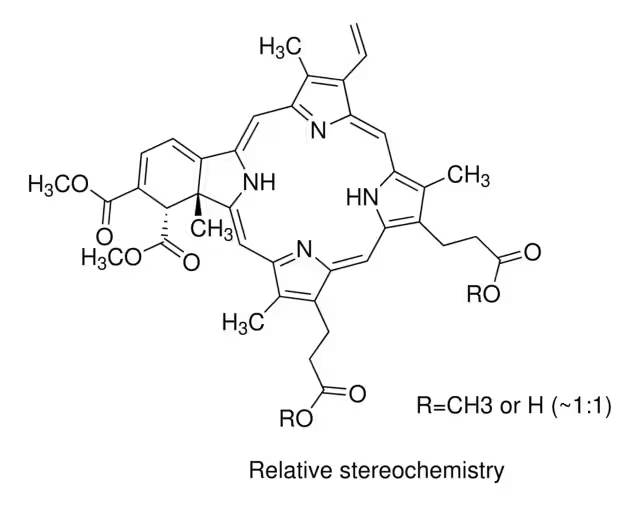
| Chemical & Physical Properties | |
|---|---|
| CAS Number | 129497-78-5 |
| Catalog No. | 2A-9051972 |
| Chinese Name | 维替泊芬 |
| Synonyms | Visudyne; Verteporphin; Verteprofin |
| Molecular Formula | C41H42N4O8 |
| Molecular Weight | 718.79 |
| Purity | ≥94 (HPLC) |
| Appearance | powder |
| Water Solubility | DMSO: soluble2mg/mL, clear (warmed) |
| Storage Condition | ?20°C |
| Application | Verteporfin is a photosensitizer used in photodynamic therapy to eliminate abnormal blood vessels in the eye associated with diseases such as age-related macular degeneration. Verteporfin is a YAP inh |
| PubChem ID | 329825538 |
| MDL Number | MFCD11982858 |
| SMILES | CC(C(/C=C1[C@@]2(C)C(/C(N/1)=C/3)=CC=C(C(OC)=O)[C@H]2C(OC)=O)=N/4)=C(CCC(OC)=O)C4=C\C5=C(CCC(O)=O)C(C)=C(/C=C6C(C=C)=C(C)C3=N/6)N5.CC(C(/C=C7[C@@]8(C)C(/C(N/7)=C/9)=CC=C(C(OC)=O)[C@H]8C(OC)=O)=N/%10)=C(CCC(O)=O)C%10=C\C%11=C(CCC(OC)=O)C(C)=C(/C=C%12C(C=C) |
| InChI | 1S/2C41H42N4O8/c1-9-23-20(2)29-17-34-27-13-10-26(39(49)52-7)38(40(50)53-8)41(27,5)35(45-34)19-30-22(4)24(11-14-36(46)47)32(44-30)18-33-25(12-15-37(48)51-6)21(3)28(43-33)16-31(23)42-29;1-9-23-20(2)29-17-34-27-13-10-26(39(49)52-7)38(40(50)53-8)41(27,5)35(45-34)19-30-22(4)25(12-15-37(48)51-6)33(44-30)18-32-24(11-14-36(46)47)21(3)28(43-32)16-31(23)42-29/h2*9-10,13,16-19,38,43,45H,1,11-12,14-15H2,2-8H3,(H,46,47)/b31-16-,32-18-,34-17-,35-19-;31-16-,33-18-,34-17-,35-19-/t2*38-,41+/m00/s1 |
| InChI Key | YHNBVDZVUQFVLS-SKJZPIBWSA-N |
| NACRES Code | NA.77 |
| UNSPSC | 12352200 |
| Hazard Symbols | transportation |
| MSDS | msds/51972_1_129497_78_5.pdf |
| Bioactivity | Verteporfin is a photosensitizer for photodynamic therapy to eliminate the abnormal blood vessels in the eye associated with conditions such as age-related macular degeneration. Verteporfin is a YAP inhibitor which disrupts YAP-TEAD interactions. Related Catalog Signaling Pathways >> Autophagy >> Autophagy Signaling Pathways >> Stem Cell/Wnt >> YAP Research Areas >> Others In Vitro Verteporfin is specifically selected by PDX-cell screening. The concentrations to cause 50% growth inhibition (GI50) for PhLO, PhLH, and PhLK are 228 nM, 395 nM, and 538 nM, respectively, whereas GI50 for ALL-1, TCC-Y/sr, and NPhA1 are 3.93 µM, 2.11 µM, and 5.61 µM, respectively. GSH significantly reduces the sensitivity of 2 out of 3 PDX cells to verteporfin. Verteporfin reduces the mitochondrial membrane potential in PDX cells[1]. Verteporfin reduces the PTX-resistance on HCT-8/T cells by inhibiting YAP expression and combination therapy with verteporfin and paclitaxel (PTX) shows synergism on inhibition of YAP and cytotoxicity to HCT-8/T[2]. In Vivo Verteporfin (10 mg/kg, c.s.c.) and dasatinib significantly reduces the leukemia cell ratio, and combined therapy further reduced the number of leukemia cells in the spleen[1]. Cell Assay PDX cells co-cultured with S17 cells are treated with 16 combinations of verteporfin (60 nM, 120 nM, 180 nM, and 240 nM) and dasatinib (12 nM, 24 nM, 36 nM, and 48 nM). The viabilities of cells treated with each combination are measured after 48 h using FACS Aria flow cytometer. In order to estimate drug interaction between verteporfin and dasatinib, a normalized isobologram and fraction affectedcombination index (CI) plot are made using CompuSyn software. CI values greater than 1.0 indicated antagonistic effects, equal to 1.0 additive effects, and below 1.0 synergistic effects. Animal Admin Mice: PhLO cells (1.0×10⁷/mouse) are injected intravenously into 6-week-old male NOG mice, which are then treated with vehicle, verteporfin (140 mg/kg/day), dasatinib (20 mg/kg/day), and a combination of these drugs from days 22 to 28. Verteporfin is administered by continuous subcutaneous infusion (c.s.c.) using Alzet osmotic pumps. An intraperitoneal injection (i.p.) is performed for dasatinib. All mice are sacrificed on day 28 and the chimerism of leukemia cells is investigated by flow cytometer using an anti-human CD19 antibody and antimouse CD45 antibody. Blood concentrations of verteporfin are calculated by LCMS-2020. References [1]. Morishita T, et al. The photosensitizer verteporfin has light-independent anti-leukemic activity for Ph-positive acute lymphoblastic leukemia and synergistically works with dasatinib. Oncotarget. 2016 Aug 2. [2]. Pan W, et al. Verteporfin can Reverse the Paclitaxel Resistance Induced by YAP Over-Expression in HCT-8/T Cells without Photoactivation through Inhibiting YAP Expression. Cell Physiol Biochem. 2016;39(2):481-90. Chemical & Physical Properties Molecular Formula C41H42N4O8 Molecular Weight 718.79 PSA 337.48000 LogP 10.24600 Storage condition ?20°C Water Solubility DMSO: soluble2mg/mL, clear (warmed) |
| Use of | Verteporfin is a photosensitizer for photodynamic therapy to eliminate the abnormal blood vessels in the eye associated with conditions such as age-related macular degeneration. Verteporfin is a YAP inhibitor which disrupts YAP-TEAD interactions. Properties Articles81 Name Verteporfin Synonym More Synonyms Verteporfin Biological Activity Description Verteporfin is a photosensitizer for photodynamic therapy to eliminate the abnormal blood vessels in the eye associated with conditions such as age-related macular degeneration. Verteporfin is a YAP inhibitor which disrupts YAP-TEAD interactions. Related Catalog Signaling Pathways >> Autophagy >> Autophagy Signaling Pathways >> Stem Cell/Wnt >> YAP Research Areas >> Others References [1]. Morishita T, et al. The photosensitizer verteporfin has light-independent anti-leukemic activity for Ph-positive acute lymphoblastic leukemia and synergistically works with dasatinib. Oncotarget. 2016 Aug 2. Chemical & Physical Properties Molecular Formula C41H42N4O8 PSA 337.48000 LogP 10.24600 |
| Transport Info | Shipping Name: UN |
| MSDS Transport Info | Module 14. Shipping information 14.1 UN dangerous goods number European Land Transport Dangerous Regulations: -International Maritime Dangerous Regulations: -International Air Transport Dangerous Regulations: - 14.2 United Nations shipping name European Land Transport Dangerous Regulations: Non-dangerous goods IMDG Code: Non-dangerous goods International air transport dangerous goods regulations: non-dangerous goods 14.3 Transport hazard categories European Land Transport Dangerous Regulations: -International Maritime Dangerous Regulations: -International Air Transport Dangerous Regulations: - 14.4 Package group European Land Transport Dangerous Regulations: -International Maritime Dangerous Regulations: -International Air Transport Dangerous Regulations: - 14.5 Environmental hazards European Land Transport Danger Regulations: No International Maritime Danger Regulations International Air Transport Danger Regulations: No Marine pollutants (yes/no): No 14.6 Special reminder to users No data available See reverse side of invoice or packing slip. |
| Related Products in Specialty Chemicals | ||
|---|---|---|
| Ganirelix | 129311-55-3 | 2A-9051957 |
| 2',4',5'-Trifluoroacetophenone | 129322-83-4 | 2A-9051959 |
| tert-Butyl (E)-3,5-dihydroxy-7-[3'-(4''-fluorophenyl)-1'-methylethyl-indol-2'-yl]-6-heptenoate | 129332-29-2 | 2A-9051960 |
| Fenal | 129332-30-5 | 2A-9051961 |
| trans-(+/-)-11-Chloro-2,3,3a,12b-tetrahydro-2-methyl-1H-dibenz[2,3:6,7]oxepino[4,5-c]pyrrol-1-one | 129385-59-7 | 2A-9051962 |
| Tolfenpyrad | 129558-76-5 | 2A-9051976 |
| Abafungin | 129639-79-8 | 2A-9051980 |
| 6-Bromo-3,4-dihydro-1H-[1,8]naphthyridin-2-one | 129686-16-4 | 2A-9051981 |
| Aluminum 1,4,8,11,15,18,22,25-octabutoxy-29H,31H-phthalocyanine triethylsiloxide | 129707-63-7 | 2A-9051982 |
| trans,trans-4-Pentyl-4'-vinylbicyclohexyl | 129738-34-7 | 2A-9051986 |
| Browse all Specialty Chemicals products » | ||
Phone:
630-322-8886
630-322-8887
Email:
Office Locations:
Chicago, IL, USA
San Francisco, CA, USA


 EN
EN


 SDS
SDS