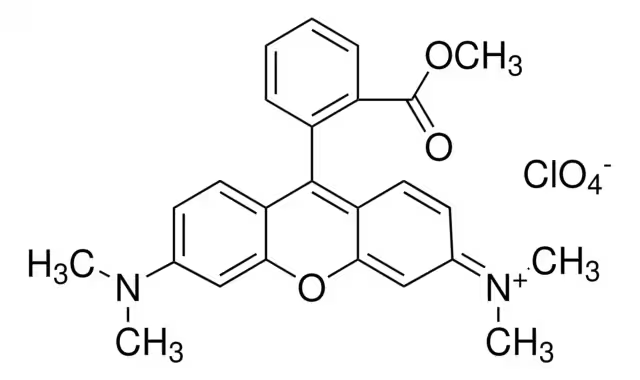
CAS Number115532-50-8
Synonyms6-(Dimethylamino)-9-[2-(methoxycarbonyl)phenyl]-N,N-dimethyl-3H-xanthen-3-iminium perchlorate; TMRM [Tetramethylrhodamine,methyl ester,perchlorate]; [6-(dimethylamino)-9-(2-methoxycarbonylphenyl)xanthen-3-ylidene]-dimethylazanium,perchlorate; MFCD00274460; TMRM Perchlorate
Molecular FormulaC25H25N2O3 · ClO4
Molecular Weight500.93
Purity≥95%
Melting Point274-276℃
Appearancepowder
Symbol
Signal WordWarning
| Chemical & Physical Properties | |
|---|---|
| CAS Number | 115532-50-8 |
| Catalog No. | 2A-9050934 |
| Chinese Name | 四甲基罗丹明甲酯高氯酸盐 |
| Synonyms | 6-(Dimethylamino)-9-[2-(methoxycarbonyl)phenyl]-N,N-dimethyl-3H-xanthen-3-iminium perchlorate; TMRM [Tetramethylrhodamine,methyl ester,perchlorate]; [6-(dimethylamino)-9-(2-methoxycarbonylphenyl)xanthen-3-ylidene]-dimethylazanium,perchlorate; MFCD00274460; TMRM Perchlorate |
| Molecular Formula | C25H25N2O3 · ClO4 |
| Molecular Weight | 500.93 |
| Purity | ≥95 |
| Melting Point | 274-276℃ |
| Appearance | powder |
| Storage Condition | Sealed, store at 2 ºC -8 ºC |
| Application | TMRM Perchlorate is a cell-permeable, cationic lipophilic red fluorescent dye (λex=530 nm, λem=592 nm). |
| PubChem ID | 24900280 |
| MDL Number | MFCD00274460 |
| SMILES | [O-]Cl(=O)(=O)=O.COC(=O)c1ccccc1C2=C3C=C\C(C=C3Oc4cc(ccc24)N(C)C)=[N+](\C)C |
| InChI | 1S/C25H25N2O3.ClHO4/c1-26(2)16-10-12-20-22(14-16)30-23-15-17(27(3)4)11-13-21(23)24(20)18-8-6-7-9-19(18)25(28)29-5;2-1(3,4)5/h6-15H,1-5H3;(H,2,3,4,5)/q+1;/p-1 |
| InChI Key | PFYWPQMAWCYNGW-UHFFFAOYSA-M |
| Beilstein/REAXYS | 7162165 |
| NACRES Code | NA.47 |
| UNSPSC | 12171500 |
| Hazard Symbols | transportation |
| MSDS | msds/50934_1_115532_50_8.pdf |
| Bioactivity | TMRM Perchlorate is a cell-permeant cationic lipophilic red fluorescent dye (λex=530 nm, λem=592 nm). Related Catalog Signaling Pathways >> Others >> Others Dye Reagents Research Areas >> Others In Vitro TMRM Perchlorate is a fluorescent probe (excitation, 530±21 nm; emission, 592±22 nm). The fluorescence signal in the presence of TMRM Perchlorate shows a slight decrease after the addition of glutamate, indicative of increased polarization of the mitochondrial inner membrane. In the presence of TMRM Perchlorate (2 μM) the coupled respiration with Complex I substrates or upon the addition of Complex II substrate is decreased by 27%[1]. Exposure of hippocampal cultures to low concentrations of TMRM Perchlorate (50 to 500 nM) for 1 to 3 hours results in selective staining of mitochondria in both neurons and the underlying glial cells. Exposure of hippocampal cultures to high concentrations of TMRM Perchlorate (1 to 25 µM) stains mitochondria selectively and quickly, reaching a plateau after 5 to 10 min. Low concentrations of TMRM Perchlorate (50 to 200 nM) do not induce apoptosis, whereas higher concentrations (0.5 and 2.5 µM) enhance apoptosis (KD = 500 nM)[2]. Cell Assay Cultures are exposed to Millipore-filtered solutions (0.22 µm) containing TMRM Perchlorate for 1 hr at 37°C (except the experiment involving different durations of exposure to TMRM Perchlorate). After treatment, solutions are removed and growth media reapplied under sterile conditions, and cultures are post-incubated for 18 hours at 37°C (except for the experiment involving analysis at different time points after exposure). Cells are then stained with 2 mg/mL bisbenzimide for 20 min at room temperature. Coverslips are subsequently washed in saline and imaged using 2P microscopy. Apoptotic cells are identified as brightly fluorescent nuclei under UV excitation indicating DNA fragmentation. Cell survivability is calculated as the percentage of live, unstained cells (±SD) in five microscopic fields per treatment[1]. References [1]. Chowdhury SR, et al. Simultaneous evaluation of substrate-dependent oxygen consumption rates and mitochondrial membrane potential by TMRM and safranin in cortical mitochondria. Biosci Rep. 2015 Dec 8;36(1):e00286. [2]. Monteith A, et al. Imaging of mitochondrial and non-mitochondrial responses in cultured rat hippocampal neurons exposed to micromolar concentrations of TMRM. PLoS One. 2013;8(3):e58059. Chemical & Physical Properties Melting Point 274-276℃ Molecular Formula C25H25ClN2O7 Molecular Weight 500.928 Exact Mass 500.135040 PSA 119.96000 LogP 4.30330 |
| Use of | TMRM Perchlorate is a cell-permeant cationic lipophilic red fluorescent dye (λex=530 nm, λem=592 nm). Properties Articles156 Name Tetramethylrhodamine methyl ester perchlorate Synonym More Synonyms TMRM Perchlorate Biological Activity Description TMRM Perchlorate is a cell-permeant cationic lipophilic red fluorescent dye (λex=530 nm, λem=592 nm). Related Catalog Signaling Pathways >> Others >> Others Dye Reagents Research Areas >> Others References [1]. Chowdhury SR, et al. Simultaneous evaluation of substrate-dependent oxygen consumption rates and mitochondrial membrane potential by TMRM and safranin in cortical mitochondria. Biosci Rep. 2015 Dec 8;36(1):e00286. [2]. Monteith A, et al. Imaging of mitochondrial and non-mitochondrial responses in cultured rat hippocampal neurons exposed to micromolar concentrations of TMRM. PLoS One. 2013;8(3):e58059. Chemical & Physical Properties Exact Mass 500.135040 PSA 119.96000 LogP 4.30330 |
| Transport Info | Product name: Purity: 98.0% |
| MSDS Transport Info | Module 14. Shipping information 14.1 UN dangerous goods number European Land Transport Dangerous Regulations: -International Maritime Dangerous Regulations: -International Air Transport Dangerous Regulations: - 14.2 Names specified by the United Nations (UN) European Land Transport Dangerous Regulations: Non-dangerous goods IMDG Code: Non-dangerous goods International air transport dangerous goods regulations: non-dangerous goods 14.3 Transport hazard categories European Land Transport Dangerous Regulations: -International Maritime Dangerous Regulations: -International Air Transport Dangerous Regulations: - 14.4 Package group European Land Transport Dangerous Regulations: -International Maritime Dangerous Regulations: -International Air Transport Dangerous Regulations: - 14.5 Environmental hazards European Land Transport Dangerous Regulations: No International Maritime Transport Dangerous Regulations Maritime Pollutants: No International Air Transport Risk Regulations: No 14.6 Special reminder to users No data available |
| Related Products in Pigments & Additives | ||
|---|---|---|
| Disperse Blue 367 | 105076-77-5 | 2A-9050159 |
| Disperse Blue 301 | 105635-65-2 | 2A-9050207 |
| Neurodye RH 421 | 107610-19-5 | 2A-9050356 |
| Dihydrorhodamine | 109244-58-8 | 2A-9050449 |
| Tetramethylrhodamine-4-iodoacetamide | 114458-99-0 | 2A-9050829 |
| Tetramethylrhodamine ethyl ester perchlorate | 115532-52-0 | 2A-9050935 |
| Pigment Red 255 | 120500-90-5 | 2A-9051349 |
| Fluorescent Brightener 90-1 | 120797-63-9 | 2A-9051375 |
| Pigment Yellow 191 | 129423-54-7 | 2A-9051966 |
| Reactive Yellow 160 | 129898-77-7 | 2A-9051998 |
| Browse all Pigments & Additives products » | ||
Phone:
630-322-8886
630-322-8887
Email:
Office Locations:
Chicago, IL, USA
San Francisco, CA, USA


 EN
EN


 SDS
SDS