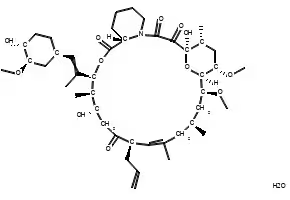
CAS Number109581-93-3
SynonymsTacroliMus Monohydrate; TACROLIMUS; Tacrolimus (monohydrate)
Molecular FormulaC44H71NO13
Molecular Weight822.033
Purity98.00%
Boiling Point871.7ºC at 760 mmHg
Melting Point127-129°
AppearanceSolid;White to Almost white powder to crystal
Symbol
Signal WordWarning
| Chemical & Physical Properties | |
|---|---|
| CAS Number | 109581-93-3 |
| Catalog No. | 2A-9050463 |
| Chinese Name | 他克莫司 |
| Synonyms | TacroliMus Monohydrate; TACROLIMUS; Tacrolimus (monohydrate) |
| Molecular Formula | C44H71NO13 |
| Molecular Weight | 822.033 |
| Purity | 98.00 |
| Boiling Point | 871.7ºC at 760 mmHg |
| Melting Point | 127-129° |
| Appearance | Solid;White to Almost white powder to crystal |
| Water Solubility | Water solubility: insoluble; soluble in: acetone, |
| Storage Condition | <0°C; avoid heating |
| Packaging | III |
| Application | Tacrolimus monohydrate binds to FK506-binding protein (FKBP) to form a complex that inhibits calcineurin (PP2B). Tacrolimus monohydrate is an mTOR-independent autophagy inducer. |
| SMILES | C=CCC1C=C(C)CC(C)CC(OC)C2OC(O)(C(=O)C(=O)N3CCCCC3C(=O)OC(C(C)=CC3CCC(O)C(OC)C3)C(C)C(O)CC1=O)C(C)CC2OC.O |
| InChI Key | NWJQLQGQZSIBAF-XIPCPWKASA-N |
| Hazard Symbols | transportation |
| MSDS | msds/50463_1_109581_93_3.pdf |
| Bioactivity | Tacrolimus monohydrate binds to FK506 binding protein (FKBP). This complex inhibits calcineurin phosphatase (PP2B). Tacrolimus monohydrate is a mTOR-independent autophagy inducer. Related Catalog Signaling Pathways >> Autophagy >> Autophagy Research Areas >> Inflammation/Immunology Target PP2B (calcineurin phosphatase)[1] Autophagy inducer[2] In Vitro Tacrolimus (FK506) inhibits calcium-dependent events, such as IL-2 gene transcription, NO synthase activation, cell degranulation, and apoptosis. Tacrolimus also potentiates the actions of glucocorticoids and progesterone by binding to FKBPs contained within the hormone receptor complex, preventing degradation. The agent may enhance expression of the TGFβ-1 gene in a fashion analogous to that demonstrated for CsA. T cell proliferation in response to ligation of the T cell receptor is inhibited by Tacrolimus[1]. Treatment with a low concentration of Tacrolimus (FK506,10 μg/L) does not significantly affect the proliferation of MH3924A cells (P=0.135). Upon treatment with higher concentrations of Tacrolimus (100-1,000 μg/L), the proliferation of MH3924A cells is significantly enhanced (P<0.01). Treatment with AMD3100 at any concentration (10, 50 or 100 μg/L), has no obvious effect on MH3924A cell proliferation (P>0.05). However, when different concentrations of AMD3100 are combined with 100 μg/L Tacrolimus, the in vitro proliferation of MH3924A cells is increased (P<0.01)[3]. In Vivo The therapeutic effect of Tacrolimus is investigated on progression and perpetuation of colitis by administering Tacrolimus to Dextran sulfate sodium (DSS)-treated mice from Days 10 to 16 or to 23. At Days 17 and 24, colon length is significantly shortened, and colon weight is significantly higher in DSS-treated control animals than in normal animals. In addition, colon weight per unit length in the control group is more than twice that in the normal group. While both 7 and 14 d treatment with Tacrolimus significantly suppresses increases in colon weight per unit length in DSS-treated animals compared with the control group, this treatment does not actually restore the colon shortening. In addition, this inhibitory effect of Tacrolimus on increases in colon weight per unit length is more pronounced with 14-d than 7-d treatment, as shown by the inhibitory percentages (59% vs. 28%)[4]. Cell Assay Tumor cell proliferation is determined by the MTT assay. Briefly, after MH3924A cells have reached the logarithmic growth phase, a 0.2-mL cell suspension at 1×10⁴ cells/mL is added into each well of a 96-well plate and cultured in DMEM with 10% FBS, 10 μg/L vascular endothelial growth factor and 0.1 g/L heparin for 24 h. When adherent growth is established, different concentrations of Tacrolimus (10, 100 and 1,000 μg/L) , AMD3100 (10, 50 and 100 μg/L) and Tacrolimus (0 and 100 μg/L)+AMD3100 (0, 10, 50 and 100 μg/L) are added into the plates. Untreated cells cultured in medium alone are used as controls. After culturing for 48 h, 10 μL MTT (5 g/L) are added, and each well is incubated for 6 h; next, 150 μL/well DMSO are added, followed by measurements of the absorbance at 570 mm on a spectrophotometer reader. Each well is measured three times, and each sample is assayed in triplicate[3]. Animal Admin Mice[4] Six-week-old male C57BL/6J mice are maintained in a temperature- and humidity-controlled room with a 12-h light-dark cycle. For the multiple dosing study, colitic mice (n=10) are orally administered Tacrolimus at 30 mg/kg for 7 d (Days 10 to 16) or 14 d (Days 10 to 23). Control (n=10) and normal groups (n=5) are administered placebo using the same regimen. Tacrolimus or placebo is administered at 10 mL/kg. Mice are euthanized by CO2 inhalation on the day following the final dosing. For the single dosing study, colitic mice are orally administered Tacrolimus at 30 mg/kg or placebo (n=8) once on Day 7, 10, 17, or 24. Normal mice (n=4) are administered placebo using the same regimen. Mice are euthanized by CO2 inhalation eight hours after dosing[4]. References [1]. Thomson AW, et al. Mode of action of Tacrolimus (FK506): molecular and cellular mechanisms. Ther Drug Monit. 1995 Dec;17(6):584-91. [2]. Vogel KR, et al. mTOR inhibitors rescue premature lethality and attenuate dysregulation of GABAergic/glutamatergic transcription in murine succinate semialdehyde dehydrogenase deficiency (SSADHD), a disorder of GABA metabolism. J Inherit Metab Dis. 2016 Nov;39(6):877-886. [3]. Zhu H, et al. Tacrolimus promotes hepatocellular carcinoma and enhances CXCR4/SDF 1α expression in vivo. Mol Med Rep. 2014 Aug;10(2):585-92. [4]. Okada Y, et al. Tacrolimus ameliorates dextran sulfate sodium-induced colitis in mice: implication of interferon-γ and interleukin-1β suppression. Biol Pharm Bull. 2011;34(12):1823-7. Chemical & Physical Properties Boiling Point 871.7ºC at 760 mmHg Melting Point 127-129° Molecular Formula C44H71NO13 Molecular Weight 822.033 Flash Point 481ºC Exact Mass 821.492554 PSA 187.59000 LogP 4.51260 Vapour Pressure 1.73E-35mmHg at 25°C InChIKey NWJQLQGQZSIBAF-XIPCPWKASA-N SMILES C=CCC1C=C(C)CC(C)CC(OC)C2OC(O)(C(=O)C(=O)N3CCCCC3C(=O)OC(C(C)=CC3CCC(O)C(OC)C3)C(C)C(O)CC1=O)C(C)CC2OC.O |
| Use of | Tacrolimus monohydrate binds to FK506 binding protein (FKBP). This complex inhibits calcineurin phosphatase (PP2B). Tacrolimus monohydrate is a mTOR-independent autophagy inducer. Properties Articles242 Name Tacrolimus Monohydrate Synonym More Synonyms Tacrolimus Biological Activity Description Tacrolimus monohydrate binds to FK506 binding protein (FKBP). This complex inhibits calcineurin phosphatase (PP2B). Tacrolimus monohydrate is a mTOR-independent autophagy inducer. Related Catalog Signaling Pathways >> Autophagy >> Autophagy Research Areas >> Inflammation/Immunology PP2B (calcineurin phosphatase)[1] Autophagy inducer[2] In Vivo The therapeutic effect of Tacrolimus is investigated on progression and perpetuation of colitis by administering Tacrolimus to Dextran sulfate sodium (DSS)-treated mice from Days 10 to 16 or to 23. At Days 17 and 24, colon length is significantly shortened, and colon weight is significantly higher in DSS-treated control animals than in normal animals. In addition, colon weight per unit length in the control group is more than twice that in the normal group. While both 7 and 14 d treatment with Tacrolimus significantly suppresses increases in colon weight per unit length in DSS-treated animals compared with the control group, this treatment does not actually restore the colon shortening. In addition, this inhibitory effect of Tacrolimus on increases in colon weight per unit length is more pronounced with 14-d than 7-d treatment, as shown by the inhibitory percentages (59% vs. 28%)[4]. References [1]. Thomson AW, et al. Mode of action of Tacrolimus (FK506): molecular and cellular mechanisms. Ther Drug Monit. 1995 Dec;17(6):584-91. [2]. Vogel KR, et al. mTOR inhibitors rescue premature lethality and attenuate dysregulation of GABAergic/glutamatergic transcription in murine succinate semialdehyde dehydrogenase deficiency (SSADHD), a disorder of GABA metabolism. J Inherit Metab Dis. 2016 Nov;39(6):877-886. [4]. Okada Y, et al. Tacrolimus ameliorates dextran sulfate sodium-induced colitis in mice: implication of interferon-γ and interleukin-1β suppression. Biol Pharm Bull. 2011;34(12):1823-7. Chemical & Physical Properties Molecular Formula C44H71NO13 Exact Mass 821.492554 PSA 187.59000 LogP 4.51260 InChIKey NWJQLQGQZSIBAF-XIPCPWKASA-N |
| Transport Info | Shipping Name: UN |
| MSDS Transport Info | Module 14. Shipping information 14.1 UN dangerous goods number European Dangerous Regulations for land transport: 2811 International Dangerous Regulations for sea transport: 2811 International Dangerous Regulations for air transport: 2811 14.2 United Nations shipping name European Land Transport Dangerous Regulations: TOXIC SOLID, ORGANIC, N.O.S. (FK-506 monohydrate) IMDG: TOXIC SOLID, ORGANIC, N.O.S. (FK-506 monohydrate) International air transport hazard regulations: Toxic solid, organic, n.o.s. (FK-506 monohydrate) 14.3 Transport hazard categories European Land Transport Danger Regulations: 6.1 International Maritime Transport Danger Regulations: 6.1 International Air Transport Danger Regulations: 6.1 14.4 Package group European Land Transport Danger Regulations: III International Maritime Transport Danger Regulations: III International Air Transport Danger Regulations: III 14.5 Environmental hazards European Land Transport Danger Regulations: No International Maritime Danger Regulations International Air Transport Danger Regulations: No Marine pollutants (yes/no): No 14.6 Special reminder to users No data available The above information is believed to be correct, but is not all-inclusive and should be used as a guide only. The information in this document is based on our current knowledge and is Correct safety instructions apply to this product. This information does not represent a warranty as to the properties of this product. See reverse side of invoice or packing slip. |
| Related Products in API & Advanced Intermediates | ||
|---|---|---|
| Norfloxacin hydrochloride | 104142-93-0 | 2A-9050081 |
| Pramipexole dihydrochloride | 104632-25-9 | 2A-9050128 |
| Mometasone | 105102-22-5 | 2A-9050161 |
| Pioglitazone | 105355-27-9 | 2A-9050183 |
| Cefepime sulfate | 107648-78-2 | 2A-9050357 |
| Donepezil hydrochloride | 110119-84-1 | 2A-9050494 |
| Quetiapine fumarate | 111974-72-2 | 2A-9050611 |
| Enrofloxacin hydrochloride | 112732-17-9 | 2A-9050675 |
| Docetaxel intermediate | 114915-14-9 | 2A-9050885 |
| Mycophenolate mofetil | 115007-34-6 | 2A-9050893 |
| Browse all API & Advanced Intermediates products » | ||
Phone:
630-322-8886
630-322-8887
Email:
Office Locations:
Chicago, IL, USA
San Francisco, CA, USA


 EN
EN


 SDS
SDS