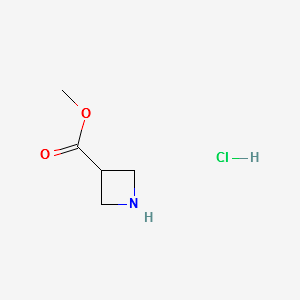
CAS Number100202-39-9
SynonymsAzetidine-3-carboxylic Acid Methyl Ester Hydrochloride; 3-Azetidinecarboxylic acid, methyl ester, hydrochloride (1:1); Methyl 3-azetidinecarboxylate hydrochloride (1:1); Methyl Azetidine-3-carboxylate Hydrochloride; Methyl 3-azetidinecarboxylate hydrochloride; Methyl azetidine-3-carboxylate hydrochloride (1:1); methyl azetidine-3-carboxylate,hydrochloride; methylazetidine-3-carboxylatehydrochloride
Molecular FormulaC5H10ClNO2
Molecular Weight151.59
Purity98.00%
Boiling Point190.9ºC at 760 mmHg
Melting Point93.0 to 97.0 °C
AppearanceSolid;White to Almost white powder to crystal
| Chemical & Physical Properties | |
|---|---|
| CAS Number | 100202-39-9 |
| Catalog No. | 2A-9049696 |
| Chinese Name | 氮杂环丁烷-3-甲酸甲酯盐酸盐 |
| Synonyms | Azetidine-3-carboxylic Acid Methyl Ester Hydrochloride; 3-Azetidinecarboxylic acid, methyl ester, hydrochloride (1:1); Methyl 3-azetidinecarboxylate hydrochloride (1:1); Methyl Azetidine-3-carboxylate Hydrochloride; Methyl 3-azetidinecarboxylate hydrochloride; Methyl azetidine-3-carboxylate hydrochloride (1:1); methyl azetidine-3-carboxylate,hydrochloride; methylazetidine-3-carboxylatehydrochloride |
| Molecular Formula | C5H10ClNO2 |
| Molecular Weight | 151.59 |
| Purity | 98.00 |
| Boiling Point | 190.9ºC at 760 mmHg |
| Melting Point | 93.0 to 97.0 °C |
| Appearance | Solid;White to Almost white powder to crystal |
| Water Solubility | Water solubility: soluble |
| Storage Condition | Store under inert gas; avoid moisture (hygroscopic |
| Application | Azetidine-3-carboxylic acid methyl ester hydrochloride is a non-cleavable ADC linker used in the synthesis of antibody-drug conjugates (ADCs). Nitrogen mustard-3-carboxylic acid methyl ester hydrochlo |
| HTC | 2933990090 |
| PubChem ID | 34858047 |
| SMILES | COC(=O)C1CNC1.Cl |
| InChI | InChI=1S/C5H9NO2.ClH/c1-8-5(7)4-2-6-3-4;/h4,6H,2-3H2,1H3;1H |
| InChI Key | UOCWTLBPYROHEF-UHFFFAOYSA-N |
| Bioactivity | Methyl azetidine-3-carboxylate hydrochloride is a non-cleavable ADC linker used in the synthesis of antibody-drug conjugates (ADCs). Methyl azetidine-3-carboxylate hydrochloride is also a alkyl chain-based PROTAC linker that can be used in the synthesis of PROTACs< Related Catalog Research Areas >> Cancer Signaling Pathways >> Antibody-drug Conjugate >> ADC Linker Signaling Pathways >> PROTAC >> PROTAC Linker Target Non-cleavable In Vitro ADCs are comprised of an antibody to which is attached an ADC cytotoxin through an ADC linker[1]. PROTACs contain two different ligands connected by a linker; one is a ligand for an E3 ubiquitin ligase and the other is for the target protein. PROTACs exploit the intracellular ubiquitin-proteasome system to selectively degrade target proteins[2]. References [1]. Beck A, et al. Strategies and challenges for the next generation of antibody-drug conjugates. Nat Rev Drug Discov. 2017;16(5):315-337. [2]. Nalawansha DA, et al. PROTACs: An Emerging Therapeutic Modality in Precision Medicine. Cell Chem Biol. 2020;27(8):998-985. Chemical & Physical Properties Boiling Point 190.9ºC at 760 mmHg Melting Point 93.0 to 97.0 °C Molecular Formula C5H10ClNO2 Molecular Weight 151.591 Flash Point 69.3ºC Exact Mass 151.040009 PSA 38.33000 LogP 0.50960 InChIKey UOCWTLBPYROHEF-UHFFFAOYSA-N SMILES COC(=O)C1CNC1.Cl |
| Use of | Methyl azetidine-3-carboxylate hydrochloride is a non-cleavable ADC linker used in the synthesis of antibody-drug conjugates (ADCs). Methyl azetidine-3-carboxylate hydrochloride is also a alkyl chain-based PROTAC linker that can be used in the synthesis of PROTACs< Properties Name Methyl azetidine-3-carboxylate hydrochloride Synonym More Synonyms Biological Activity Description Methyl azetidine-3-carboxylate hydrochloride is a non-cleavable ADC linker used in the synthesis of antibody-drug conjugates (ADCs). Methyl azetidine-3-carboxylate hydrochloride is also a alkyl chain-based PROTAC linker that can be used in the synthesis of PROTACs< Related Catalog Research Areas >> Cancer Signaling Pathways >> Antibody-drug Conjugate >> ADC Linker Signaling Pathways >> PROTAC >> PROTAC Linker Non-cleavable In Vitro ADCs are comprised of an antibody to which is attached an ADC cytotoxin through an ADC linker[1]. PROTACs contain two different ligands connected by a linker; one is a ligand for an E3 ubiquitin ligase and the other is for the target protein. PROTACs exploit the intracellular ubiquitin-proteasome system to selectively degrade target proteins[2]. References [1]. Beck A, et al. Strategies and challenges for the next generation of antibody-drug conjugates. Nat Rev Drug Discov. 2017;16(5):315-337. [2]. Nalawansha DA, et al. PROTACs: An Emerging Therapeutic Modality in Precision Medicine. Cell Chem Biol. 2020;27(8):998-985. Chemical & Physical Properties Exact Mass 151.040009 PSA 38.33000 LogP 0.50960 InChIKey UOCWTLBPYROHEF-UHFFFAOYSA-N |
| Tax Rebate | 13.0% |
| Supervision | None. MFN tariff: 6.5%. Ordinary tariff: 20.0% |
| Transport Info | Product name: Purity: 98.0% |
| MSDS Transport Info | Module 14. Shipping information United Nations classification: inconsistent with United Nations classification standards UN number: not specified |
| Related Products in Heterocyclic Building Blocks | ||
|---|---|---|
| 4-Amino-2-methylquinoline-6-carboxylic acid | 99984-73-3 | 2A-9049677 |
| 4-Aminopyridine-2-carboxylic acid | 100047-36-7 | 2A-0202234 |
| 1-Methyl-6-oxo-1,6-dihydropyridazine-3-carboxylic acid | 100047-66-3 | 2A-9049681 |
| 5-Methyl-2-(methylthio)pyrimidine | 100114-24-7 | 2A-9049686 |
| 6-Methyl-3-pyridineethanol | 100189-17-1 | 2A-9049694 |
| Quinoline Yellow | 100208-62-6 | 2A-9049697 |
| 2-Acetamido-5-fluoropyridine | 100304-88-9 | 2A-9049703 |
| 4-(Benzylamino)-3-nitropyridine | 100306-70-5 | 2A-9049705 |
| N-tert-Butyl-2-thiophenesulfonamide | 100342-30-1 | 2A-9049707 |
| 4-Bromo-2-methoxypyridine | 100367-39-3 | 2A-9049711 |
| Browse all Heterocyclic Building Blocks products » | ||
Phone:
630-322-8886
630-322-8887
Email:
Office Locations:
Chicago, IL, USA
San Francisco, CA, USA


 EN
EN


 SDS
SDS