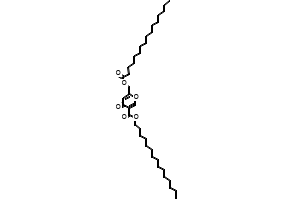
CAS Number79725-98-7
Synonyms(5-hexadecanoyloxy-4-oxopyran-2-yl)methyl hexadecanoate; 6-[(hexadecanoyloxy)methyl]-4-oxo-4H-pyran-3-yl hexadecanoate; 4-Oxo-6-[(palmitoyloxy)methyl]-4H-pyran-3-yl palmitate; MFCD03840587; Hexadecanoic acid, 4-oxo-6-[[(1-oxohexadecyl)oxy]methyl]-4H-pyran-3-yl ester; EINECS 207-922-4
Molecular FormulaC38H66O6
Molecular Weight618.94
Purity98.00%
Density1.0±0.1 g/cm3
Boiling Point684.7±55.0 °C at 760 mmHg
Melting Point92-96ºC
AppearanceWhite to off-white crystalline powder
| Chemical & Physical Properties | |
|---|---|
| CAS Number | 79725-98-7 |
| Catalog No. | 2A-9048379 |
| Chinese Name | 曲酸双棕榈酸酯 |
| Synonyms | (5-hexadecanoyloxy-4-oxopyran-2-yl)methyl hexadecanoate; 6-[(hexadecanoyloxy)methyl]-4-oxo-4H-pyran-3-yl hexadecanoate; 4-Oxo-6-[(palmitoyloxy)methyl]-4H-pyran-3-yl palmitate; MFCD03840587; Hexadecanoic acid, 4-oxo-6-[[(1-oxohexadecyl)oxy]methyl]-4H-pyran-3-yl ester; EINECS 207-922-4 |
| Molecular Formula | C38H66O6 |
| Molecular Weight | 618.94 |
| Purity | 98.00 |
| Density | 1.0±0.1 g/cm3 |
| Boiling Point | 684.7±55.0 °C at 760 mmHg |
| Melting Point | 92-96ºC |
| Appearance | White to off-white crystalline powder |
| Storage Condition | room temperature, dry |
| Application | Kojic dipalmitate is a derivative of kojic acid (HY-W050154), a fungal metabolite produced by Aspergillus, Acetobacter and Penicillium. Kojic acid dipalmitate is a slow and reversible competitive inhi |
| HTC | 2915709000 |
| PubChem ID | 56486885 |
| MDL Number | MFCD03840587 |
| InChI | InChI=1S/C38H66O6/c1-3-5-7-9-11-13-15-17-19-21-23-25-27-29-37(40)43-32-34-31-35(39)36(33-42-34)44-38(41)30-28-26-24-22-20-18-16-14-12-10-8-6-4-2/h31,33H,3-30,32H2,1-2H3 |
| InChI Key | SGEADTGIZKXPIP-UHFFFAOYSA-N |
| MSDS | msds/48379_1_79725_98_7.pdf |
| Bioactivity | Kojic acid dipalmitate (Kojic dipalmitate) is a derivative of Kojic acid (HY-W050154), a fungal metabolite that can be produced by species of Aspergillus, Acetobacter and Penicillium. Kojic acid dipalmitate is a slow and reversible competitive inhibitor of tyrosinase. Kojic acid dipalmitate can be used for skin-lightening agent research[1]. Related Catalog Research Areas >> Endocrinology Signaling Pathways >> Metabolic Enzyme/Protease >> Tyrosinase In Vitro Kojic acid dipalmitate can effectively inhibit tyrosinase activity in the skin, thereby inhibiting melanin formation. Kojic acid dipalmitate is more effective than Kojic Acid (HY-W050154) [1]. References [1]. Madhogaria S, et al. Leucoderma after use of a skin-lightening cream containing kojic dipalmitate, liquorice root extract and Mitracarpus scaber extract. Clin Exp Dermatol. 2010 Jun;35(4):e103-5. Chemical & Physical Properties Density 1.0±0.1 g/cm3 Boiling Point 684.7±55.0 °C at 760 mmHg Melting Point 92-96ºC Molecular Formula C38H66O6 Molecular Weight 618.927 Flash Point 273.9±31.5 °C Exact Mass 618.485962 PSA 82.81000 LogP 15.30 Vapor Pressure 0.0±2.1 mmHg at 25°C Index of Refraction 1.492 |
| Use of | Kojic acid dipalmitate (Kojic dipalmitate) is a derivative of Kojic acid (HY-W050154), a fungal metabolite that can be produced by species of Aspergillus, Acetobacter and Penicillium. Kojic acid dipalmitate is a slow and reversible competitive inhibitor of tyrosinase. Kojic Acid Dipalmitate Synonym More Synonyms Kojic acid dipalmitate Biological Activity Description Kojic acid dipalmitate (Kojic dipalmitate) is a derivative of Kojic acid (HY-W050154), a fungal metabolite that can be produced by species of Aspergillus, Acetobacter and Penicillium. Kojic acid dipalmitate is a slow and reversible competitive inhibitor of tyrosinase. Kojic acid dipalmitate can be used for skin‐lightening agent research[1]. Related Catalog Research Areas >> Endocrinology Signaling Pathways >> Metabolic Enzyme/Protease >> Tyrosinase In Vitro Kojic acid dipalmitate can effectively inhibit tyrosinase activity in the skin, thereby inhibiting melanin formation. Kojic acid dipalmitate is more effective than Kojic Acid (HY-W050154) [1]. References [1]. Madhogaria S, et al. Leucoderma after use of a skin-lightening cream containing kojic dipalmitate, liquorice root extract and Mitracarpus scaber extract. Clin Exp Dermatol. 2010 Jun;35(4):e103-5. Chemical & Physical Properties Molecular Formula C38H66O6 Exact Mass 618.485962 PSA 82.81000 LogP 15.30 Index of Refraction 1.492 |
| Tax Rebate | 13.0% |
| Supervision | None. MFN tariff: 6.5%. Ordinary tariff: 20.0% |
| Transport Info | Product name: Purity: 0.0% |
| MSDS Transport Info | Module 14. Shipping information United Nations classification: inconsistent with United Nations classification standards UN number: not specified |
| Related Products in Active Ingredients | ||
|---|---|---|
| Hyaluronic acid | 9004-61-9 | 2A-9034424 |
| Sodium hyaluronate | 9067-32-7 | 2A-0200211 |
| Deoxyarbutin | 53936-56-4 | 2A-9044083 |
| Avobenzone | 70356-09-1 | 2A-9047153 |
| UV absorber-928 | 73936-91-1 | 2A-9047677 |
| Ceramides | 100403-19-8 | 2A-9049720 |
| Argireline | 616204-22-9 | 2A-9057720 |
| dehydroretinol | 79-80-1 | 2A-9060131 |
| N-LIGNOCEROYL-D-SPHINGOSINE 1-BENZOATE | 123446-98-0 | 2A-9060523 |
| all-trans 3-Hydroxyretinol | 6890-93-3 | 2A-9060652 |
| Browse all Active Ingredients products » | ||
Phone:
630-322-8886
630-322-8887
Email:
Office Locations:
Chicago, IL, USA
San Francisco, CA, USA


 EN
EN


 SDS
SDS