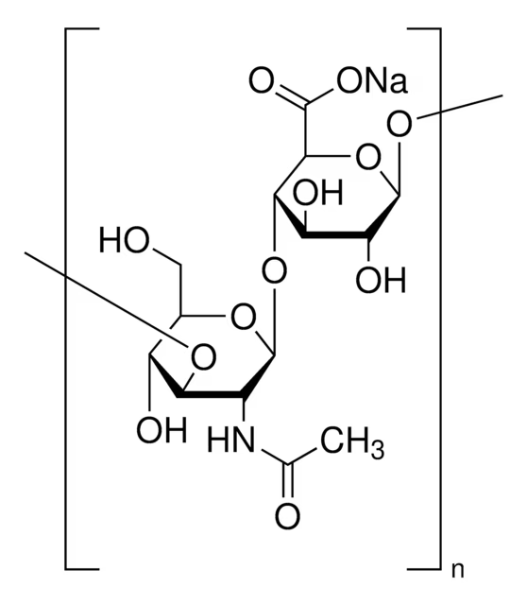
CAS Number9067-32-7
SynonymsMFCD00875848; Sodium 4-O-(2-acetamido-2,3-dideoxy-β-D-ribo-hexopyranosyl)-β-D-glucopyranuronate; hyaluronic acid sodium salt; EINECS 232-678-0
Molecular FormulaC14H22NNaO11
Molecular Weight799.63800
Purity98%
Density1.78g/cm3
Boiling Point791.6ºC
Appearancesolid
Symbol
Signal WordWarning
| Chemical & Physical Properties | |
|---|---|
| CAS Number | 9067-32-7 |
| Catalog No. | 2A-0200211 |
| Chinese Name | 透明质酸钠 |
| Synonyms | MFCD00875848; Sodium 4-O-(2-acetamido-2,3-dideoxy-β-D-ribo-hexopyranosyl)-β-D-glucopyranuronate; hyaluronic acid sodium salt; EINECS 232-678-0 |
| Molecular Formula | C14H22NNaO11 |
| Molecular Weight | 799.63800 |
| Purity | 98 |
| Density | 1.78g/cm3 |
| Boiling Point | 791.6ºC |
| Appearance | solid |
| Water Solubility | SOLUBLE |
| Storage Condition | -20°C sealed, protected from light, ventilated and |
| Application | Hyaluronic acid sodium salt is a biopolymer composed of repeating units of disaccharides and has a wide range of applications. |
| HTC | 3913900000 |
| SMILES | [Na+].CC(=O)N[C@H]1[C@H](O)O[C@H](CO)[C@@H](O)[C@@H]1O[C@@H]2O[C@@H]([C@@H](O[C@@H]3O[C@H](CO)[C@@H](O)[C@H](O[C@@H]4O[C@@H]([C@@H](O)[C@H](O)[C@H]4O)C(O)=O)[C@H]3NC(C)=O)[C@H](O)[C@H]2O)C(O)=O |
| InChI | InChI=1S/C28H44N2O23.Na/c1-5(33)29-9-18(11(35)7(3-31)47-25(9)46)49-28-17(41)15(39)20(22(53-28)24(44)45)51-26-10(30-6(2)34)19(12(36)8(4-32)48-26)50-27-16(40)13(37)14(38)21(52-27)23(42)43;/h7-22,25-28,31-32,35-41,46H,3-4H2,1-2H3,(H,29,33)(H,30,34)(H,42,43)(H,44,45);/q;+1/t7-,8-,9-,10-,11-,12-,13+,14+,15-,16-,17-,18-,19-,20+,21+,22+,25-,26+,27-,28-;/m1./s1 |
| InChI Key | InChIKey=YWIVKILSMZOHHF-QJZPQSOGSA-N |
| Hazard Symbols | transportation |
| Safety Description | S22;S24/25 |
| Bioactivity | Hyaluronic acid sodium salt is a biopolymer composed of repeating units of disaccharides with various applications. Related Catalog Signaling Pathways >> Others >> Others Natural Products >> Saccharides and Glycosides Research Areas >> Cancer In Vitro Hyaluronic acid (HA) is widely used in aesthetic medicine due to its binding ability with a large number of water molecules. It improves tissue hydration and their resistance to mechanical damage. HA plays an important role in wound healing, ovulation, fertilization, signal transduction, and tumor physiology. HA is used in joint diseases such as osteoarthritis or rheumatoid arthritis. HA of a high molecular mass reduces the chemotaxis and migration of inflammatory cells which acts as a good barrier to the inflammatory process and protects against the effects of free radicals. HA is used in ophthalmology due to its lubricating properties for the corneal endothelium, and improves tissue hydration and cellular resistance to mechanical damage in aesthetic dermatology, and has marginal adverse effects. Several trials indicate its role in tumor markers, liver diseases, and in pharmaceuticals[1]. Hyaluronan plays an important role in cancer growth and metastasis. HA and HA fragment-tumor cell interaction could activate the downstream signaling pathways, promoting cell proliferation, adhesion, migration and invasion, and inducing angiogenesis, lymphangiogenesis, epithelial-mesenchymal transition, stem cell-like property, and chemoradioresistance in digestive cancers[2]. In Vivo The impact of applied intra-articular HA has been proven in many studies in animals. Studies on HA have shown that it promotes the synthesis of cartilage matrix, prevents its degradation, reduces inflammation, stimulates the synthesis of endogenous HA, and improves the resilience and moisture of cartilage[1]. High molecular size HA preparations, applied topically, promote healing of fresh skin wounds. They also promote the healing of venous leg ulcers and are useful in the management of chronic wounds[3]. References [1]. Salwowska NM, et al. Physiochemical properties and application of hyaluronic acid: a systematic review. J Cosmet Dermatol. 2016 Dec;15(4):520-526. [2]. Wu RL, et al. Hyaluronic acid in digestive cancers. J Cancer Res Clin Oncol. 2017 Jan;143(1):1-16. [3]. Kogan G, et al. Hyaluronic acid: a natural biopolymer with a broad range of biomedical and industrial applications. Biotechnol Lett. 2007 Jan;29(1):17-25. Chemical & Physical Properties Density 1.78g/cm3 Boiling Point 791.6ºC Molecular Formula C14H22NNaO11 Molecular Weight 799.63800 Flash Point 432.5ºC Exact Mass 799.22300 PSA 399.71000 Storage condition −20°C Stability Stable. Incompatible with strong oxidizing agents. Water Solubility SOLUBLE |
| Use of | Hyaluronic acid sodium salt is a biopolymer composed of repeating units of disaccharides with various applications. Properties Articles137 Name Sodium hyaluronate Synonym More Synonyms Sodium Hyaluronate Biological Activity Description Hyaluronic acid sodium salt is a biopolymer composed of repeating units of disaccharides with various applications. Related Catalog Signaling Pathways >> Others >> Others Natural Products >> Saccharides and Glycosides Research Areas >> Cancer In Vitro Hyaluronic acid (HA) is widely used in aesthetic medicine due to its binding ability with a large number of water molecules. It improves tissue hydration and their resistance to mechanical damage. HA plays an important role in wound healing, ovulation, fertilization, signal transduction, and tumor physiology. HA is used in joint diseases such as osteoarthritis or rheumatoid arthritis. HA of a high molecular mass reduces the chemotaxis and migration of inflammatory cells which acts as a good barrier to the inflammatory process and protects against the effects of free radicals. HA is used in ophthalmology due to its lubricating properties for the corneal endothelium, and improves tissue hydration and cellular resistance to mechanical damage in aesthetic dermatology, and has marginal adverse effects. Several trials indicate its role in tumor markers, liver diseases, and in pharmaceuticals[1]. Hyaluronan plays an important role in cancer growth and metastasis. HA and HA fragment-tumor cell interaction could activate the downstream signaling pathways, promoting cell proliferation, adhesion, migration and invasion, and inducing angiogenesis, lymphangiogenesis, epithelial-mesenchymal transition, stem cell-like property, and chemoradioresistance in digestive cancers[2]. In Vivo The impact of applied intra-articular HA has been proven in many studies in animals. Studies on HA have shown that it promotes the synthesis of cartilage matrix, prevents its degradation, reduces inflammation, stimulates the synthesis of endogenous HA, and improves the resilience and moisture of cartilage[1]. High molecular size HA preparations, applied topically, promote healing of fresh skin wounds. They also promote the healing of venous leg ulcers and are useful in the management of chronic wounds[3]. References [1]. Salwowska NM, et al. Physiochemical properties and application of hyaluronic acid: a systematic review. J Cosmet Dermatol. 2016 Dec;15(4):520-526. [2]. Wu RL, et al. Hyaluronic acid in digestive cancers. J Cancer Res Clin Oncol. 2017 Jan;143(1):1-16. [3]. Kogan G, et al. Hyaluronic acid: a natural biopolymer with a broad range of biomedical and industrial applications. Biotechnol Lett. 2007 Jan;29(1):17-25. Chemical & Physical Properties Molecular Formula C14H22NNaO11 Exact Mass 799.22300 PSA 399.71000 Stability Stable. Incompatible with strong oxidizing agents. Water Solubility SOLUBLE |
| Transport Info | Shipping Name: UN |
| MSDS Transport Info | Module 14. Shipping information 14.1 UN dangerous goods number European Land Transport Dangerous Regulations: -International Maritime Dangerous Regulations: -International Air Transport Dangerous Regulations: - 14.2 United Nations shipping name European Land Transport Dangerous Regulations: Non-dangerous goods IMDG Code: Non-dangerous goods International air transport dangerous goods regulations: non-dangerous goods 14.3 Transport hazard categories European Land Transport Dangerous Regulations: -International Maritime Dangerous Regulations: -International Air Transport Dangerous Regulations: - 14.4 Package group European Land Transport Dangerous Regulations: -International Maritime Dangerous Regulations: -International Air Transport Dangerous Regulations: - 14.5 Environmental hazards European Land Transport Danger Regulations: No International Maritime Danger Regulations International Air Transport Danger Regulations: No Marine pollutants (yes/no): No 14.6 Special reminder to users No data available |
| Related Products in Active Ingredients | ||
|---|---|---|
| Retinyl acetate | 127-47-9 | 2A-9020582 |
| Oxybenzone | 131-57-7 | 2A-9020675 |
| Arbutin | 497-76-7 | 2A-9022280 |
| Kojic acid | 501-30-4 | 2A-9022314 |
| Hyaluronic acid | 9004-61-9 | 2A-9034424 |
| Deoxyarbutin | 53936-56-4 | 2A-9044083 |
| Avobenzone | 70356-09-1 | 2A-9047153 |
| UV absorber-928 | 73936-91-1 | 2A-9047677 |
| Kojic acid dipalmitate | 79725-98-7 | 2A-9048379 |
| Ceramides | 100403-19-8 | 2A-9049720 |
| Browse all Active Ingredients products » | ||
Phone:
630-322-8886
630-322-8887
Email:
Office Locations:
Chicago, IL, USA
San Francisco, CA, USA


 EN
EN


 SDS
SDS