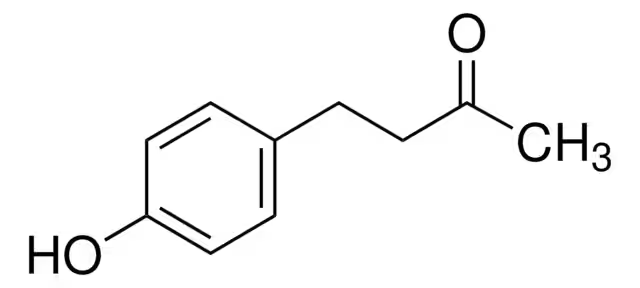
CAS Number5471-51-2
SynonymsOxyphenalon; 4-hydroxy benzyl acetone; Raspberry keton; 4-(4-Hydroxyphenyl)-2-butanone; Frambinone; Rheosmin; OXYPHENONE; OXYPHENYLON; Raspberry ketone; EINECS 226-806-4; RASBERRY KETONE; MFCD00002394; p-Hydroxy benzylacetone; FEMA 2588; OXANONE
Molecular FormulaHOC6H4CH2CH2COCH3
Molecular Weight164.20
Purity99%
Density1.1±0.1 g/cm3
Boiling Point292.2±15.0 °C at 760 mmHg
Melting Point81-85 °C (lit.)
Appearancesolid
EINECS226-806-4
Symbol
Signal WordWarning
| Chemical & Physical Properties | |
|---|---|
| CAS Number | 5471-51-2 |
| Catalog No. | 2A-9004810 |
| Chinese Name | 覆盆子酮 |
| Synonyms | Oxyphenalon; 4-hydroxy benzyl acetone; Raspberry keton; 4-(4-Hydroxyphenyl)-2-butanone; Frambinone; Rheosmin; OXYPHENONE; OXYPHENYLON; Raspberry ketone; EINECS 226-806-4; RASBERRY KETONE; MFCD00002394; p-Hydroxy benzylacetone; FEMA 2588; OXANONE |
| Molecular Formula | HOC6H4CH2CH2COCH3 |
| Molecular Weight | 164.20 |
| Purity | 99 |
| Density | 1.1±0.1 g/cm3 |
| Boiling Point | 292.2±15.0 °C at 760 mmHg |
| Melting Point | 81-85 °C (lit.) |
| Appearance | solid |
| Storage Condition | Store at room temperature, away from light, in a c |
| Application | Raspberry ketone is the main aromatic compound in raspberries and is mainly used as a spice in cosmetics and food flavor enhancer; it also acts as an agonist of PPAR-α. |
| EINECS | 226-806-4 |
| HTC | 2914501100 |
| PubChem ID | 24850752 |
| MDL Number | MFCD00002394 |
| SMILES | CC(=O)CCc1ccc(O)cc1 |
| InChI | 1S/C10H12O2/c1-8(11)2-3-9-4-6-10(12)7-5-9/h4-7,12H,2-3H2,1H3 |
| InChI Key | NJGBTKGETPDVIK-UHFFFAOYSA-N |
| Beilstein/REAXYS | 776080 |
| NACRES Code | NA.22 |
| UNSPSC | 12352100 |
| Hazard Symbols | Transport |
| Risk Codes | R22 |
| MSDS | msds/4810_1_5471_51_2.pdf |
| Bioactivity | Raspberry ketone is a major aromatic compound of red raspberry, widely used as a fragrance in cosmetics and as a flavoring agent in foodstuff; also shows PPAR-α agonistic activity. Related Catalog Research Areas >> Metabolic Disease Natural Products >> Phenols Research Areas >> Cardiovascular Disease Target PPAR-α In Vitro Raspberry ketone (1, 10, 20, and 50 μM) suppresses adipogenesis and lipid accumulation in 3T3-L1 pre-adipocytes. Raspberry ketone (10 µM) significantly blocks C/EBPα, PPARγ, and aP2 expression and increases the expression of ATGL and HSL, and CPT1B[1]. In Vivo Raspberry ketone (0.5%, 1%, or 2%) increasses the levels of total cholesterol (TC), triglycerides (TG), low-density lipoprotein cholesterol contents (LDL-C), ISI (insulin-sensitivr index), PPAR-α and LDLR, decreases the serum levels of AST (aspartate aminotransferase), ALT (alanine aminotransferase), ALP (alkaline phosphatase), IRI (insulin resistance index), GLU (glucose), INS (insulin-sensitivr index), LEP (leptin), and TNF-α in rats compared with a high-fat diet-induced NASH model. Raspberry ketone also causes increased SOD activities[2]. Raspberry ketone shows cardioprotective action against isoproterenol-induced myocardial infarction in rats, and the effects may be due to its PPAR-α agonistic activity[3]. Cell Assay For the cytotoxicity study, 3T3-L1 pre-adipocytes are cultured and differentiated. After Raspberry ketone treatment for 4 d in DMEM containing 10% fetal bovine serum, the lactate dehydrogenase (LDH) concentration in the medium is immediately detected with the CytoTox 96 nonradioactive cytotoxicity assay kit[1]. Animal Admin During the experimental period, the animal room holds four rats per cage, with free access to water and food, under conditions of temperature controlled at 20-26°C, humidity at 40-70%, and a 12/12-h day-night light cycle. Rats are fed with normal diet for 1 week and then randomly divided into five groups: normal control (NC) group (n=8) fed normal diet for 8 weeks, the model control (MC) group (n=8) fed high-fat diet (82% standard diet, 8.3% yolk powder, 9.0% lard, 0.5% cholesterol, and 0.2% sodium taurocholate), the Raspberry ketone low-dose (RKL) group (n=8), the Raspberry ketone middle-dose (RKM) group (n=8), and the Raspberry ketone high-dose (RKH) group (n=8). Rats are first fed with high-fat diet for 4 weeks, and then these rats are given intragastrically 0.5%, 1%, or 2% Raspberry ketone. The first two groups of rats are intragastrically administered salad oil at the same dose (2 mL/day per rat) once a day at 10:00 a.m., lasting for 4 weeks[2]. References [1]. Park KS. Raspberry ketone, a naturally occurring phenolic compound, inhibits adipogenic and lipogenic gene expression in 3T3-L1 adipocytes. Pharm Biol. 2015 Jun;53(6):870-5. [2]. Wang L, et al. Raspberry ketone protects rats fed high-fat diets against nonalcoholic steatohepatitis. J Med Food. 2012 May;15(5):495-503. [3]. Khan V, et al. Raspberry ketone protects against isoproterenol-induced myocardial infarction in rats. Life Sci. 2018 Feb 1;194:205-212. Chemical & Physical Properties Density 1.1±0.1 g/cm3 Boiling Point 292.2±15.0 °C at 760 mmHg Melting Point 81-85 °C(lit.) Molecular Formula C10H12O2 Molecular Weight 164.201 Flash Point 122.9±13.0 °C Exact Mass 164.083725 PSA 37.30000 LogP 0.94 Vapour Pressure 0.0±0.6 mmHg at 25°C Index of Refraction 1.535 InChIKey NJGBTKGETPDVIK-UHFFFAOYSA-N SMILES CC(=O)CCc1ccc(O)cc1 Storage condition Refrigerator |
| Use of | Raspberry ketone is a major aromatic compound of red raspberry, widely used as a fragrance in cosmetics and as a flavoring agent in foodstuff; also shows PPAR-α agonistic activity. Properties Articles27 Name raspberry ketone Synonym More Synonyms 4-(4-Hydroxyphenyl)-2-butanone Biological Activity Description Raspberry ketone is a major aromatic compound of red raspberry, widely used as a fragrance in cosmetics and as a flavoring agent in foodstuff; also shows PPAR-α agonistic activity. Related Catalog Research Areas >> Metabolic Disease Natural Products >> Phenols Research Areas >> Cardiovascular Disease In Vitro Raspberry ketone (1, 10, 20, and 50 μM) suppresses adipogenesis and lipid accumulation in 3T3-L1 pre-adipocytes. Raspberry ketone (10 µM) significantly blocks C/EBPα, PPARγ, and aP2 expression and increases the expression of ATGL and HSL, and CPT1B[1]. In Vivo Raspberry ketone (0.5%, 1%, or 2%) increasses the levels of total cholesterol (TC), triglycerides (TG), low-density lipoprotein cholesterol contents (LDL-C), ISI (insulin-sensitivr index), PPAR-α and LDLR, decreases the serum levels of AST (aspartate aminotransferase), ALT (alanine aminotransferase), ALP (alkaline phosphatase), IRI (insulin resistance index), GLU (glucose), INS (insulin-sensitivr index), LEP (leptin), and TNF-α in rats compared with a high-fat diet-induced NASH model. Raspberry ketone also causes increased SOD activities[2]. Raspberry ketone shows cardioprotective action against isoproterenol-induced myocardial infarction in rats, and the effects may be due to its PPAR-α agonistic activity[3]. Cell Assay For the cytotoxicity study, 3T3-L1 pre-adipocytes are cultured and differentiated. After Raspberry ketone treatment for 4 d in DMEM containing 10% fetal bovine serum, the lactate dehydrogenase (LDH) concentration in the medium is immediately detected with the CytoTox 96 nonradioactive cytotoxicity assay kit[1]. References [1]. Park KS. Raspberry ketone, a naturally occurring phenolic compound, inhibits adipogenic and lipogenic gene expression in 3T3-L1 adipocytes. Pharm Biol. 2015 Jun;53(6):870-5. [2]. Wang L, et al. Raspberry ketone protects rats fed high-fat diets against nonalcoholic steatohepatitis. J Med Food. 2012 May;15(5):495-503. [3]. Khan V, et al. Raspberry ketone protects against isoproterenol-induced myocardial infarction in rats. Life Sci. 2018 Feb 1;194:205-212. Chemical & Physical Properties Molecular Formula C10H12O2 Exact Mass 164.083725 PSA 37.30000 Index of Refraction 1.535 InChIKey NJGBTKGETPDVIK-UHFFFAOYSA-N Storage condition Refrigerator |
| Tax Rebate | 9.0% |
| Supervision | None. Minimum tariff: 5.5%. Ordinary tariff: 30.0% |
| Transport Info | Shipping Name: UN |
| MSDS Transport Info | Module 14. Shipping information 14.1 UN dangerous goods number European Land Transport Dangerous Regulations: -International Maritime Dangerous Regulations: -International Air Transport Dangerous Regulations: - 14.2 United Nations shipping name European Land Transport Dangerous Regulations: Non-dangerous goods IMDG Code: Non-dangerous goods International air transport dangerous goods regulations: non-dangerous goods 14.3 Transport hazard categories European Land Transport Dangerous Regulations: -International Maritime Dangerous Regulations: -International Air Transport Dangerous Regulations: - 14.4 Package group European Land Transport Dangerous Regulations: -International Maritime Dangerous Regulations: -International Air Transport Dangerous Regulations: - 14.5 Environmental hazards European Land Transport Danger Regulations: No International Maritime Danger Regulations International Air Transport Danger Regulations: No Marine pollutants (yes/no): No 14.6 Special reminder to users No data available |
| Related Products in Specialty Chemicals | ||
|---|---|---|
| 4-(4'-Bromobiphenyl-4-yl)thiazol-2-ylamine | 676348-26-8 | 2A-9004798 |
| 4-(4-Chloro-3-methylphenoxy)-3-nitrobenzotrifluoride | 1799-97-9 | 2A-9004799 |
| 4-(4-Chloro-L-cyanobenzyl)-(2H)-phthalazinone | 2A-104800 | 2A-9004800 |
| 4-(4-Ethylphenyl)benzoic acid | 5731-13-5 | 2A-9004805 |
| 4-(4-Ethylphenyl)phenol | 21345-28-8 | 2A-9004806 |
| 4-(4-Methoxy-2,3,6-trimethylphenyl)-but-3-en-2-one | 54757-47-0 | 2A-9004812 |
| 4-(4-Methoxyphenyl)-2-butanone | 104-20-1 | 2A-9004813 |
| 4-(4-Methoxyphenyl)butyric acid | 4521-28-2 | 2A-9004814 |
| 4-(4-Methylpiperazinomethyl)benzoic acid | 2A-104816 | 2A-9004816 |
| 4-(4-n-Butylphenyl)phenol | 84016-40-0 | 2A-9004817 |
| Browse all Specialty Chemicals products » | ||
Phone:
630-322-8886
630-322-8887
Email:
Office Locations:
Chicago, IL, USA
San Francisco, CA, USA


 EN
EN


 SDS
SDS