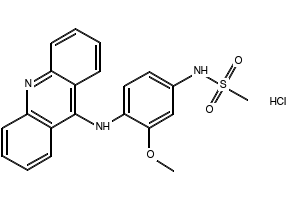
CAS Number54301-15-4
SynonymsN-[4-(acridin-9-ylamino)-3-methoxyphenyl]methanesulfonamide,hydrochloride; Amsacrine (hydrochloride)
Molecular FormulaC21H20ClN3O3S
Molecular Weight429.93
Purity98.00%
Boiling Point563ºC at 760 mmHg
Melting Point197-199ºC
AppearanceSolid;Light yellow to Amber to Dark green powder to crystal
Symbol
Signal WordWarning
| Chemical & Physical Properties | |
|---|---|
| CAS Number | 54301-15-4 |
| Catalog No. | 2A-9044172 |
| Chinese Name | 盐酸胺苯吖啶 |
| Synonyms | N-[4-(acridin-9-ylamino)-3-methoxyphenyl]methanesulfonamide,hydrochloride; Amsacrine (hydrochloride) |
| Molecular Formula | C21H20ClN3O3S |
| Molecular Weight | 429.93 |
| Purity | 98.00 |
| Boiling Point | 563ºC at 760 mmHg |
| Melting Point | 197-199ºC |
| Appearance | Solid;Light yellow to Amber to Dark green powder to crystal |
| Storage Condition | Warehouse ventilation and low temperature drying |
| Packaging | III |
| Application | Amsacrine (mAMSA) is a tumor cell DNA intercalator and also inhibits topoisomerase II. |
| HTC | 2935009090 |
| PubChem ID | 559100 |
| MDL Number | C21H20ClN3O3S |
| SMILES | COc1cc(NS(C)(=O)=O)ccc1Nc1c2ccccc2nc2ccccc12.Cl |
| InChI | InChI=1S/C21H19N3O3S.ClH/c1-27-20-13-14(24-28(2,25)26)11-12-19(20)23-21-15-7-3-5-9-17(15)22-18-10-6-4-8-16(18)21;/h3-13,24H,1-2H3,(H,22,23);1H |
| InChI Key | WDISRLXRMMTXEV-UHFFFAOYSA-N |
| Hazard Symbols | 6.1(b) |
| MSDS | msds/44172_1_54301_15_4.pdf |
| Bioactivity | Amsacrine is an inhibitor of topoisomerase II, and acts as an antineoplastic agent which can intercalates into the DNA of tumor cells. Related Catalog Signaling Pathways >> Autophagy >> Autophagy Natural Products >> Alkaloid Research Areas >> Cancer Target Topoisomerase II In Vitro Amsacrine blocks HERG currents in HEK 293 cells and Xenopus oocytes in a concentration-dependent manner, with IC50 values of 209.4 nM and 2.0 μM, respectively. Amsacrine causes a negative shift in the voltage dependence of both activation (−7.6 mV) and inactivation (−7.6 mV). HERG current block by amsacrine is not frequency dependent[1]. In vitro studies of normal human lymphocytes with various concentrations of m-AMSA, show both increased levels of chromosomal aberrations, ranging from 8% to 100%, and increase SCEs, ranging from 1.5 times the normal at the lowest concentration studied (0.005 μg/mL) to 12 times the normal (0.25 μg/mL)[3]. Amsacrine-induced apoptosis of U937 cells is characterized by caspase-9 and caspase-3 activation, increased intracellular Ca2+ concentration, mitochondrial depolarization, and MCL1 down-regulation. Amsacrine induces MCL1 down-regulation by decreasing its stability. Further, amsacrine-treated U937 cells show AKT degradation and Ca2+-mediated ERK inactivation[4]. In Vivo In animals treated with different doses of amsacrine (0.5-12 mg/kg), the frequencies of micronucleated polychromatic erythrocytes increase significantly after treatment with 9 and 12 mg/kg. Furthermore, the present study demonstrates for the first time that amsacrine has high incidences of clastogenicity and low incidences of aneugenicity whereas nocodazole has high incidences of aneugenicity and low incidences of clastogenicity during mitotic phases in vivo[2]. Animal Admin Mice[2] Amsacrine is investigated in three separated experiments. In the first experiment, animals are treated by intraperitoneal injection with 0.5, 1.5 and 4.5 mg/kg of Amsacrine and bone marrow is sampled 24 h after treatment. Preliminary negative MN results at this sampling time lead to the use of 30 h sampling time for Amsacrine. Thus, in the second experiment, mice are treated with 0.5, 1.5 and 4.5 mg/kg of Amsacrine and bone marrow is sampled 30 h after treatment. The doses and sampling times for Amsacrine are chosen by reference to earlier studies and the selected doses are within the dose range used for human chemotherapy. The results again show that the micronuclei frequency in the bone marrow of mice is not affected by treatment with any of the selected doses of the test agent, at 30 h sampling time, thus, in the third experiment, mice are treated with 6, 9 and 12 mg/kg of Amsacrine and bone marrow is sampled 24 and 30 h after treatment. References [1]. Thomas D, et al. Inhibition of cardiac HERG currents by the DNA topoisomerase II inhibitor amsacrine: mode of action. Br J Pharmacol. 2004 Jun;142(3):485-94. [2]. Attia SM. Molecular cytogenetic evaluation of the mechanism of genotoxic potential of amsacrine and nocodazole in mouse bone marrow cells. J Appl Toxicol. 2013 Jun;33(6):426-33. [3]. Kao-Shan CS, et al. Cytogenetic effects of amsacrine on human lymphocytes in vivo and in vitro. Cancer Treat Rep. 1984 Jul-Aug;68(7-8):989-97. [4]. Lee YC, et al. Amsacrine-induced apoptosis of human leukemia U937 cells is mediated by the inhibition of AKT- and ERK-induced stabilization of MCL1. Apoptosis. 2017 Mar;22(3):406-420. Chemical & Physical Properties Boiling Point 563ºC at 760 mmHg Melting Point 197-199ºC Molecular Formula C21H20ClN3O3S Molecular Weight 429.92000 Flash Point 294.3ºC Exact Mass 429.09100 PSA 88.70000 LogP 6.54050 InChIKey WDISRLXRMMTXEV-UHFFFAOYSA-N SMILES COc1cc(NS(C)(=O)=O)ccc1Nc1c2ccccc2nc2ccccc12.Cl |
| Use of | Amsacrine is an inhibitor of topoisomerase II, and acts as an antineoplastic agent which can intercalates into the DNA of tumor cells. Properties Name Amsacrine hydrochloride Synonym More Synonyms acridinyl anisidide Biological Activity Description Amsacrine is an inhibitor of topoisomerase II, and acts as an antineoplastic agent which can intercalates into the DNA of tumor cells. Related Catalog Signaling Pathways >> Autophagy >> Autophagy Natural Products >> Alkaloid Research Areas >> Cancer Topoisomerase II References [1]. Thomas D, et al. Inhibition of cardiac HERG currents by the DNA topoisomerase II inhibitor amsacrine: mode of action. Br J Pharmacol. 2004 Jun;142(3):485-94. [2]. Attia SM. Molecular cytogenetic evaluation of the mechanism of genotoxic potential of amsacrine and nocodazole in mouse bone marrow cells. J Appl Toxicol. 2013 Jun;33(6):426-33. [3]. Kao-Shan CS, et al. Cytogenetic effects of amsacrine on human lymphocytes in vivo and in vitro. Cancer Treat Rep. 1984 Jul-Aug;68(7-8):989-97. Chemical & Physical Properties Exact Mass 429.09100 PSA 88.70000 LogP 6.54050 InChIKey WDISRLXRMMTXEV-UHFFFAOYSA-N |
| Tax Rebate | 9.0% |
| Supervision | None MFN tariff: 6.5% Ordinary tariff: 35.0% |
| Transport Info | Product name: Purity: 98.0% |
| MSDS Transport Info | Module 14. Shipping information 14.1 UN dangerous goods number European Dangerous Regulations for land transport: 2811 International Dangerous Regulations for sea transport: 2811 International Dangerous Regulations for air transport: 2811 14.2 Names specified by the United Nations (UN) European Land Transport Dangerous Regulations: TOXIC SOLID, ORGANIC, N.O.S. (Amsacrine hydrochloride) IMDG: TOXIC SOLID, ORGANIC, N.O.S. (Amsacrine hydrochloride) International air transport hazard regulations: Toxic solid, organic, n.o.s. (Amsacrine hydrochloride) 14.3 Transport hazard categories European Land Transport Danger Regulations: 6.1 International Maritime Transport Danger Regulations: 6.1 International Air Transport Danger Regulations: 6.1 14.4 Package group European Land Transport Danger Regulations: III International Maritime Transport Danger Regulations: III International Air Transport Danger Regulations: III 14.5 Environmental hazards European Land Transport Dangerous Regulations: No International Maritime Transport Dangerous Regulations Maritime Pollutants: No International Air Transport Risk Regulations: No 14.6 Special reminder to users No data available The above information is believed to be correct, but is not all-inclusive and should be used as a guide only. The information in this document is based on our current knowledge and is Correct safety instructions apply to this product. This information does not represent a warranty as to the properties of this product. See reverse side of invoice or packing slip. |
| Related Products in Specialty Chemicals | ||
|---|---|---|
| Mabuterol hydrochloride | 54240-36-7 | 2A-9044163 |
| Copper methane sulfonate | 54253-62-2 | 2A-9044164 |
| 1,10-Phenanthrolin-5-amine | 54258-41-2 | 2A-9044166 |
| 2-[5-(1,3-Dihydro-1,3,3-trimethyl-2H-indol-2-ylidene)-1,3-pentadien-1-yl]-1,3,3-trimethyl-3H-indolium chloride | 54268-70-1 | 2A-9044167 |
| (+)-Cloprostenol | 54276-21-0 | 2A-9044168 |
| Benzyl 3-bromopropyl ether | 54314-84-0 | 2A-9044173 |
| N-Acetyl-L-thioproline | 54323-50-1 | 2A-9044175 |
| N,N-Diethyl-2-chloropropionamide | 54333-75-4 | 2A-9044178 |
| Meptazinol | 54340-58-8 | 2A-9044180 |
| HC Orange 1 | 54381-08-7 | 2A-9044186 |
| Browse all Specialty Chemicals products » | ||
Phone:
630-322-8886
630-322-8887
Email:
Office Locations:
Chicago, IL, USA
San Francisco, CA, USA


 EN
EN


 SDS
SDS