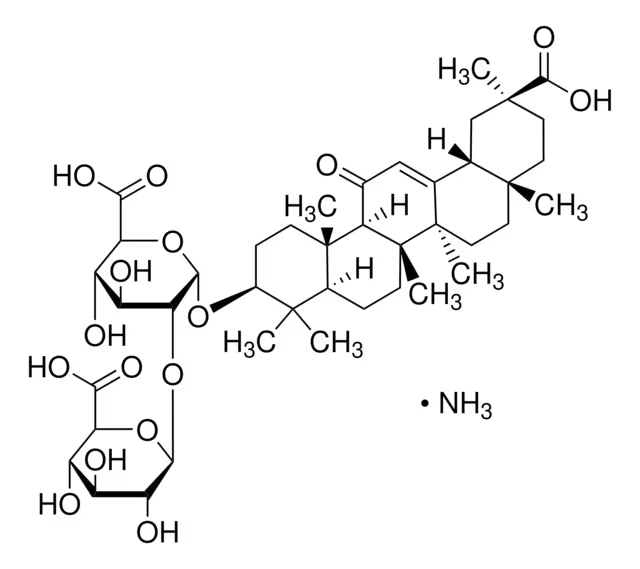
CAS Number53956-04-0
SynonymsGLYCAMIL; Ammoniumglycynhizinato; glycyrrhizic acid monoammonium salt; ammonium glycyrrhizinate; MFCD00167400; Glycyrrhizin Monoammonium Salt Hydrate; Glycyrrhizic Acid Monoammonium Salt Hydrate; GLYCYRRHIZICAMMONIUM; Magnasweet; ammoniate; Monoammonium Glycyrrhizinate Hydrate; Glycyrrhizate monoammonium; Glycyrrhizin ammonium; Glycyrrhiz; AMMONIUMGLYCYRRHIZIN; Ammonium glycyrrhizate; GLYCYRRHIZIC ACID,NH4; ammoniumglycyrrhizate; Monoammoniumglycyrrhizinate; Glycyrrhizic acid monoammonium salt trihydrate; glycyrram; EINECS 258-887-7
Molecular FormulaC42H65NO16
Molecular Weight839.96
Purity98.00%
Density1.43g/cm3
Boiling Point971.4ºC at 760mmHg
Melting Point209ºC
AppearanceWhite crystalline powder
Symbol
Signal WordWarning
| Chemical & Physical Properties | |
|---|---|
| CAS Number | 53956-04-0 |
| Catalog No. | 2A-9044090 |
| Chinese Name | 甘草酸铵 |
| Synonyms | GLYCAMIL; Ammoniumglycynhizinato; glycyrrhizic acid monoammonium salt; ammonium glycyrrhizinate; MFCD00167400; Glycyrrhizin Monoammonium Salt Hydrate; Glycyrrhizic Acid Monoammonium Salt Hydrate; GLYCYRRHIZICAMMONIUM; Magnasweet; ammoniate; Monoammonium Glycyrrhizinate Hydrate; Glycyrrhizate monoammonium; Glycyrrhizin ammonium; Glycyrrhiz; AMMONIUMGLYCYRRHIZIN; Ammonium glycyrrhizate; GLYCYRRHIZIC ACID,NH4; ammoniumglycyrrhizate; Monoammoniumglycyrrhizinate; Glycyrrhizic acid monoammonium salt trihydrate; glycyrram; EINECS 258-887-7 |
| Molecular Formula | C42H65NO16 |
| Molecular Weight | 839.96 |
| Purity | 98.00 |
| Density | 1.43g/cm3 |
| Boiling Point | 971.4ºC at 760mmHg |
| Melting Point | 209ºC |
| Appearance | White crystalline powder |
| Water Solubility | Slightly soluble in water, very slightly soluble i |
| Storage Condition | Sealed, store at 2 ºC -8 ºC |
| Application | Monoammonium glycyrrhizinate hydrate has pharmacological activities such as anti-inflammatory, anti-allergic, anti-gastric ulcer, and anti-hepatitis. |
| PubChem ID | 329749010 |
| SMILES | CC1(C(=O)O)CCC2(C)CCC3(C)C(=CC(=O)C4C5(C)CCC(OC6OC(C(=O)O)C(O)C(O)C6OC6OC(C(=O)O)C(O)C(O)C6O)C(C)(C)C5CCC43C)C2C1.N.O |
| InChI | InChI=1S/C42H62O16.H3N/c1-37(2)21-8-11-42(7)31(20(43)16-18-19-17-39(4,36(53)54)13-12-38(19,3)14-15-41(18,42)6)40(21,5)10-9-22(37)55-35-30(26(47)25(46)29(57-35)33(51)52)58-34-27(48)23(44)24(45)28(56-34)32(49)50;/h16,19,21-31,34-35,44-48H,8-15,17H2,1-7H3,(H,49,50)(H,51,52)(H,53,54);1H3/t19-,21-,22-,23-,24-,25-,26-,27+,28-,29-,30+,31+,34-,35-,38+,39-,40-,41+,42+;/m0./s1 |
| InChI Key | NNMYEXLTVQXZCA-VLQRKCJKSA-N |
| Hazard Symbols | transportation |
| Bioactivity | Monoammonium glycyrrhizinate hydrate has various pharmacological actions such as anti-inflammatory, antiallergic, antigastriculcer, and antihepatitis activities. Related Catalog Signaling Pathways >> Others >> Others Research Areas >> Inflammation/Immunology In Vivo The increase of the lung W/D weight ratios is significantly reduced by high and medium dose of MAG (10 and 30mg/kg) administration. Pretreatment with MAG (10 and 30mg/kg) efficiently reduces the production of TNF-α and IL-1β. MAG (10, 30mg/kg) significantly decreases NF-κB p65 protein expression, compared with LPS. On the contrary, LPS significantly reduces IκB-α protein expression compared with the control group, whereas MAG (10 and 30mg/kg) significantly increased IκB-α expression, compared with the LPS group[1]. Low- and high-dose MAG treatment significantly reduces the AST, ALT, TBIL, and TBA levels at 14 and 21 d time points when compared with that of the RIF and INH group, suggesting the protective effect of MAG on RIF- and INH-induced liver injury. MAG treatment groups elevate the hepatic GSH level at 7, 14, and 21 d time points and markedly reduce the MDA level at 14 and 21 d time points in RIF- and INH-treated rats, suggesting the protective effect of MAG in RIF- and INH induced liver injuries[2]. Animal Admin Mice[1] In this study, BALB/c mice (male, 6-8weeks old, and 20-25 g) are used. Mice are randomly divided into five groups: control group, LPS group, and LPS + Monoammonium glycyrrhizinate (MAG: 3, 10, and 30mg/kg) groups. Each group contains eight mice. Mice are anesthetized with intraperitoneal injection of sodium pentobarbital (50mg/kg). Before inducing acute lung injury, the mice are given intraperitoneal injection with MAG (3, 10, and 30mg/kg). One hour later, LPS (5mg/kg) is instilled intratracheally to induce acute lung injury. Normal mice are given PBS[1]. Rats[2] Male Wistar rats (180-220 g) are used. Rats are randomly divided into four groups, i.e., control group, RIF and INH group, MAG low-dose group, and MAG high-dose group, each group has 15 rats. Rats in the RIF and INH group receive RIF (60 mg/kg) and INH (60 mg/kg) by gavage administration once daily; rats in MAG groups are pretreated with MAG at the doses of 45 or 90 mg/kg, RIF (60 mg/kg) and INH (60 mg/kg) are given 3 h after MAG administration; rats in the control group are treated with saline. To evaluate the dynamic effect of drugs, rats in each group are sacrificed on 7, 14, and 21 d after drug administration[2]. References [1]. Huang X, et al. Anti-Inflammatory Effects of Monoammonium Glycyrrhizinate on Lipopolysaccharide-Induced Acute Lung Injury in Mice through Regulating Nuclear Factor-Kappa B Signaling Pathway. Evid Based Complement Alternat Med. 2015;2015:272474. [2]. Zhou L, et al. Monoammonium glycyrrhizinate protects rifampicin- and isoniazid-induced hepatotoxicity via regulating the expression of transporter Mrp2, Ntcp, and Oatp1a4 in liver. Pharm Biol. 2016;54(6):931-7. Chemical & Physical Properties Density 1.43g/cm3 Boiling Point 971.4ºC at 760mmHg Melting Point 209ºC Molecular Formula C42H65NO16 Molecular Weight 839.96 Flash Point 288.1ºC PSA 272.70000 LogP 0.32860 Index of Refraction 49 ° (C=1.5, EtOH) InChIKey NNMYEXLTVQXZCA-VLQRKCJKSA-N SMILES CC1(C(=O)O)CCC2(C)CCC3(C)C(=CC(=O)C4C5(C)CCC(OC6OC(C(=O)O)C(O)C(O)C6OC6OC(C(=O)O)C(O)C(O)C6O)C(C)(C)C5CCC43C)C2C1.N.O Storage condition 2-8°C Water Solubility Slightly soluble in water, very slightly soluble in anhydrous ethanol, practically insoluble in acetone. It dissolves in dilute solutions of acids and of alkali hydroxides. |
| Use of | Monoammonium glycyrrhizinate hydrate has various pharmacological actions such as anti-inflammatory, antiallergic, antigastriculcer, and antihepatitis activities. Properties Articles41 Name Glycyrrhizic acid ammonium salt Synonym More Synonyms Glycyrrhizic acid ammonium salt Biological Activity Description Monoammonium glycyrrhizinate hydrate has various pharmacological actions such as anti-inflammatory, antiallergic, antigastriculcer, and antihepatitis activities. Related Catalog Signaling Pathways >> Others >> Others Research Areas >> Inflammation/Immunology References [1]. Huang X, et al. Anti-Inflammatory Effects of Monoammonium Glycyrrhizinate on Lipopolysaccharide-Induced Acute Lung Injury in Mice through Regulating Nuclear Factor-Kappa B Signaling Pathway. Evid Based Complement Alternat Med. 2015;2015:272474. [2]. Zhou L, et al. Monoammonium glycyrrhizinate protects rifampicin- and isoniazid-induced hepatotoxicity via regulating the expression of transporter Mrp2, Ntcp, and Oatp1a4 in liver. Pharm Biol. 2016;54(6):931-7. Chemical & Physical Properties Molecular Formula C42H65NO16 PSA 272.70000 LogP 0.32860 InChIKey NNMYEXLTVQXZCA-VLQRKCJKSA-N Water Solubility Slightly soluble in water, very slightly soluble in anhydrous ethanol, practically insoluble in acetone. It dissolves in dilute solutions of acids and of alkali hydroxides. |
| Transport Info | Product name: Purity: 70.0% |
| MSDS Transport Info | Module 14. Shipping information 14.1 UN dangerous goods number European Land Transport Dangerous Regulations: -International Maritime Dangerous Regulations: -International Air Transport Dangerous Regulations: - 14.2 Names specified by the United Nations (UN) European Land Transport Dangerous Regulations: Non-dangerous goods IMDG Code: Non-dangerous goods International air transport dangerous goods regulations: non-dangerous goods 14.3 Transport hazard categories European Land Transport Dangerous Regulations: -International Maritime Dangerous Regulations: -International Air Transport Dangerous Regulations: - 14.4 Package group European Land Transport Dangerous Regulations: -International Maritime Dangerous Regulations: -International Air Transport Dangerous Regulations: - 14.5 Environmental hazards European Land Transport Dangerous Regulations: No International Maritime Transport Dangerous Regulations Maritime Pollutants: No International Air Transport Risk Regulations: No 14.6 Special reminder to users No data available The above information is believed to be correct, but is not all-inclusive and should be used as a guide only. The information in this document is based on our current knowledge and is Correct safety instructions apply to this product. This information does not represent a warranty as to the properties of this product. See reverse side of invoice or packing slip. |
| Related Products in Botanical Reference Standards | ||
|---|---|---|
| Ginsenoside Re | 51542-56-4 | 2A-9043509 |
| Ginsenoside Rf | 52286-58-5 | 2A-9043718 |
| Ethyl 2,3,4,6-tetra-O-acetyl-alpha-D-thioglucopyranoside | 52645-73-5 | 2A-9043821 |
| Sennoside B calcium salt | 52730-37-7 | 2A-9043844 |
| Methyl 2,3,4-tri-O-benzyl-alpha-D-glucopyranoside | 53008-65-4 | 2A-9043883 |
| Allyl 2-acetamido-2-deoxy-beta-D-glucopyranoside | 54400-77-0 | 2A-9044196 |
| 4,4'-Diaminostilbene dihydrochloride | 54760-75-7 | 2A-9044267 |
| Methyl 2,3,4,6-tetra-O-acetyl-beta-D-thiogalactopyranoside | 55722-48-0 | 2A-9044472 |
| Pseudohypericin | 55954-61-5 | 2A-9044528 |
| Ethyl 4,6-O-benzylidene-thio-beta-D-galactoside | 56119-28-9 | 2A-9044557 |
| Browse all Botanical Reference Standards products » | ||
Phone:
630-322-8886
630-322-8887
Email:
Office Locations:
Chicago, IL, USA
San Francisco, CA, USA


 EN
EN


 SDS
SDS