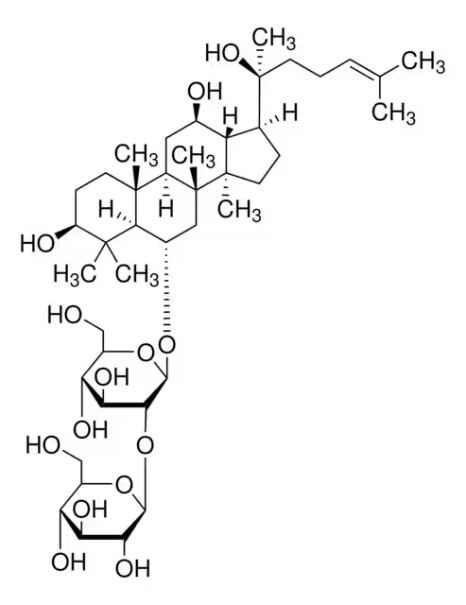
CAS Number52286-58-5
Synonyms(3β,6α,12β)-3,12,20-Trihydroxydammar-24-en-6-yl 2-O-β-D-glucopyranosyl-β-D-glucopyranoside; Ginsenoside Rf; GinsenosideRf; PANAXOSIDE RF; ginsinoside Rf
Molecular FormulaC42H72O14
Molecular Weight801.01
Purity98.00%
Density1.3±0.1 g/cm3
Boiling Point912.3±65.0 °C at 760 mmHg
Symbol
Signal WordWarning
| Chemical & Physical Properties | |
|---|---|
| CAS Number | 52286-58-5 |
| Catalog No. | 2A-9043718 |
| Chinese Name | 人参皂苷Rf |
| Synonyms | (3β,6α,12β)-3,12,20-Trihydroxydammar-24-en-6-yl 2-O-β-D-glucopyranosyl-β-D-glucopyranoside; Ginsenoside Rf; GinsenosideRf; PANAXOSIDE RF; ginsinoside Rf |
| Molecular Formula | C42H72O14 |
| Molecular Weight | 801.01 |
| Purity | 98.00 |
| Density | 1.3±0.1 g/cm3 |
| Boiling Point | 912.3±65.0 °C at 760 mmHg |
| Storage Condition | ?20°C |
| Application | Ginsenoside Rf is a trace component of ginseng root. Ginsenoside Rf inhibits N-type Ca2+ channels. |
| HTC | 29389090 |
| PubChem ID | 329747330 |
| SMILES | CC(C)=CCCC(C)(O)C1CCC2(C)C1C(O)CC1C3(C)CCC(O)C(C)(C)C3C(OC3OC(CO)C(O)C(O)C3OC3OC(CO)C(O)C(O)C3O)CC12C |
| InChI | InChI=1S/C42H72O14/c1-20(2)10-9-13-42(8,52)21-11-15-40(6)28(21)22(45)16-26-39(5)14-12-27(46)38(3,4)35(39)23(17-41(26,40)7)53-37-34(32(50)30(48)25(19-44)55-37)56-36-33(51)31(49)29(47)24(18-43)54-36/h10,21-37,43-52H,9,11-19H2,1-8H3/t21-,22+,23-,24+,25+,26+,27-,28-,29+,30+,31-,32-,33+,34+,35-,36-,37+,39+,40+,41+,42-/m0/s1 |
| InChI Key | UZIOUZHBUYLDHW-XUBRWZAZSA-N |
| Hazard Symbols | transportation |
| Bioactivity | Ginsenoside Rf is a trace component of ginseng root. Ginsenoside Rf inhibits N-type Ca2+ channel. Related Catalog Signaling Pathways >> Membrane Transporter/Ion Channel >> Calcium Channel Research Areas >> Neurological Disease Natural Products >> Terpenoids and Glycosides Research Areas >> Cancer Target N-Type Ca2+ Channel In Vitro Ginsenoside Rf is a saponin, which is present in only trace amounts within ginseng. At saturating concentrations, Ginsenoside Rf rapidly and reversibly inhibits N-type, and other high-threshold, Ca2+ channels in rat sensory neurons to the same degree as a maximal dose of opioids. The effect is dose-dependent (half-maximal inhibition: 40 μM) and it is virtually eliminated by pretreatment of the neurons with pertussis toxin, an inhibitor of G(o) and Gi GTP-binding proteins. Ginsenoside Rf also inhibits Ca2+ channels in the hybrid F-11 cell line[1]. In Vivo Since inhibition of Ca2+ channels in sensory neurons contributes to antinociception by opioids, analgesic actions of Ginsenoside Rf are tested. Dose-dependent antinociception is found by systemic administration of Ginsenoside Rf in mice using two separate assays of tonic pain: in the acetic acid abdominal constriction test, the ED50 is 56±9 mg/kg, a concentration similar to those reported for aspirin and acetaminophen in the same assay; in the tonic phase of the biphasic formalin test, the ED50 is 129±32 mg/kg[2]. Animal Admin Mice[2] Naive, adult (7-12 week old) mice of outbred Swiss-Webster stock are used in all in vivo experiments. Mice are brought to a quiet testing room, and acclimated to table-top Plexiglas observation chambers (30 cm high; 30 cm diameter) for 30 min. They are then weighed and injected with Ginsenoside Rf (25, 50, or 75 mg/kg) or vehicle (preceded by naloxone or saline in one experiment). Twenty min later, a 0.9% solution of glacial acetic acid is injected intraperitoneally (i.p.) in a volume of 10 mL/kg. For the next 30 min, the number of constrictions (writhes)-strong contractions of the abdominal musculature accompanied by dorsoflexion of the back and extension of the hindlimbs-are counted and recorded in 5-min blocks. Four mice (one per chamber) are observed simultaneously by a single, experienced experimenter. To control for the considerable circadian and other environmental variance accompanying this nociceptive assay, two vehicle controls are tested alongside two Ginsenoside Rf-administered mice in every experimental session[2]. References [1]. Nah SY, et al. A trace component of ginseng that inhibits Ca2+ channels through a pertussis toxin-sensitive G protein. Proc Natl Acad Sci U S A. 1995 Sep 12;92(19):8739-43. [2]. Mogil JS, et al. Ginsenoside Rf, a trace component of ginseng root, produces antinociception in mice. Brain Res. 1998 May 11;792(2):218-28. Chemical & Physical Properties Density 1.3±0.1 g/cm3 Boiling Point 912.3±65.0 °C at 760 mmHg Molecular Formula C42H72O14 Molecular Weight 801.013 Flash Point 505.5±34.3 °C Exact Mass 800.492188 PSA 239.22000 LogP 3.51 Vapour Pressure 0.0±0.6 mmHg at 25°C Index of Refraction 1.602 InChIKey UZIOUZHBUYLDHW-XUBRWZAZSA-N SMILES CC(C)=CCCC(C)(O)C1CCC2(C)C1C(O)CC1C3(C)CCC(O)C(C)(C)C3C(OC3OC(CO)C(O)C(O)C3OC3OC(CO)C(O)C(O)C3O)CC12C Storage condition ?20°C |
| Use of | Ginsenoside Rf is a trace component of ginseng root. Ginsenoside Rf inhibits N-type Ca2+ channel. Properties Articles23 Name ginsenoside Rf Synonym More Synonyms Ginsenoside Rf Biological Activity Description Ginsenoside Rf is a trace component of ginseng root. Ginsenoside Rf inhibits N-type Ca2+ channel. Related Catalog Signaling Pathways >> Membrane Transporter/Ion Channel >> Calcium Channel Research Areas >> Neurological Disease Natural Products >> Terpenoids and Glycosides Research Areas >> Cancer N-Type Ca2+ Channel References [1]. Nah SY, et al. A trace component of ginseng that inhibits Ca2+ channels through a pertussis toxin-sensitive G protein. Proc Natl Acad Sci U S A. 1995 Sep 12;92(19):8739-43. [2]. Mogil JS, et al. Ginsenoside Rf, a trace component of ginseng root, produces antinociception in mice. Brain Res. 1998 May 11;792(2):218-28. Chemical & Physical Properties Molecular Formula C42H72O14 Exact Mass 800.492188 PSA 239.22000 Index of Refraction 1.602 InChIKey UZIOUZHBUYLDHW-XUBRWZAZSA-N |
| Transport Info | Product name: Purity: 98.0% |
| MSDS Transport Info | Module 14. Shipping information 14.1 UN dangerous goods number European Land Transport Dangerous Regulations: -International Maritime Dangerous Regulations: -International Air Transport Dangerous Regulations: - 14.2 Names specified by the United Nations (UN) European Land Transport Dangerous Regulations: Non-dangerous goods IMDG Code: Non-dangerous goods International air transport dangerous goods regulations: non-dangerous goods 14.3 Transport hazard categories European Land Transport Dangerous Regulations: -International Maritime Dangerous Regulations: -International Air Transport Dangerous Regulations: - 14.4 Package group European Land Transport Dangerous Regulations: -International Maritime Dangerous Regulations: -International Air Transport Dangerous Regulations: - 14.5 Environmental hazards European Land Transport Dangerous Regulations: No International Maritime Transport Dangerous Regulations Maritime Pollutants: No International Air Transport Risk Regulations: No 14.6 Special reminder to users No data available |
| Related Products in Botanical Reference Standards | ||
|---|---|---|
| Crocin | 42553-65-1 | 2A-9042990 |
| 4-Fluorophenyl beta-glucoside | 50819-52-8 | 2A-9043327 |
| Soyasaponin Bb | 51330-27-9 | 2A-9043455 |
| Cholesterol-3-D1 | 51467-57-3 | 2A-9043485 |
| Ginsenoside Re | 51542-56-4 | 2A-9043509 |
| Ethyl 2,3,4,6-tetra-O-acetyl-alpha-D-thioglucopyranoside | 52645-73-5 | 2A-9043821 |
| Sennoside B calcium salt | 52730-37-7 | 2A-9043844 |
| Methyl 2,3,4-tri-O-benzyl-alpha-D-glucopyranoside | 53008-65-4 | 2A-9043883 |
| Glycyrrhizic acid ammonium salt | 53956-04-0 | 2A-9044090 |
| Allyl 2-acetamido-2-deoxy-beta-D-glucopyranoside | 54400-77-0 | 2A-9044196 |
| Browse all Botanical Reference Standards products » | ||
Phone:
630-322-8886
630-322-8887
Email:
Office Locations:
Chicago, IL, USA
San Francisco, CA, USA


 EN
EN


 SDS
SDS