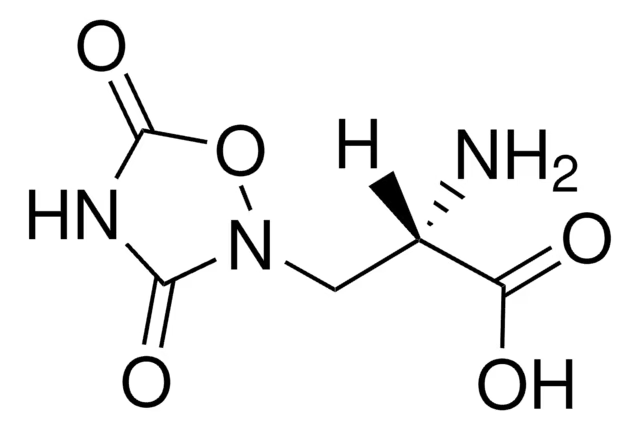
CAS Number52809-07-1
SynonymsL-Quisqualic acid; MFCD00069337; 3-(3,5-Dioxo-1,2,4-oxadiazolidin-2-yl)-L-alanine; b-(3,5-Dioxo-1,2,4-oxodiazolidin-2-yl)-L-alanine; L-(+)-a-Amino-3,5-dioxo-1,2,4-oxadiazolidine-2-propanoic Acid; (L)-(+)-a-Amino-3,5-dioxo-1,2,4-oxadiazolidine-2-propanoic acid; Quisqualic acid; 3-(3-Hydroxy-5-oxo-1,2,4-oxadiazol-2(5H)-yl)-L-alanine; β-(3,5-Dioxo-1,2,4-oxadiazolidin-2-yl)-L-alanine; L-Quisqualic acid,(L)-(+)-α-Amino-3,5-dioxo-1,2,4-oxadiazolidine-2-propanoicacid; (S)-a-Amino-3,5-dioxo-1,2,4-oxadiazolidine-2-propanoic Acid
Molecular FormulaC5H7N3O5
Molecular Weight189.13
Purity98.00%
Density2.0±0.1 g/cm3
Boiling Point405.9±55.0 °C at 760 mmHg
Melting Point185-187ºC dec.
Appearancepowder
Symbol
Signal WordWarning
| Chemical & Physical Properties | |
|---|---|
| CAS Number | 52809-07-1 |
| Catalog No. | 2A-9043858 |
| Chinese Name | 异喹啉酸(mM/ml) |
| Synonyms | L-Quisqualic acid; MFCD00069337; 3-(3,5-Dioxo-1,2,4-oxadiazolidin-2-yl)-L-alanine; b-(3,5-Dioxo-1,2,4-oxodiazolidin-2-yl)-L-alanine; L-(+)-a-Amino-3,5-dioxo-1,2,4-oxadiazolidine-2-propanoic Acid; (L)-(+)-a-Amino-3,5-dioxo-1,2,4-oxadiazolidine-2-propanoic acid; Quisqualic acid; 3-(3-Hydroxy-5-oxo-1,2,4-oxadiazol-2(5H)-yl)-L-alanine; β-(3,5-Dioxo-1,2,4-oxadiazolidin-2-yl)-L-alanine; L-Quisqualic acid,(L)-(+)-α-Amino-3,5-dioxo-1,2,4-oxadiazolidine-2-propanoicacid; (S)-a-Amino-3,5-dioxo-1,2,4-oxadiazolidine-2-propanoic Acid |
| Molecular Formula | C5H7N3O5 |
| Molecular Weight | 189.13 |
| Purity | 98.00 |
| Density | 2.0±0.1 g/cm3 |
| Boiling Point | 405.9±55.0 °C at 760 mmHg |
| Melting Point | 185-187ºC dec. |
| Appearance | powder |
| Storage Condition | Keep the container sealed and stored in a cool, dr |
| Application | Quisqualic acid (L-Quisqualic acid), a natural glutamate analog, is a potent, non-selective agonist of two isoform subsets (iGluR and mGluR) of excitatory amino acids (EAA), with an EC50 of 45 nM and |
| HTC | 2934999090 |
| PubChem ID | 24278004 |
| MDL Number | MFCD00069337 |
| SMILES | N[C@@H](CN1OC(=O)NC1=O)C(O)=O |
| InChI | 1S/C5H7N3O5/c6-2(3(9)10)1-8-4(11)7-5(12)13-8/h2H,1,6H2,(H,9,10)(H,7,11,12)/t2-/m0/s1 |
| InChI Key | ASNFTDCKZKHJSW-REOHCLBHSA-N |
| Beilstein/REAXYS | 1078734 |
| NACRES Code | NA.32 |
| UNSPSC | 12352106 |
| Hazard Symbols | transportation |
| MSDS | msds/43858_1_52809_07_1.pdf |
| Bioactivity | Quisqualic acid (L-Quisqualic acid), a natural analog of glutamate, is a potent and pan two subsets (iGluR and mGluR) of excitatory amino acid (EAA) agonist with an EC50 of 45 nM and a Ki of 10 nM for mGluR1R. Quisqualic acid is isolated from the fruits of Quisqualis chinensis[1][2]. Related Catalog Signaling Pathways >> Neuronal Signaling >> iGluR Signaling Pathways >> GPCR/G Protein >> mGluR Research Areas >> Neurological Disease Signaling Pathways >> Membrane Transporter/Ion Channel >> iGluR Target mGluR1R:45 nM (EC50) mGluR1R:10 nM (Ki) mGluR2R:108 μM (IC50) mGluR2R:113 μM (Ki) mGluR4R:593 μM (IC50) mGluR4R:112 μM (Ki) In Vitro Quisqualic acid is an agonist of AMPA and metabotropic glutamate receptors. Quisqualic acid activates mGluR2R (EC50=108 μM; Ki=113 μM) and mGluR4R (EC50=593 μM; Ki=112 μM)[1]. References [1]. Hugues-Olivier Bertrand, et al. Common and Selective Molecular Determinants Involved in Metabotopic Glutamate Receptor Agonist Activity. J Med Chem. 2002 Jul 18;45(15):3171-83. [2]. H Bräuner-Osborne, et al. Ligands for Glutamate Receptors: Design and Therapeutic Prospects. J Med Chem. 2000 Jul 13;43(14):2609-45. Chemical & Physical Properties Density 2.0±0.1 g/cm3 Boiling Point 405.9±55.0 °C at 760 mmHg Melting Point 185-187ºC dec. Molecular Formula C5H7N3O5 Molecular Weight 189.126 Flash Point 199.3±31.5 °C Exact Mass 189.038574 PSA 131.32000 LogP -1.85 Vapour Pressure 0.0±2.1 mmHg at 25°C Index of Refraction 1.726 InChIKey ASNFTDCKZKHJSW-REOHCLBHSA-N SMILES NC(Cn1oc(=O)[nH]c1=O)C(=O)O |
| Use of | Quisqualic acid (L-Quisqualic acid), a natural analog of glutamate, is a potent and pan two subsets (iGluR and mGluR) of excitatory amino acid (EAA) agonist with an EC50 of 45 nM and a Ki of 10 nM for mGluR1R. Quisqualic acid is isolated from the fruits of Quisqualis chinensis[1][2]. Properties Articles42 Name (+)-Quisqualic Acid Synonym More Synonyms Quisqualic acid Biological Activity Description Quisqualic acid (L-Quisqualic acid), a natural analog of glutamate, is a potent and pan two subsets (iGluR and mGluR) of excitatory amino acid (EAA) agonist with an EC50 of 45 nM and a Ki of 10 nM for mGluR1R. Quisqualic acid is isolated from the fruits of Quisqualis chinensis[1][2]. Related Catalog Signaling Pathways >> Neuronal Signaling >> iGluR Signaling Pathways >> GPCR/G Protein >> mGluR Research Areas >> Neurological Disease Signaling Pathways >> Membrane Transporter/Ion Channel >> iGluR mGluR1R:45 nM (EC50) mGluR1R:10 nM (Ki) mGluR2R:108 μM (IC50) mGluR2R:113 μM (Ki) mGluR4R:593 μM (IC50) mGluR4R:112 μM (Ki) In Vitro Quisqualic acid is an agonist of AMPA and metabotropic glutamate receptors. Quisqualic acid activates mGluR2R (EC50=108 μM; Ki=113 μM) and mGluR4R (EC50=593 μM; Ki=112 μM)[1]. References [1]. Hugues-Olivier Bertrand, et al. Common and Selective Molecular Determinants Involved in Metabotopic Glutamate Receptor Agonist Activity. J Med Chem. 2002 Jul 18;45(15):3171-83. [2]. H Bräuner-Osborne, et al. Ligands for Glutamate Receptors: Design and Therapeutic Prospects. J Med Chem. 2000 Jul 13;43(14):2609-45. Chemical & Physical Properties Molecular Formula C5H7N3O5 Exact Mass 189.038574 PSA 131.32000 LogP -1.85 Index of Refraction 1.726 InChIKey ASNFTDCKZKHJSW-REOHCLBHSA-N SMILES NC(Cn1oc(=O)[nH]c1=O)C(=O)O |
| Tax Rebate | 13.0% |
| Supervision | None. MFN tariff: 6.5%. Ordinary tariff: 20.0% |
| Transport Info | Shipping Name: UN |
| MSDS Transport Info | Module 14. Shipping information 14.1 UN dangerous goods number European Land Transport Dangerous Regulations: -International Maritime Dangerous Regulations: -International Air Transport Dangerous Regulations: - 14.2 United Nations shipping name European Land Transport Dangerous Regulations: Non-dangerous goods IMDG Code: Non-dangerous goods International air transport dangerous goods regulations: non-dangerous goods 14.3 Transport hazard categories European Land Transport Dangerous Regulations: -International Maritime Dangerous Regulations: -International Air Transport Dangerous Regulations: - 14.4 Package group European Land Transport Dangerous Regulations: -International Maritime Dangerous Regulations: -International Air Transport Dangerous Regulations: - 14.5 Environmental hazards European Land Transport Danger Regulations: No International Maritime Danger Regulations International Air Transport Danger Regulations: No Marine pollutants (yes/no): No 14.6 Special reminder to users No data available |
| Related Products in Specialty Chemicals | ||
|---|---|---|
| N-(5-Chloro-2-methoxyphenyl)-3-oxobutanamide | 52793-11-0 | 2A-9043852 |
| D-3,4-Dichlorophenylalanine | 52794-98-6 | 2A-9043853 |
| 3-Hydroxy-4-methoxybenzonitrile | 52805-46-6 | 2A-9043855 |
| 4-Chloro-2-iodoanisole | 52807-27-9 | 2A-9043856 |
| 2-(2-Methoxyethoxy)ethyl chloride | 52808-36-3 | 2A-9043857 |
| N-Methyl-N-thiobenzoylhydrazine hydrochloride | 52816-36-1 | 2A-9043860 |
| Bis(2,2,6,6-tetramethyl-4-piperidyl)sebacate | 52829-07-9 | 2A-9043863 |
| 2-Amino-5-bromonicotinic acid | 52833-94-0 | 2A-9043866 |
| 4-Amino-5-chloronicotinic acid | 52834-09-0 | 2A-9043867 |
| 3-(Dichloroacetyl)-2,2,5-trimethyloxazolidine | 52836-31-4 | 2A-9043868 |
| Browse all Specialty Chemicals products » | ||
Phone:
630-322-8886
630-322-8887
Email:
Office Locations:
Chicago, IL, USA
San Francisco, CA, USA


 EN
EN


 SDS
SDS