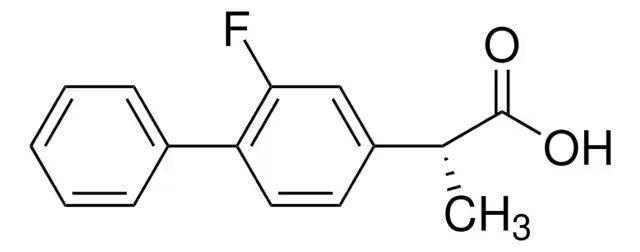
CAS Number51543-40-9
SynonymsR-Flurbiprofen; R-(-)-Flurbiprofen; EINECS 257-264-7; MPC-7869; (2R)-2-(2-fluorobiphenyl-4-yl)propanoic acid; UNII-501W00OOWA; (-)-Flurbiprofen; (R)-Flurbiprofen; (2R)-2-(2-Fluoro-1,1'-biphenyl-4-yl)propanoic acid; Flurizan; (R)-2-Flubiprofen; (R)-(−)-2-Fluoro-α-methyl-4-biphenylacetic acid; (2R)-2-(2-Fluoro-4-biphenylyl)propanoic acid; (R)-2-Flurbiprofen; (2R)-2-(3-fluoro-4-phenylphenyl)propanoic acid; (R)-(-)-2-Fluoro-alpha-methyl-4-biphenylacetic acid; tarenflurbil; MFCD00869714; E-7869; Flurbiprofen
Molecular FormulaC6H5C6H3(F)CH(CH3)CO2H
Molecular Weight244.26
Purity98.00%
Density1.2±0.1 g/cm3
Boiling Point376.2±30.0 °C at 760 mmHg
Melting Point110-113ºC
AppearanceCrystalline Powder | White to off-white
Symbol
Signal WordWarning
| Chemical & Physical Properties | |
|---|---|
| CAS Number | 51543-40-9 |
| Catalog No. | 2A-9043510 |
| Chinese Name | (R)-氟比洛芬(Tarenflurbil) |
| Synonyms | R-Flurbiprofen; R-(-)-Flurbiprofen; EINECS 257-264-7; MPC-7869; (2R)-2-(2-fluorobiphenyl-4-yl)propanoic acid; UNII-501W00OOWA; (-)-Flurbiprofen; (R)-Flurbiprofen; (2R)-2-(2-Fluoro-1,1'-biphenyl-4-yl)propanoic acid; Flurizan; (R)-2-Flubiprofen; (R)-(−)-2-Fluoro-α-methyl-4-biphenylacetic acid; (2R)-2-(2-Fluoro-4-biphenylyl)propanoic acid; (R)-2-Flurbiprofen; (2R)-2-(3-fluoro-4-phenylphenyl)propanoic acid; (R)-(-)-2-Fluoro-alpha-methyl-4-biphenylacetic acid; tarenflurbil; MFCD00869714; E-7869; Flurbiprofen |
| Molecular Formula | C6H5C6H3(F)CH(CH3)CO2H |
| Molecular Weight | 244.26 |
| Purity | 98.00 |
| Density | 1.2±0.1 g/cm3 |
| Boiling Point | 376.2±30.0 °C at 760 mmHg |
| Melting Point | 110-113ºC |
| Appearance | Crystalline Powder | White to off-white |
| Storage Condition | Keep receptacles sealed Place in a tight container |
| Application | Tarenflurbil ((R)-Flurbiprofen), the R enantiomer of Flurbiprofen, inhibits the binding of [3H]9-cis-RA to the RXRα LBD with an IC50 of 75 μM. |
| HTC | 2916399090 |
| PubChem ID | 520769 |
| MDL Number | MFCD00869714 |
| SMILES | CC(C(=O)O)c1ccc(-c2ccccc2)c(F)c1 |
| InChI | InChI=1S/C15H13FO2/c1-10(15(17)18)12-7-8-13(14(16)9-12)11-5-3-2-4-6-11/h2-10H,1H3,(H,17,18)/t10-/m1/s1 |
| InChI Key | SYTBZMRGLBWNTM-SNVBAGLBSA-N |
| NACRES Code | NA.77 |
| UNSPSC | 12352200 |
| Hazard Symbols | transportation |
| Bioactivity | Tarenflurbil ((R)-Flurbiprofen) is the R-enantiomer of the racemate NSAID Flurbiprofen, Tarenflurbil ((R)-Flurbiprofen) inhibits the binding of [3H]9-cis-RA to RXRα LBD with IC50 of 75 μM. Related Catalog Signaling Pathways >> Metabolic Enzyme/Protease >> RAR/RXR Research Areas >> Inflammation/Immunology Target IC50: 75 μM (RXRα)[1] In Vitro Tarenflurbil ((R)-Flurbiprofen) can significantly reduce Aβ secretion, but at the same time, increases the level of intracellular Aβ. The binding between [3H]9-cis-RA and RXRα is competitively inhibited by both unlabeled (R)-Flurbiprofen and 9-cis-RA. (R)-Flurbiprofen can interfere with the interaction between RXRα and 9-cis-retinoid acid (9-cis-RA), and that 9-cis-RA decreases Tarenflurbil ((R)-Flurbiprofen)'s reduction of Aβ secretion. Tarenflurbil ((R)-Flurbiprofen) treatment significantly increases the levels of intracellular Aβ species[1]. The well characterized, nonsteroidal anti-inflammatory drug (nonsteroidal anti-inflammatory drug), Tarenflurbil ((R)-Flurbiprofen) affects only Aβ and not Notch β formation, indicating that second generation GSMs and nonsteroidal anti-inflammatory drug-based GSMs have different modes of action regarding Notch processing[2]. In Vivo Effects of the early and late onset of treatment with Tarenflurbil ((R)-Flurbiprofen) are assessed in C57BL6/J mice that develop a non-remitting form of the disease, and in SJL mice that develop a relapsing-remitting (RR)-EAE. Tarenflurbil ((R)-Flurbiprofen) completely prevents the development of clinical EAE scores in C57BL6/J mice when the treatment is started within 3 days after immunization. This regimen is referred to as preventive treatment. The effect is dose-dependent, and the minimum daily dose for complete prevention is 5 mg/kg/day. Effects of Tarenflurbil ((R)-Flurbiprofen) are comparable to those of Fingolimod (FTY720, 0.5 mg/kg/day), which is used as the positive control. Tarenflurbil ((R)-Flurbiprofen) also significantly reduces clinical EAE scores in C57BL6/J mice when treatment is started shortly before onset of clinical manifestations, referred to as semi-therapeutic (10 mg/kg/day) and reduces clinical scores when the treatment is initiated after full development of the disease on day 13 (5 mg/g/day)[3]. Cell Assay HEK293 cells stably expressing human FLAG-Notch1-ΔE (FLAG-NΔE) or APPswe are cultured in Dulbecco's modified Eagle's medium supplemented with 10% fetal bovine serum, nonessential amino acids, 10 μM Hepes, and 300 μg/mL hygromycin or 100 μg/mL Zeocin, respectively. For each experiment, the cells are counted and plated in T75 flasks, 6- or 384-well plates (for Nβ, Aβ, and NICD experiments, respectively) the day before treatment. On the following day, the GSM, Tarenflurbil ((R)-Flurbiprofen) (200 μM), sulindac sulfide (125 μM), AZ1136 (25 μM), AZ4126 (400 nM), or vehicle control (Me2SO) is separately added to fresh cell media and incubated for 24, 16, or 5 h (for Nβ, Aβ, and NICD experiments, respectively) before conditioned media or cells are analyzed[2]. Animal Admin Mice[3] Female C57BL6/J and female SJL mice, aged 10-12 weeks at immunization, are used for study of primary progressive EAE and relapsing-remitting EAE, respectively. Mice are housed at 3-5 mice per cage at constant room temperature (21±1°C) under a regular light/dark schedule with light from 7:00 a.m. to 7:00 p.m. Food and water are available ad libitum. Animals are treated orally with Tarenflurbil ((R)-Flurbiprofen), S-Flurbiprofen or vehicle or FTY720 via the drinking water. FTY720 (fingolimod) is used as the positive control at 0.5 mg/kg/day. The therapy is continuous and started on day 3 after immunization for preventive treatment, on day 7-8 to allow for some immune activation for analysis, 4 days before onset of clinical symptoms for semi-therapeutic treatment (C57BL6/J), on day 13 after full development of EAE for late-therapeutic treatment of C57BL6/J mice or after the first peak of the disease 19 days after immunization for late-therapeutic treatment of SJL mice. For late-therapeutic treatment of C57BL6/J mice that have a primary progressive course of the disease and do not recover, ${(R)-Flurbiprofen} or vehicle are administered via drug or vehicle soaked sweet cornflakes to ensure drug, fluid and calories intake during the disease. The animals are accustomed to the cornflakes before the start of the therapy. The evaluation of these different therapeutic paradigms increases the predictability of a potential clinical usefulness of Tarenflurbil ((R)-Flurbiprofen) in human MS. For the"late treatment", mice are allocated pairwise to vehicle and ${(R)-Flurbiprofen} groups according to their clinical scores during the first peak so that the scores are identical in both groups at the onset of treatment. The doses of R-Flurbiprofen are 2.5, 5 and 10 mg/kg in C57BL6/J mice and 5 mg/kg/day for SJL mice. S-Flurbiprofen is used at 10 mg/kg/day. The purity of R- and S-Flurbiprofen is >99.9%, and the stability in drinking water and food is confirmed by LC-MS/MS analyses for up to 7 days at room temperature. After this time, recovery of R-Flurbiprofen is 95.7% and of S-Flurbiprofen 91.5%. The experiments adhered to the guidelines of the Committee for Research and Ethical Issues of the International Association for the Study of Pain (IASP) and to those of GV-SOLAS for animal welfare in science. References [1]. You X, et al. Retinoid X receptor-alpha mediates (R )-flurbiprofen's effect on the levels of Alzheimer's beta-amyloid. J Neurochem. 2009 Oct;111(1):142-9. [2]. Wanngren J, et al. Second generation γ-secretase modulators exhibit different modulation of Notch β and Aβ production. J Biol Chem. 2012 Sep 21;287(39):32640-50. [3]. Schmitz K, et al. R-flurbiprofen attenuates experimental autoimmune encephalomyelitis in mice. EMBO Mol Med. 2014 Sep 30;6(11):1398-422. Chemical & Physical Properties Density 1.2±0.1 g/cm3 Boiling Point 376.2±30.0 °C at 760 mmHg Melting Point 110-113ºC Molecular Formula C15H13FO2 Molecular Weight 244.261 Flash Point 181.3±24.6 °C Exact Mass 244.089951 PSA 37.30000 LogP 4.11 Appearance of Characters Crystalline Powder | White to off-white Vapour Pressure 0.0±0.9 mmHg at 25°C Index of Refraction 1.568 InChIKey SYTBZMRGLBWNTM-SNVBAGLBSA-N SMILES CC(C(=O)O)c1ccc(-c2ccccc2)c(F)c1 |
| Use of | Tarenflurbil ((R)-Flurbiprofen) is the R-enantiomer of the racemate NSAID Flurbiprofen, Tarenflurbil ((R)-Flurbiprofen) inhibits the binding of [3H]9-cis-RA to RXRα LBD with IC50 of 75 μM. Properties Name (R)-flurbiprofen Synonym More Synonyms Tarenflurbil Biological Activity Description Tarenflurbil ((R)-Flurbiprofen) is the R-enantiomer of the racemate NSAID Flurbiprofen, Tarenflurbil ((R)-Flurbiprofen) inhibits the binding of [3H]9-cis-RA to RXRα LBD with IC50 of 75 μM. Related Catalog Signaling Pathways >> Metabolic Enzyme/Protease >> RAR/RXR Research Areas >> Inflammation/Immunology IC50: 75 μM (RXRα)[1] In Vitro Tarenflurbil ((R)-Flurbiprofen) can significantly reduce Aβ secretion, but at the same time, increases the level of intracellular Aβ. The binding between [3H]9-cis-RA and RXRα is competitively inhibited by both unlabeled (R)-Flurbiprofen and 9-cis-RA. (R)-Flurbiprofen can interfere with the interaction between RXRα and 9-cis-retinoid acid (9-cis-RA), and that 9-cis-RA decreases Tarenflurbil ((R)-Flurbiprofen)'s reduction of Aβ secretion. Tarenflurbil ((R)-Flurbiprofen) treatment significantly increases the levels of intracellular Aβ species[1]. The well characterized, nonsteroidal anti-inflammatory drug (nonsteroidal anti-inflammatory drug), Tarenflurbil ((R)-Flurbiprofen) affects only Aβ and not Notch β formation, indicating that second generation GSMs and nonsteroidal anti-inflammatory drug-based GSMs have different modes of action regarding Notch processing[2]. References [1]. You X, et al. Retinoid X receptor-alpha mediates (R )-flurbiprofen's effect on the levels of Alzheimer's beta-amyloid. J Neurochem. 2009 Oct;111(1):142-9. [2]. Wanngren J, et al. Second generation γ-secretase modulators exhibit different modulation of Notch β and Aβ production. J Biol Chem. 2012 Sep 21;287(39):32640-50. [3]. Schmitz K, et al. R-flurbiprofen attenuates experimental autoimmune encephalomyelitis in mice. EMBO Mol Med. 2014 Sep 30;6(11):1398-422. Chemical & Physical Properties Molecular Formula C15H13FO2 Exact Mass 244.089951 PSA 37.30000 Appearance of Characters Crystalline Powder | White to off-white Index of Refraction 1.568 InChIKey SYTBZMRGLBWNTM-SNVBAGLBSA-N |
| Tax Rebate | 9.0% |
| Supervision | None MFN tariff: 6.5% Ordinary tariff: 30.0% |
| Transport Info | Product name: Purity: 99.0% |
| MSDS Transport Info | Module 14. Shipping information 14.1 UN number European Dangerous Regulations for land transport: 2811 International Dangerous Regulations for sea transport: 2811 International Dangerous Regulations for air transport: 2811 14.2 Names specified by the United Nations (UN) European Land Transport Dangerous Regulations: TOXIC SOLID, ORGANIC, N.O.S. ((R)-2-Fluoro-α-methyl[1,1'-biphenyl]-4-acetic acid) IMDG: TOXIC SOLID, ORGANIC, N.O.S. ((R)-2-Fluoro-α-methyl[1,1'-biphenyl]-4-acetic acid) International air transport hazard regulations: Toxic solid, organic, n.o.s. ((R)-2-Fluoro-α-methyl[1,1'-biphenyl]-4-acetic acid) 14.3 Transport hazard categories European Land Transport Danger Regulations: 6.1 International Maritime Transport Danger Regulations: 6.1 International Air Transport Danger Regulations: 6.1 14.4 Package group European Dangerous Regulations for land transport: II International Dangerous Regulations for sea transport: II International Dangerous Regulations for air transport: II 14.5 Environmental hazards European Land Transport Dangerous Regulations: No International Maritime Transport Dangerous Regulations Maritime Pollutants: No International Air Transport Risk Regulations: No 14.6 Special precautions for users No data available |
| Related Products in Pharmaceutical Intermediates | ||
|---|---|---|
| (S)-(+)-2-Benzylamino-1-phenylethanol | 51096-49-2 | 2A-9043408 |
| 4-Morpholinophenyl isothiocyanate | 51317-66-9 | 2A-9043449 |
| 4-Methylbenzylsulfonyl chloride | 51419-59-1 | 2A-9043470 |
| 2-Chloro-4-(trifluoromethyl)phenyl isocyanate | 51488-22-3 | 2A-9043490 |
| 2-Bromo-1,5-naphthyridine | 51532-07-1 | 2A-9043506 |
| N-Boc-cadaverine | 51644-96-3 | 2A-9043544 |
| (S)-(+)-5-(Hydroxymethyl)-2-pyrrolidinone p-toluenesulfonate | 51693-17-5 | 2A-9043560 |
| 2-(4-Piperidinyl)-1,3-benzothiazole | 51784-73-7 | 2A-9043589 |
| Ethyl N-Cbz-4-oxopyrrolidine-3-carboxylate | 51814-19-8 | 2A-9043598 |
| Calcium (S)-3-methyl-2-oxovalerate | 51828-96-7 | 2A-9043602 |
| Browse all Pharmaceutical Intermediates products » | ||
Phone:
630-322-8886
630-322-8887
Email:
Office Locations:
Chicago, IL, USA
San Francisco, CA, USA


 EN
EN


 SDS
SDS