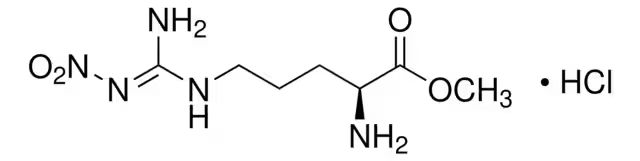
CAS Number51298-62-5
SynonymsLNAME hydrochloride; Nitro-L-arginine Methyl Ester Hydrochloride; MFCD00039052; N(γ)-nitro-L-arginine methyl ester hydrochloride; N'-Nitro-L-arginine methyl ester hydrochloride; Methyl (E)-N-[amino(nitroamino)methylene]-L-ornithinate hydrochloride (1:1); L-NAME hydrochloride; methyl (2S)-2-amino-5-[[amino(nitramido)methylidene]amino]pentanoate,hydrochloride; Nω-Nitro-L-arginine Methyl Ester Hydrochloride; NG-Nitro-L-arginine-methyl ester hydrochloride; EINECS 257-116-1; L-Ornithine, N-[amino(nitroamino)methylene]-, methyl ester, (E)-, hydrochloride (1:1); N-Nitro-L-Arginine methyl ester hydrochloride; (S)-Methyl 2-amino-5-(3-nitroguanidino)pentanoate hydrochloride; H-Arg(NO2)-Ome·Hcl; H-Arg(NO2)-Ome.HCl; N'-Nitro-L-arginine-methylester hydrochloride; L-NAME (hydrochloride)
Molecular FormulaC7H16ClN5O4
Molecular Weight269.69
Purity≥97 (TLC)%
Boiling Point383.5ºC at 760 mmHg
Melting Point132 °C
Appearancepowder
EINECS257-116-1
Symbol
Signal WordWarning
| Chemical & Physical Properties | |
|---|---|
| CAS Number | 51298-62-5 |
| Catalog No. | 2A-9043443 |
| Chinese Name | N-硝基-L-精氨酸甲酯 |
| Synonyms | LNAME hydrochloride; Nitro-L-arginine Methyl Ester Hydrochloride; MFCD00039052; N(γ)-nitro-L-arginine methyl ester hydrochloride; N'-Nitro-L-arginine methyl ester hydrochloride; Methyl (E)-N-[amino(nitroamino)methylene]-L-ornithinate hydrochloride (1:1); L-NAME hydrochloride; methyl (2S)-2-amino-5-[[amino(nitramido)methylidene]amino]pentanoate,hydrochloride; Nω-Nitro-L-arginine Methyl Ester Hydrochloride; NG-Nitro-L-arginine-methyl ester hydrochloride; EINECS 257-116-1; L-Ornithine, N-[amino(nitroamino)methylene]-, methyl ester, (E)-, hydrochloride (1:1); N-Nitro-L-Arginine methyl ester hydrochloride; (S)-Methyl 2-amino-5-(3-nitroguanidino)pentanoate hydrochloride; H-Arg(NO2)-Ome·Hcl; H-Arg(NO2)-Ome.HCl; N'-Nitro-L-arginine-methylester hydrochloride; L-NAME (hydrochloride) |
| Molecular Formula | C7H16ClN5O4 |
| Molecular Weight | 269.69 |
| Purity | ≥97 (TLC) |
| Boiling Point | 383.5ºC at 760 mmHg |
| Melting Point | 132 °C |
| Appearance | powder |
| Storage Condition | Sealed, store at 2 ºC -8 ºC |
| Application | L-NAME hydrochloride is an inhibitor of NOS with an IC50 of 70 μM. |
| EINECS | 257-116-1 |
| PubChem ID | 24278011 |
| MDL Number | MFCD00039052 |
| SMILES | Cl.COC(=O)[C@@H](N)CCCNC(=N)N[N+]([O-])=O |
| InChI | 1S/C7H15N5O4.ClH/c1-16-6(13)5(8)3-2-4-10-7(9)11-12(14)15;/h5H,2-4,8H2,1H3,(H3,9,10,11);1H/t5-;/m0./s1 |
| InChI Key | QBNXAGZYLSRPJK-JEDNCBNOSA-N |
| Beilstein/REAXYS | 3744166 |
| NACRES Code | NA.77 |
| UNSPSC | 12352209 |
| Hazard Symbols | transportation |
| MSDS | msds/43443_1_51298_62_5.pdf |
| Bioactivity | L-NAME hydrochloride inhibits NOS with an IC50 of 70 μM. L-NAME is a precursor to NOS inhibitor L-NOARG which has an IC50 value of 1.4 μM. Related Catalog Signaling Pathways >> Immunology/Inflammation >> NO Synthase Research Areas >> Cancer Target IC50: 70 μM (NOS)[1] In Vitro L-arginine analogues are widely used inhibitors of nitric oxide synthase (NOS) activity, with Nw-nitro-L-arginine methyl ester (L-NAME) being at the head[2]. Freshly dissolved L-NAME is a 50 fold less potent inhibitor of purified brain NOS (mean IC50= 70 μM) than L-NOARG (IC50= 1.4 μM), but the apparent inhibitory potency of L-NAME approached that of L-NOARG upon prolonged incubation at neutral or alkaline pH. HPLC analyses reveal that NOS inhibition by L-NAME closely correlated with hydrolysis of the drug to L-NOARG[1]. In Vivo L-NAME infusion significantly decreases NKT-leukocyte level, tumor-necrosis factor (TNF)-alpha production by T-splenocytes and macrophages, and interferon-gamma production by T-leukocytes, monocytes, and T-splenocytes, as well as increased interleukin-6 production by T-leukocytes and monocytes and nitrate/nitrite production by T-leukocytes[3]. There is increasing evidence that nitric oxide may be involved in learning and memory. l-NAME produces a task-dependent impairment of fear extinction, and implies that nitric oxide signaling is involved in memory process of certain fear extinction tasks[4]. Chronic L-NAME administration induces cardiac hypertrophy in rodent models. Six weeks L-NAME administration induces significant cardiac hypertrophy compared to control hearts[5]. Animal Admin Rats: The purpose is to investigate dose effects of chronically infused NOS inhibitor, LNAME on the anabolism, inflammatory responses, and arginine metabolism in parenterally fed rats with cecal puncture-induced subacute peritonitis. Male Wistar rats (8-9 weeks old), initially weighing 250 g, are used in the study. Rats are divided into 4 groups and are administered total parenteral nutrition solutions with 0, 5 (low dose), 25 (medium dose), or 50 (high dose) mg/kg per day of L-NAME for 7 days[3]. Mice: 12-20 week old C57BL/6J mice (5 per group) are administered L-NAME (0.325mg/mL) in the drinking water. Hearts are excised at 1-day, 2-days, 5-days, 2-weeks or 6-weeks; or controls which received no L-NAME. Ventricular cross-sectional wall thickness and individual cardiac myocytes cross-sectional area and cardiomyocyte/nuclear ratio to determine cardiac hypertrophy. Immuno-histochemical staining for c-kit, sca-1 and BCRP undertaken[5]. References [1]. Pfeiffer S, et al. Inhibition of nitric oxide synthesis by NG-nitro-L-arginine methyl ester (L-NAME): requirement forbioactivation to the free acid, NG-nitro-L-arginine. Br J Pharmacol. 1996 Jul;118(6):1433-40. [2]. Kopincová J, et al. L-NAME in the cardiovascular system - nitric oxide synthase activator? Pharmacol Rep. 2012;64(3):511-20. [3]. Lo HC, et al. The Nitric Oxide Synthase Inhibitor NG-Nitro-L-Arginine Methyl Ester Diminishes the Immunomodulatory Effects of Parental Arginine in Rats with Subacute Peritonitis. PLoSOne. 2016 Mar 23;11(3):e0151973. [4]. Luo H, et al. Effect of nitric oxide synthase inhibitor L-NAME on fear extinction in rats: a task-dependent effect. Neurosci Lett. 2014 Jun 20;572:13-8. [5]. Ocsan RJ, et al. Chronic NG-nitro-l-arginine methyl ester (L-NAME) administration in C57BL/6J mice induces a sustained decrease in c-kit positive cells during development of cardiac hypertrophy. J Physiol Pharmacol. 2013 Dec;64(6):727-36. Chemical & Physical Properties Boiling Point 383.5ºC at 760 mmHg Melting Point 157-161 °C (dec.) Molecular Formula C7H16ClN5O4 Molecular Weight 269.686 Flash Point 185.8ºC Exact Mass 269.089081 PSA 146.05000 LogP 1.47960 Index of Refraction 15 ° (C=3, MeOH) InChIKey QBNXAGZYLSRPJK-JEDNCBNOSA-N SMILES COC(=O)C(N)CCCN=C(N)N[N+](=O)[O-].Cl Storage condition 2~8°C |
| Use of | L-NAME hydrochloride inhibits NOS with an IC50 of 70 μM. L-NAME is a precursor to NOS inhibitor L-NOARG which has an IC50 value of 1.4 μM. Properties Articles86 Name N'-Nitro-L-arginine-methyl ester hydrochloride Synonym More Synonyms L-NAME HCl Biological Activity Description L-NAME hydrochloride inhibits NOS with an IC50 of 70 μM. L-NAME is a precursor to NOS inhibitor L-NOARG which has an IC50 value of 1.4 μM. Related Catalog Signaling Pathways >> Immunology/Inflammation >> NO Synthase Research Areas >> Cancer IC50: 70 μM (NOS)[1] In Vitro L-arginine analogues are widely used inhibitors of nitric oxide synthase (NOS) activity, with Nw-nitro-L-arginine methyl ester (L-NAME) being at the head[2]. Freshly dissolved L-NAME is a 50 fold less potent inhibitor of purified brain NOS (mean IC50= 70 μM) than L-NOARG (IC50= 1.4 μM), but the apparent inhibitory potency of L-NAME approached that of L-NOARG upon prolonged incubation at neutral or alkaline pH. HPLC analyses reveal that NOS inhibition by L-NAME closely correlated with hydrolysis of the drug to L-NOARG[1]. In Vivo L-NAME infusion significantly decreases NKT-leukocyte level, tumor-necrosis factor (TNF)-alpha production by T-splenocytes and macrophages, and interferon-gamma production by T-leukocytes, monocytes, and T-splenocytes, as well as increased interleukin-6 production by T-leukocytes and monocytes and nitrate/nitrite production by T-leukocytes[3]. There is increasing evidence that nitric oxide may be involved in learning and memory. l-NAME produces a task-dependent impairment of fear extinction, and implies that nitric oxide signaling is involved in memory process of certain fear extinction tasks[4]. Chronic L-NAME administration induces cardiac hypertrophy in rodent models. Six weeks L-NAME administration induces significant cardiac hypertrophy compared to control hearts[5]. References [1]. Pfeiffer S, et al. Inhibition of nitric oxide synthesis by NG-nitro-L-arginine methyl ester (L-NAME): requirement forbioactivation to the free acid, NG-nitro-L-arginine. Br J Pharmacol. 1996 Jul;118(6):1433-40. [2]. Kopincová J, et al. L-NAME in the cardiovascular system - nitric oxide synthase activator? Pharmacol Rep. 2012;64(3):511-20. [3]. Lo HC, et al. The Nitric Oxide Synthase Inhibitor NG-Nitro-L-Arginine Methyl Ester Diminishes the Immunomodulatory Effects of Parental Arginine in Rats with Subacute Peritonitis. PLoSOne. 2016 Mar 23;11(3):e0151973. [4]. Luo H, et al. Effect of nitric oxide synthase inhibitor L-NAME on fear extinction in rats: a task-dependent effect. Neurosci Lett. 2014 Jun 20;572:13-8. [5]. Ocsan RJ, et al. Chronic NG-nitro-l-arginine methyl ester (L-NAME) administration in C57BL/6J mice induces a sustained decrease in c-kit positive cells during development of cardiac hypertrophy. J Physiol Pharmacol. 2013 Dec;64(6):727-36. Chemical & Physical Properties Exact Mass 269.089081 PSA 146.05000 LogP 1.47960 InChIKey QBNXAGZYLSRPJK-JEDNCBNOSA-N SMILES COC(=O)C(N)CCCN=C(N)N[N+](=O)[O-].Cl |
| Transport Info | Product name: Purity: 98.0% |
| MSDS Transport Info | Module 14. Shipping information 14.1 UN dangerous goods number European Land Transport Dangerous Regulations: -International Maritime Dangerous Regulations: -International Air Transport Dangerous Regulations: - 14.2 Names specified by the United Nations (UN) European Land Transport Dangerous Regulations: Non-dangerous goods IMDG Code: Non-dangerous goods International air transport dangerous goods regulations: non-dangerous goods 14.3 Transport hazard categories European Land Transport Dangerous Regulations: -International Maritime Dangerous Regulations: -International Air Transport Dangerous Regulations: - 14.4 Package group European Land Transport Dangerous Regulations: -International Maritime Dangerous Regulations: -International Air Transport Dangerous Regulations: - 14.5 Environmental hazards European Land Transport Dangerous Regulations: No International Maritime Transport Dangerous Regulations Maritime Pollutants: No International Air Transport Risk Regulations: No 14.6 Special reminder to users No data available |
| Related Products in Nutritional Ingredients | ||
|---|---|---|
| Vitamin E nicotinate | 43119-47-7 | 2A-9043079 |
| Boc-N-methyl-L-valine | 45170-31-8 | 2A-9043109 |
| N-Hexadecanoyl-L-valine | 45287-42-1 | 2A-9043112 |
| Boc-O-tert-butyl-L-tyrosine | 47375-34-8 | 2A-9043158 |
| 4-(Methylsulfinyl)-L-2-aminobutanoyl-L-alpha-glutamyl-L-histidyl-L-phenylalanyl-D-lysyl-L-phenylalanine | 50913-93-4 | 2A-9043367 |
| L-Dierucoyl lecithin | 51779-95-4 | 2A-9043587 |
| Tocopherol nicotinate | 51898-34-1 | 2A-9043621 |
| O-Benzyl-L-tyrosine benzyl ester hydrochloride | 52142-01-5 | 2A-9043678 |
| Argininyl-valinyl-tyrosinyl-isoleucinyl-histidinyl-prolinyl-isoleucine | 52498-25-6 | 2A-9043779 |
| Boc-N-Methyl-L-isoleucine | 52498-32-5 | 2A-9043780 |
| Browse all Nutritional Ingredients products » | ||
Phone:
630-322-8886
630-322-8887
Email:
Office Locations:
Chicago, IL, USA
San Francisco, CA, USA


 EN
EN


 SDS
SDS