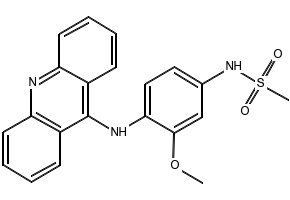
CAS Number51264-14-3
Synonymsm-AMSA; meta-Amsacrine; Amsacrine; 4'-(Acridinylamino)methanesulfon-m-anisidide; Amsidyl; AMSA P-D; Amekrin; EINECS 257-094-3; Amsine; Amsidine; N-[4-(9-Acridinylamino)-3-methoxuphenyl]methanesulfonamide; N-[4-(9-Acridinylamino)-3-methoxyphenyl]methanesulfonamide; N-[4-(acridin-9-ylamino)-3-(methyloxy)phenyl]methanesulfonamide; N-[4-(acridin-9-ylamino)-3-methoxyphenyl]methanesulfonamide
Molecular FormulaC21H19O3N3S1
Molecular Weight393.47
Purity98.00%
Density1.4±0.1 g/cm3
Boiling Point563.0±60.0 °C at 760 mmHg
Melting Point230-240ºC
Appearancewhite solid
Symbol
Signal WordWarning
| Chemical & Physical Properties | |
|---|---|
| CAS Number | 51264-14-3 |
| Catalog No. | 2A-9043436 |
| Chinese Name | 安吖啶 |
| Synonyms | m-AMSA; meta-Amsacrine; Amsacrine; 4'-(Acridinylamino)methanesulfon-m-anisidide; Amsidyl; AMSA P-D; Amekrin; EINECS 257-094-3; Amsine; Amsidine; N-[4-(9-Acridinylamino)-3-methoxuphenyl]methanesulfonamide; N-[4-(9-Acridinylamino)-3-methoxyphenyl]methanesulfonamide; N-[4-(acridin-9-ylamino)-3-(methyloxy)phenyl]methanesulfonamide; N-[4-(acridin-9-ylamino)-3-methoxyphenyl]methanesulfonamide |
| Molecular Formula | C21H19O3N3S1 |
| Molecular Weight | 393.47 |
| Purity | 98.00 |
| Density | 1.4±0.1 g/cm3 |
| Boiling Point | 563.0±60.0 °C at 760 mmHg |
| Melting Point | 230-240ºC |
| Appearance | white solid |
| Storage Condition | Keep the container sealed and stored in a cool, dr |
| Packaging | III |
| Application | Amsacrine is a tumor cell DNA intercalator and also inhibits topoisomerase II. |
| HTC | 2935009090 |
| PubChem ID | 4711 |
| MDL Number | MFCD00242748 |
| SMILES | COc1cc(NS(C)(=O)=O)ccc1Nc1c2ccccc2nc2ccccc12 |
| InChI | InChI=1S/C21H19N3O3S/c1-27-20-13-14(24-28(2,25)26)11-12-19(20)23-21-15-7-3-5-9-17(15)22-18-10-6-4-8-16(18)21/h3-13,24H,1-2H3,(H,22,23) |
| InChI Key | XCPGHVQEEXUHNC-UHFFFAOYSA-N |
| Hazard Symbols | 6.1(b) |
| MSDS | msds/43436_1_51264_14_3.pdf |
| Use of | Amsacrine is an inhibitor of topoisomerase II, and acts as an antineoplastic agent which can intercalates into the DNA of tumor cells. Properties Name amsacrine Synonym More Synonyms Amsacrine Biological Activity Description Amsacrine is an inhibitor of topoisomerase II, and acts as an antineoplastic agent which can intercalates into the DNA of tumor cells. Related Catalog Signaling Pathways >> Autophagy >> Autophagy Signaling Pathways >> Cell Cycle/DNA Damage >> Topoisomerase Research Areas >> Cancer Topoisomerase II References [1]. Thomas D, et al. Inhibition of cardiac HERG currents by the DNA topoisomerase II inhibitor amsacrine: mode of action. Br J Pharmacol. 2004 Jun;142(3):485-94. [2]. Attia SM. Molecular cytogenetic evaluation of the mechanism of genotoxic potential of amsacrine and nocodazole in mouse bone marrow cells. J Appl Toxicol. 2013 Jun;33(6):426-33. [3]. Kao-Shan CS, et al. Cytogenetic effects of amsacrine on human lymphocytes in vivo and in vitro. Cancer Treat Rep. 1984 Jul-Aug;68(7-8):989-97. Chemical & Physical Properties Molecular Formula C21H19N3O3S Exact Mass 393.114716 PSA 88.70000 Index of Refraction 1.723 InChIKey XCPGHVQEEXUHNC-UHFFFAOYSA-N Toxicological Information CHEMICAL IDENTIFICATION RTECS NUMBER : CHEMICAL NAME : Methanesulfon-m-anisidide, 4'-(9-acridinylamino)- CAS REGISTRY NUMBER : 51264-14-3 BEILSTEIN REFERENCE NO. : LAST UPDATED : DATA ITEMS CITED : MOLECULAR FORMULA : C21-H19-N3-O3-S MOLECULAR WEIGHT : WISWESSER LINE NOTATION : T C666 BNJ IMR BO1 DMSW1 HEALTH HAZARD DATA ACUTE TOXICITY DATA TYPE OF TEST : LDLo - Lowest published lethal dose ROUTE OF EXPOSURE : Intravenous SPECIES OBSERVED : Human - man DOSE/DURATION : 5405 ug/kg/3H-C TOXIC EFFECTS : Blood - changes in bone marrow (not otherwise specified) TYPE OF TEST : TDLo - Lowest published toxic dose ROUTE OF EXPOSURE : Intravenous SPECIES OBSERVED : DOSE/DURATION : TOXIC EFFECTS : Vascular - thrombosis distant from injection site Gastrointestinal - nausea or vomiting Blood - other changes TYPE OF TEST : LD50 - Lethal dose, 50 percent kill ROUTE OF EXPOSURE : SPECIES OBSERVED : Rodent - mouse DOSE/DURATION : 53420 ug/kg TOXIC EFFECTS : Details of toxic effects not reported other than lethal dose value TYPE OF TEST : LD50 - Lethal dose, 50 percent kill ROUTE OF EXPOSURE : Intraperitoneal SPECIES OBSERVED : Rodent - mouse DOSE/DURATION : 15470 ug/kg TOXIC EFFECTS : Details of toxic effects not reported other than lethal dose value TYPE OF TEST : LD50 - Lethal dose, 50 percent kill ROUTE OF EXPOSURE : Subcutaneous SPECIES OBSERVED : Rodent - mouse DOSE/DURATION : TOXIC EFFECTS : Details of toxic effects not reported other than lethal dose value TYPE OF TEST : LD50 - Lethal dose, 50 percent kill ROUTE OF EXPOSURE : Intravenous SPECIES OBSERVED : Rodent - mouse DOSE/DURATION : 33700 ug/kg TOXIC EFFECTS : Behavioral - somnolence (general depressed activity) Behavioral - convulsions or effect on seizure threshold Lungs, Thorax, or Respiration - dyspnea TYPE OF TEST : LD50 - Lethal dose, 50 percent kill ROUTE OF EXPOSURE : SPECIES OBSERVED : Mammal - dog DOSE/DURATION : TOXIC EFFECTS : Behavioral - food intake (animal) Gastrointestinal - hypermotility, diarrhea Gastrointestinal - nausea or vomiting TYPE OF TEST : LD50 - Lethal dose, 50 percent kill ROUTE OF EXPOSURE : Intravenous SPECIES OBSERVED : Mammal - dog DOSE/DURATION : 6250 ug/kg TOXIC EFFECTS : Behavioral - convulsions or effect on seizure threshold Lungs, Thorax, or Respiration - dyspnea Nutritional and Gross Metabolic - weight loss or decreased weight gain TYPE OF TEST : LDLo - Lowest published lethal dose ROUTE OF EXPOSURE : Intravenous SPECIES OBSERVED : Primate - monkey DOSE/DURATION : 10400 ug/kg TOXIC EFFECTS : Blood - changes in bone marrow (not otherwise specified) TYPE OF TEST : TDLo - Lowest published toxic dose ROUTE OF EXPOSURE : Intraperitoneal SPECIES OBSERVED : Rodent - rat DOSE/DURATION : TOXIC EFFECTS : Blood - changes in bone marrow (not otherwise specified) Related to Chronic Data - death TYPE OF TEST : TDLo - Lowest published toxic dose ROUTE OF EXPOSURE : Intravenous SPECIES OBSERVED : Rodent - rat DOSE/DURATION : TOXIC EFFECTS : Blood - changes in bone marrow (not otherwise specified) Nutritional and Gross Metabolic - weight loss or decreased weight gain Related to Chronic Data - changes in testicular weight TYPE OF TEST : TDLo - Lowest published toxic dose ROUTE OF EXPOSURE : Intravenous SPECIES OBSERVED : Rodent - mouse DOSE/DURATION : 69250 ug/kg/5D-I TOXIC EFFECTS : Behavioral - muscle contraction or spasticity Blood - pigmented or nucleated red blood cells Related to Chronic Data - death TYPE OF TEST : TDLo - Lowest published toxic dose ROUTE OF EXPOSURE : SPECIES OBSERVED : Mammal - dog DOSE/DURATION : TOXIC EFFECTS : Behavioral - somnolence (general depressed activity) Blood - changes in bone marrow (not otherwise specified) Related to Chronic Data - death TYPE OF TEST : TDLo - Lowest published toxic dose ROUTE OF EXPOSURE : Intravenous SPECIES OBSERVED : Mammal - dog DOSE/DURATION : 1950 ug/kg/5D-I TOXIC EFFECTS : Blood - hemorrhage Blood - changes in bone marrow (not otherwise specified) Blood - changes in leukocyte (WBC) count TYPE OF TEST : TDLo - Lowest published toxic dose ROUTE OF EXPOSURE : Intravenous SPECIES OBSERVED : Primate - monkey DOSE/DURATION : TOXIC EFFECTS : Blood - changes in bone marrow (not otherwise specified) Blood - changes in leukocyte (WBC) count TYPE OF TEST : TDLo - Lowest published toxic dose ROUTE OF EXPOSURE : Intravenous SPECIES OBSERVED : Rodent - rat DOSE/DURATION : TOXIC EFFECTS : Tumorigenic - Carcinogenic by RTECS criteria Gastrointestinal - tumors Skin and Appendages - tumors TYPE OF TEST : TDLo - Lowest published toxic dose ROUTE OF EXPOSURE : Intravenous 6486 ug/kg SEX/DURATION : male 3 week(s) pre-mating TOXIC EFFECTS : Reproductive - Paternal Effects - spermatogenesis (incl. genetic material, sperm morphology, motility, and count) TYPE OF TEST : TDLo - Lowest published toxic dose ROUTE OF EXPOSURE : Intraperitoneal SEX/DURATION : female 6-9 day(s) after conception TOXIC EFFECTS : Reproductive - Fertility - post-implantation mortality (e.g. dead and/or resorbed implants per total number of implants) Reproductive - Fertility - litter size (e.g. # fetuses per litter; measured before birth) Reproductive - Effects on Embryo or Fetus - fetotoxicity (except death, e.g., stunted fetus) TYPE OF TEST : TDLo - Lowest published toxic dose ROUTE OF EXPOSURE : Intraperitoneal SEX/DURATION : male 1 day(s) pre-mating TOXIC EFFECTS : Reproductive - Paternal Effects - spermatogenesis (incl. genetic material, sperm morphology, motility, and count) TYPE OF TEST : Micronucleus test TYPE OF TEST : DNA damage TYPE OF TEST : Cytogenetic analysis MUTATION DATA TYPE OF TEST : DNA damage TEST SYSTEM : Mammal - species unspecified Lymphocyte DOSE/DURATION : REFERENCE : Safety Information RIDADR UN 3249 Packaging Group III Hazard Class 6.1(b) HS Code 2935009090 |
| Tax Rebate | 9.0% |
| Supervision | None MFN tariff: 6.5% Ordinary tariff: 35.0% |
| Transport Info | Product name: Summary 2935009090 other sulphonamides VAT:17.0% Tax rebate rate:9.0% Supervision conditions:none MFN tariff:6.5% General tariff:35.0% |
| Related Products in Specialty Chemicals | ||
|---|---|---|
| Ethyl 2-acetyl-3-(dimethylamino)acrylate | 51145-57-4 | 2A-9043417 |
| 2-Fluoro-2-deoxy-D-glucose | 51146-53-3 | 2A-9043418 |
| Heptakis(2,6-di-O-methyl)-beta-cyclodextrin | 51166-71-3 | 2A-0202152 |
| 4,4-Dimethyloxazolidine | 51200-87-4 | 2A-9043426 |
| Substituted benzene sulfonamide | 51253-00-0 | 2A-9043432 |
| N-Hydroxycyclopropanecarboxamidine | 51285-13-3 | 2A-9043439 |
| 5-(4,6-Dichlorotriazinyl)aminofluorescein | 51306-35-5 | 2A-9043444 |
| 9-Chloro-1-nonanol | 51308-99-7 | 2A-9043446 |
| 4-(Dicyanomethylene)-2-methyl-6-(4-dimethylaminostyryl)-4H-pyran | 51325-91-8 | 2A-9043452 |
| 4-(Dicyanomethylene)-2-methyl-6-(julolidin-4-ylvinyl)-4H-pyran | 51325-95-2 | 2A-9043453 |
| Browse all Specialty Chemicals products » | ||
Phone:
630-322-8886
630-322-8887
Email:
Office Locations:
Chicago, IL, USA
San Francisco, CA, USA


 EN
EN


 SDS
SDS