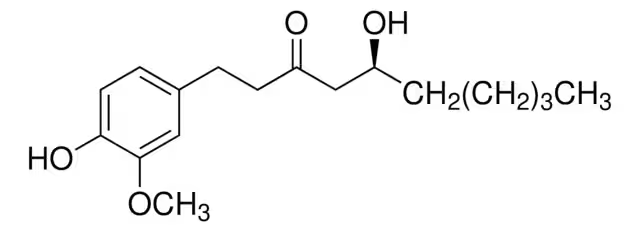
CAS Number23513-14-6
Synonyms(S)-5-Hydroxy-1-(4-hydroxy-3-methoxyphenyl)decan-3-one; 3-Decanone (5-hydroxy-1-(4-hydroxy-3-methoxyphenyl); (+)-Gingerol; (S)-[6]Gingerol; (S)-5-Hydroxy-1-(4-hydroxy-3-methoxyphenyl)-3-decanone; (+)-5-Hydroxy-1-(4-hydroxy-3-methoxyphenyl)-3-decanone; (S)-(+)-[6]Gingerol; (+)-[6]-Gingerol; 6-Gingerol; (S)-(6)-Gingerol; (5S)-5-Hydroxy-1-(4-hydroxy-3-methoxy-phenyl)decan-3-one; Gingerol; UNII-925QK2Z900; (5S)-5-Hydroxy-1-(4-hydroxy-3-methoxyphenyl)-3-decanone; (5S)-5-Hydroxy-1-(4-hydroxy-3-methoxyphenyl)decan-3-one; MFCD00210507; [6]-Gingerol
Molecular FormulaC17H26O4
Molecular Weight294.39
Purity≥98 (HPLC)%
Density1.1±0.1 g/cm3
Boiling Point453.0±35.0 °C at 760 mmHg
Melting Point30 - 32ºC
AppearanceLight yellow oily
Symbol
Signal WordWarning
| Chemical & Physical Properties | |
|---|---|
| CAS Number | 23513-14-6 |
| Catalog No. | 2A-9039272 |
| Chinese Name | 6-姜酚 |
| Synonyms | (S)-5-Hydroxy-1-(4-hydroxy-3-methoxyphenyl)decan-3-one; 3-Decanone (5-hydroxy-1-(4-hydroxy-3-methoxyphenyl); (+)-Gingerol; (S)-[6]Gingerol; (S)-5-Hydroxy-1-(4-hydroxy-3-methoxyphenyl)-3-decanone; (+)-5-Hydroxy-1-(4-hydroxy-3-methoxyphenyl)-3-decanone; (S)-(+)-[6]Gingerol; (+)-[6]-Gingerol; 6-Gingerol; (S)-(6)-Gingerol; (5S)-5-Hydroxy-1-(4-hydroxy-3-methoxy-phenyl)decan-3-one; Gingerol; UNII-925QK2Z900; (5S)-5-Hydroxy-1-(4-hydroxy-3-methoxyphenyl)-3-decanone; (5S)-5-Hydroxy-1-(4-hydroxy-3-methoxyphenyl)decan-3-one; MFCD00210507; [6]-Gingerol |
| Molecular Formula | C17H26O4 |
| Molecular Weight | 294.39 |
| Purity | ≥98 (HPLC) |
| Density | 1.1±0.1 g/cm3 |
| Boiling Point | 453.0±35.0 °C at 760 mmHg |
| Melting Point | 30 - 32ºC |
| Appearance | Light yellow oily |
| Water Solubility | Soluble in: benzene, ether, chloroform |
| Storage Condition | Place in a tight storage container |
| Application | [6]-Gingerol is an active substance isolated from ginger that has a variety of biological activities, including anti-cancer, anti-inflammatory, and antioxidant. |
| HTC | 2914509090 |
| PubChem ID | 329799719 |
| MDL Number | MFCD00210507 |
| SMILES | CCCCC[C@H](O)CC(=O)CCc1ccc(O)c(OC)c1 |
| InChI | 1S/C17H26O4/c1-3-4-5-6-14(18)12-15(19)9-7-13-8-10-16(20)17(11-13)21-2/h8,10-11,14,18,20H,3-7,9,12H2,1-2H3/t14-/m0/s1 |
| InChI Key | NLDDIKRKFXEWBK-AWEZNQCLSA-N |
| NACRES Code | NA.25 |
| UNSPSC | 12352205 |
| Hazard Symbols | transportation |
| MSDS | msds/39272_1_23513_14_6.pdf |
| Bioactivity | [6]-Gingerol is an active compound isolated from Ginger (Zingiber officinale Rosc), exhibits a variety of biological activities including anticancer, anti-inflammation, and anti-oxidation. Related Catalog Signaling Pathways >> Epigenetics >> AMPK Signaling Pathways >> PI3K/Akt/mTOR >> AMPK Signaling Pathways >> Apoptosis >> Apoptosis Research Areas >> Cancer Natural Products >> Flavonoids Target AMPK Apoptosis In Vitro [6]-gingerol inhibits colon cancer cell proliferation and induced apoptosis, while the normal colon cells are unaffected. [6]-gingerol down-regulates phorbol myristate acetate induced phosphorylation of ERK1/2 and JNK MAP kinases and activation of AP-1 transcription factor, but has only little effects on phosphorylation of p38 MAP kinase and activation of NF-kappa B[1]. [6]-gingerol treatment is shown to restore impaired intestinal barrier function and to suppress proinflammatory responses in DSS-treated Caco-2 monolayers. AMPK is activated on [6]-gingerol treatment[2]. Treatment with [6]-gingerol results in a significant decrease in the viability of osteosarcoma cells in a dose-dependent fashion. In parallel, the number of cells arrested at the sub-G1 cell cycle phase is significantly increased. [6]-gingerol induces activation of caspase cascades and regulates cellular levels of Bcl2 and Bax[3]. In Vivo In animal studies, [6]-gingerol significantly ameliorates DSS-induced colitis by restoration of body weight loss, reduction in intestinal bleeding, and prevention of colon length shortening. In addition, [6]-gingerol suppresses DSS-elevated production of proinflammatory cytokines (IL-1β, TNFα, and IL-12)[2]. Cell Assay [6]-gingerol stock (20 mg/mL) is prepared in ethanol and the working concentrations are prepared by diluting this stock in dimethyl sufoxide (DMSO). For MTT assay, 5×10³ cells/well of human colon cancer cells and 104 cells/well of mouse IECs are seeded in 96-well plates. Cells are treated with [6]-gingerol for 48 h,72 h or 96 h before performing MTT assay and for 16 h before Annexin-V staining[1]. Animal Admin Mice: Mice with DSS-induced colitis are given different oral dosages of [6]-gingerol daily for 14 days. Body weight and colon inflammation are evaluated, and level of proinflammatory cytokines in colon tissues is measured[2]. References [1]. Radhakrishnan EK, et al. [6]-Gingerol induces caspase-dependent apoptosis and prevents PMA-induced proliferation in colon cancer cells by inhibiting MAPK/AP-1 signaling. PLoS One. 2014 Aug 26;9(8):e104401. [2]. Chang KW, et al. 6-Gingerol modulates proinflammatory responses in dextran sodium sulfate (DSS)-treated Caco-2 cells and experimental colitis in mice through adenosine monophosphate-activated protein kinase (AMPK) activation. Food Funct. 2015 Oct;6(10):3334-41. [3]. Fan J, et al. 6-Gingerol inhibits osteosarcoma cell proliferation through apoptosis and AMPK activation. Tumour Biol. 2015 Feb;36(2):1135-41. Chemical & Physical Properties Density 1.1±0.1 g/cm3 Boiling Point 453.0±35.0 °C at 760 mmHg Melting Point 30 - 32ºC Molecular Formula C17H26O4 Molecular Weight 294.386 Flash Point 159.0±19.4 °C Exact Mass 294.183105 PSA 66.76000 LogP 2.48 Vapour Pressure 0.0±1.2 mmHg at 25°C Index of Refraction 1.523 InChIKey NLDDIKRKFXEWBK-AWEZNQCLSA-N SMILES CCCCCC(O)CC(=O)CCc1ccc(O)c(OC)c1 Storage condition ?20°C |
| Use of | [6]-Gingerol is an active compound isolated from Ginger (Zingiber officinale Rosc), exhibits a variety of biological activities including anticancer, anti-inflammation, and anti-oxidation. Properties Articles19 Name gingerol Synonym More Synonyms 6-Gingerol Biological Activity Description [6]-Gingerol is an active compound isolated from Ginger (Zingiber officinale Rosc), exhibits a variety of biological activities including anticancer, anti-inflammation, and anti-oxidation. Related Catalog Signaling Pathways >> Epigenetics >> AMPK Signaling Pathways >> PI3K/Akt/mTOR >> AMPK Signaling Pathways >> Apoptosis >> Apoptosis Research Areas >> Cancer Natural Products >> Flavonoids In Vivo In animal studies, [6]-gingerol significantly ameliorates DSS-induced colitis by restoration of body weight loss, reduction in intestinal bleeding, and prevention of colon length shortening. In addition, [6]-gingerol suppresses DSS-elevated production of proinflammatory cytokines (IL-1β, TNFα, and IL-12)[2]. Animal Admin Mice: Mice with DSS-induced colitis are given different oral dosages of [6]-gingerol daily for 14 days. Body weight and colon inflammation are evaluated, and level of proinflammatory cytokines in colon tissues is measured[2]. References [1]. Radhakrishnan EK, et al. [6]-Gingerol induces caspase-dependent apoptosis and prevents PMA-induced proliferation in colon cancer cells by inhibiting MAPK/AP-1 signaling. PLoS One. 2014 Aug 26;9(8):e104401. [3]. Fan J, et al. 6-Gingerol inhibits osteosarcoma cell proliferation through apoptosis and AMPK activation. Tumour Biol. 2015 Feb;36(2):1135-41. Chemical & Physical Properties Molecular Formula C17H26O4 Exact Mass 294.183105 PSA 66.76000 Index of Refraction 1.523 InChIKey NLDDIKRKFXEWBK-AWEZNQCLSA-N |
| Tax Rebate | 9.0% |
| Supervision | None MFN tariff: 5.5% Ordinary tariff: 30.0% |
| Transport Info | Product name: Purity: 98.0% |
| MSDS Transport Info | Module 14. Shipping information 14.1 UN dangerous goods number European Dangerous Regulations for land transport: 2811 International Dangerous Regulations for sea transport: 2811 International Dangerous Regulations for air transport: 2811 14.2 Names specified by the United Nations (UN) European land transport hazard regulations: TOXIC SOLID, ORGANIC, N.O.S. (5-Hydroxy-1 -(4-hydroxy-3-methoxyphenyl)-3- decanone) IMDG: TOXIC SOLID, ORGANIC, N.O.S. (5-Hydroxy-1 -(4-hydroxy-3-methoxyphenyl)-3- decanone) International air transport hazard regulations: Toxic solid, organic, n.o.s. (5-Hydroxy-1 -(4-hydroxy-3-methoxyphenyl)-3-decanone) 14.3 Transport hazard categories European Land Transport Danger Regulations: 6.1 International Maritime Transport Danger Regulations: 6.1 International Air Transport Danger Regulations: 6.1 14.4 Package group European Land Transport Danger Regulations: III International Maritime Transport Danger Regulations: III International Air Transport Danger Regulations: III 14.5 Environmental hazards European Land Transport Dangerous Regulations: No International Maritime Transport Dangerous Regulations Maritime Pollutants: No International Air Transport Risk Regulations: No 14.6 Special reminder to users No data available |
| Related Products in Botanical Reference Standards | ||
|---|---|---|
| Pinosylvin | 22139-77-1 | 2A-9038893 |
| Demethoxycurcumin | 22608-11-3 | 2A-9039038 |
| Kaempferol-3-beta-O-glucuronide | 22688-78-4 | 2A-9039054 |
| 2-Chlorochalcone | 22966-11-6 | 2A-9039125 |
| Paeoniflorin | 23180-57-6 | 2A-9039198 |
| Methyl 6-azido-6-deoxy-alpha-D-glucopyranoside | 23701-87-3 | 2A-9039324 |
| 2,3',4,5'-Tetramethoxystilbene | 24144-92-1 | 2A-9039412 |
| Hesperidin methylchalcone | 24292-52-2 | 2A-9039449 |
| Demethoxycurcumin | 24939-17-1 | 2A-9039590 |
| Cholesterol 3,5-dinitrobenzoate | 25279-63-4 | 2A-9039692 |
| Browse all Botanical Reference Standards products » | ||
Phone:
630-322-8886
630-322-8887
Email:
Office Locations:
Chicago, IL, USA
San Francisco, CA, USA


 EN
EN


 SDS
SDS