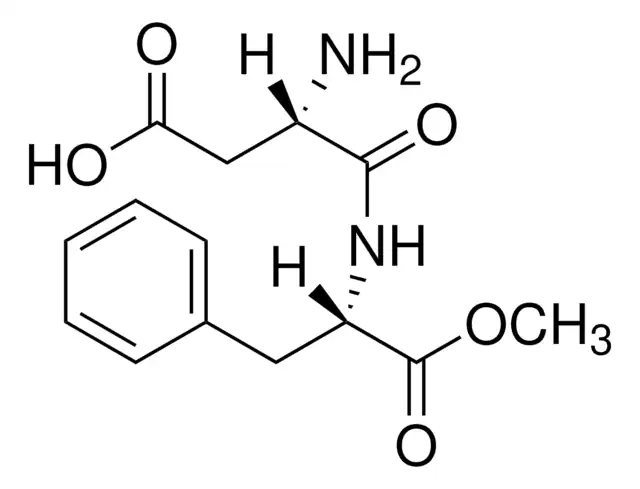
CAS Number22839-47-0
Synonymstri-sweet; Aspartylphenylalanine methyl ester; Methyl L-α-aspartyl-L-phenylalaninate; Zero-Cal; Aspartame; Equal; Canderel; N-L-α-Aspartyl-L-phenylalanine 1-Methyl Ester; mer; Asp-Phe-Ome; ASPARTAM; E 951; L-Phenylalanine, L-α-aspartyl-, methyl ester; H-Asp-Phe-OMe; MFCD00002724; EINECS 245-261-3; N-(L-α-Aspartyl)-L-phenylalanine methyl ester; methyl L-a-aspartyl-L-phenylalaninate; (S)-3-Amino-4-(((S)-1-methoxy-1-oxo-3-phenylpropan-2-yl)amino)-4-oxobutanoic acid; NutraSweet; Methyl N-L-α-aspartyl-L-phenylalaninate; N-L-a-Aspartyl-L-phenylalanine-1-Methyl Ester; Asp-Phe methyl ester; L-Aspartyl-L-phenylalanine methyl ester; L-phenylalanine, L-a-aspartyl-, methyl ester; 3-Amino-N-(a-carboxyphenethyl)succinamic Acid N-Methyl Ester; APM; β-Aspartame; Aspertame
Molecular FormulaHOOCCH2CH(NH2)CONHCH(CH2C6H5)COOCH3
Molecular Weight294.30
Purity98.00%
Density1.3±0.1 g/cm3
Boiling Point535.8±50.0 °C at 760 mmHg
Melting Point242-248 °C
Appearancewhite powder or tablets
EINECS245-261-3
Symbol
Signal WordWarning
| Chemical & Physical Properties | |
|---|---|
| CAS Number | 22839-47-0 |
| Catalog No. | 2A-0202018 |
| Chinese Name | 阿斯巴甜 |
| Synonyms | tri-sweet; Aspartylphenylalanine methyl ester; Methyl L-α-aspartyl-L-phenylalaninate; Zero-Cal; Aspartame; Equal; Canderel; N-L-α-Aspartyl-L-phenylalanine 1-Methyl Ester; mer; Asp-Phe-Ome; ASPARTAM; E 951; L-Phenylalanine, L-α-aspartyl-, methyl ester; H-Asp-Phe-OMe; MFCD00002724; EINECS 245-261-3; N-(L-α-Aspartyl)-L-phenylalanine methyl ester; methyl L-a-aspartyl-L-phenylalaninate; (S)-3-Amino-4-(((S)-1-methoxy-1-oxo-3-phenylpropan-2-yl)amino)-4-oxobutanoic acid; NutraSweet; Methyl N-L-α-aspartyl-L-phenylalaninate; N-L-a-Aspartyl-L-phenylalanine-1-Methyl Ester; Asp-Phe methyl ester; L-Aspartyl-L-phenylalanine methyl ester; L-phenylalanine, L-a-aspartyl-, methyl ester; 3-Amino-N-(a-carboxyphenethyl)succinamic Acid N-Methyl Ester; APM; β-Aspartame; Aspertame |
| Molecular Formula | HOOCCH2CH(NH2)CONHCH(CH2C6H5)COOCH3 |
| Molecular Weight | 294.30 |
| Purity | 98.00 |
| Density | 1.3±0.1 g/cm3 |
| Boiling Point | 535.8±50.0 °C at 760 mmHg |
| Melting Point | 242-248 °C |
| Appearance | white powder or tablets |
| Storage Condition | 2-8℃ |
| Application | Aspartame is an artificial non-sugar sweetener. |
| EINECS | 245-261-3 |
| HTC | 2924299090 |
| PubChem ID | 24870725 |
| MDL Number | MFCD00002724 |
| SMILES | COC(=O)[C@H](Cc1ccccc1)NC(=O)[C@@H](N)CC(O)=O |
| InChI | 1S/C14H18N2O5/c1-21-14(20)11(7-9-5-3-2-4-6-9)16-13(19)10(15)8-12(17)18/h2-6,10-11H,7-8,15H2,1H3,(H,16,19)(H,17,18)/t10-,11-/m0/s1 |
| InChI Key | IAOZJIPTCAWIRG-QWRGUYRKSA-N |
| Beilstein/REAXYS | 2223850 |
| NACRES Code | NA.24 |
| UNSPSC | 12164500 |
| Hazard Symbols | transportation |
| MSDS | msds/39084_1_22839_47_0.pdf |
| Bioactivity | Aspartame is an artificial, non-saccharide sweetener used as a sugar substitute in some foods and beverages.Target: OthersAspartame is a flavoring agent sweeter than sugar. Aspartame is a methyl ester of a dipeptide used as a synthetic nonnutritive sweetener. Epidemiological studies on aspartame include several case-control studies and one well-conducted prospective epidemiological study with a large cohort, in which the consumption of aspartame was measured. The studies provide no evidence to support an association between aspartame and cancer in any tissue. The weight of existing evidence is that aspartame is safe at current levels of consumption as a nonnutritive sweetener [1]. aspartame is safe, and there are no unresolved questions regarding its safety under conditions of intended use [2]. excessive aspartame ingestion might be involved in the pathogenesis of certain mental disorders (DSM-IV-TR 2000) and also in compromised learning and emotional functioning [3]. Related Catalog Signaling Pathways >> Others >> Others Research Areas >> Others References [1]. Magnuson, B.A., et al., Aspartame: a safety evaluation based on current use levels, regulations, and toxicological and epidemiological studies. Crit Rev Toxicol, 2007. 37(8): p. 629-727. [2]. Butchko, H.H., et al., Aspartame: review of safety. Regul Toxicol Pharmacol, 2002. 35(2 Pt 2): p. S1-93. [3]. Humphries, P., E. Pretorius, and H. Naude, Direct and indirect cellular effects of aspartame on the brain. Eur J Clin Nutr, 2008. 62(4): p. 451-62. Chemical & Physical Properties Density 1.3±0.1 g/cm3 Boiling Point 535.8±50.0 °C at 760 mmHg Melting Point 242-248 °C Molecular Formula C14H18N2O5 Molecular Weight 294.303 Flash Point 277.8±30.1 °C Exact Mass 294.121582 PSA 118.72000 LogP 1.11 Vapour Pressure 0.0±1.5 mmHg at 25°C Index of Refraction 1.557 InChIKey IAOZJIPTCAWIRG-QWRGUYRKSA-N SMILES COC(=O)C(Cc1ccccc1)NC(=O)C(N)CC(=O)O |
| Use of | Aspartame is an artificial, non-saccharide sweetener used as a sugar substitute in some foods and beverages.Target: OthersAspartame is a flavoring agent sweeter than sugar. Aspartame is a methyl ester of a dipeptide used as a synthetic nonnutritive sweetener. Epidemiological studies on aspartame include several case-control studies and one well-conducted prospective epidemiological study with a large cohort, in which the consumption of aspartame was measured. The studies provide no evidence to support an association between aspartame and cancer in any tissue. The weight of existing evidence is that aspartame is safe at current levels of consumption as a nonnutritive sweetener [1]. aspartame is safe, and there are no unresolved questions regarding its safety under conditions of intended use [2]. excessive aspartame ingestion might be involved in the pathogenesis of certain mental disorders (DSM-IV-TR 2000) and also in compromised learning and emotional functioning [3]. Properties Articles67 Name aspartame Synonym More Synonyms Aspartame Biological Activity Description Aspartame is an artificial, non-saccharide sweetener used as a sugar substitute in some foods and beverages.Target: OthersAspartame is a flavoring agent sweeter than sugar. Aspartame is a methyl ester of a dipeptide used as a synthetic nonnutritive sweetener. Epidemiological studies on aspartame include several case-control studies and one well-conducted prospective epidemiological study with a large cohort, in which the consumption of aspartame was measured. The studies provide no evidence to support an association between aspartame and cancer in any tissue. The weight of existing evidence is that aspartame is safe at current levels of consumption as a nonnutritive sweetener [1]. aspartame is safe, and there are no unresolved questions regarding its safety under conditions of intended use [2]. excessive aspartame ingestion might be involved in the pathogenesis of certain mental disorders (DSM-IV-TR 2000) and also in compromised learning and emotional functioning [3]. Related Catalog Signaling Pathways >> Others >> Others Research Areas >> Others References [1]. Magnuson, B.A., et al., Aspartame: a safety evaluation based on current use levels, regulations, and toxicological and epidemiological studies. Crit Rev Toxicol, 2007. 37(8): p. 629-727. [2]. Butchko, H.H., et al., Aspartame: review of safety. Regul Toxicol Pharmacol, 2002. 35(2 Pt 2): p. S1-93. [3]. Humphries, P., E. Pretorius, and H. Naude, Direct and indirect cellular effects of aspartame on the brain. Eur J Clin Nutr, 2008. 62(4): p. 451-62. Chemical & Physical Properties Molecular Formula C14H18N2O5 Exact Mass 294.121582 PSA 118.72000 Index of Refraction 1.557 InChIKey IAOZJIPTCAWIRG-QWRGUYRKSA-N |
| Tax Rebate | 13.0% |
| Supervision | None. MFN tariff: 6.5%. Ordinary tariff: 30.0% |
| Transport Info | Product name: Purity: 98.0% |
| MSDS Transport Info | Module 14. Shipping information 14.1 UN dangerous goods number European Land Transport Dangerous Regulations: -International Maritime Dangerous Regulations: -International Air Transport Dangerous Regulations: - 14.2 Names specified by the United Nations (UN) European Land Transport Dangerous Regulations: Non-dangerous goods IMDG Code: Non-dangerous goods International air transport dangerous goods regulations: non-dangerous goods 14.3 Transport hazard categories European Land Transport Dangerous Regulations: -International Maritime Dangerous Regulations: -International Air Transport Dangerous Regulations: - 14.4 Package group European Land Transport Dangerous Regulations: -International Maritime Dangerous Regulations: -International Air Transport Dangerous Regulations: - 14.5 Environmental hazards European Land Transport Dangerous Regulations: No International Maritime Transport Dangerous Regulations Maritime Pollutants: No International Air Transport Risk Regulations: No 14.6 Special reminder to users No data available |
| Related Products in Food Additives | ||
|---|---|---|
| Xanthan gum | 11138-66-2 | 2A-9035010 |
| Erythrosine Lake | 12227-78-0 | 2A-9035168 |
| N-Methylsaccharin | 15448-99-4 | 2A-9036548 |
| SODIUM NITRITE-15N | 68378-96-1 | 2A-9036933 |
| Vanillin isobutyrate | 20665-85-4 | 2A-9038479 |
| Potassium sorbate salt | 24634-61-5 | 2A-9039536 |
| Allura Red AC | 25956-17-6 | 2A-9039837 |
| Maltol acetate | 28787-36-2 | 2A-9040456 |
| Monosodium glutamate | 32221-81-1 | 2A-0201768 |
| Acesulfame | 33665-90-6 | 2A-9041311 |
| Browse all Food Additives products » | ||
Phone:
630-322-8886
630-322-8887
Email:
Office Locations:
Chicago, IL, USA
San Francisco, CA, USA


 EN
EN


 SDS
SDS