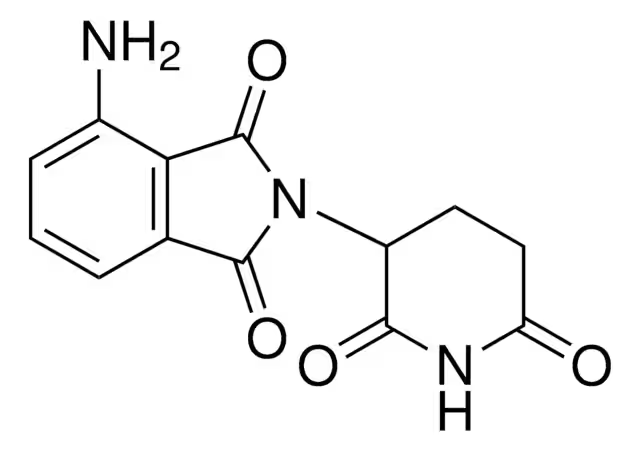
CAS Number19171-19-8
Synonyms4-Amino-2-(2,6-dioxo-3-piperidinyl)-1H-isoindole-1,3(2H)-dione; Pomalidomide; Pomalyst; 4-amino-2-(2,6-dioxopiperidin-3-yl)isoindoline-1,3-dione; 3-Amino-N-(2,6-dioxo-3-piperidyl)phthalimide; CC-4047
Molecular FormulaC13H11N3O4
Molecular Weight273.24
Purity≥98 (HPLC)%
Density1.6±0.1 g/cm3
Boiling Point582.9±45.0 °C at 760 mmHg
Melting Point318.5 - 320.5°
Appearancepowder
Symbol
Signal WordWarning
| Chemical & Physical Properties | |
|---|---|
| CAS Number | 19171-19-8 |
| Catalog No. | 2A-9038038 |
| Chinese Name | 泊马度胺 |
| Synonyms | 4-Amino-2-(2,6-dioxo-3-piperidinyl)-1H-isoindole-1,3(2H)-dione; Pomalidomide; Pomalyst; 4-amino-2-(2,6-dioxopiperidin-3-yl)isoindoline-1,3-dione; 3-Amino-N-(2,6-dioxo-3-piperidyl)phthalimide; CC-4047 |
| Molecular Formula | C13H11N3O4 |
| Molecular Weight | 273.24 |
| Purity | ≥98 (HPLC) |
| Density | 1.6±0.1 g/cm3 |
| Boiling Point | 582.9±45.0 °C at 760 mmHg |
| Melting Point | 318.5 - 320.5° |
| Appearance | powder |
| Water Solubility | DMSO: ≥14mg/mL |
| Storage Condition | 2-8°C |
| Application | Pomalidomide is an anti-angiogenic agent and immunomodulator. Pomalidomide inhibits TNF-α release in LPS-stimulated human PBMC with an IC50 of 13 nM. |
| HTC | 2925190090 |
| PubChem ID | 329819974 |
| MDL Number | MFCD12756407 |
| SMILES | Nc1cccc2C(=O)N(C3CCC(=O)NC3=O)C(=O)c12 |
| InChI | 1S/C13H11N3O4/c14-7-3-1-2-6-10(7)13(20)16(12(6)19)8-4-5-9(17)15-11(8)18/h1-3,8H,4-5,14H2,(H,15,17,18) |
| InChI Key | UVSMNLNDYGZFPF-UHFFFAOYSA-N |
| NACRES Code | NA.77 |
| UNSPSC | 12352200 |
| Hazard Symbols | transportation |
| MSDS | msds/38038_1_19171_19_8.pdf |
| Bioactivity | Pomalidomide is an anti-angiogenic agent and an immunomodulator. Pomalidomide inhibits TNF-α release in LPS stimulated human PBMC with an IC50 of 13 nM. Related Catalog Signaling Pathways >> Apoptosis >> TNF Receptor Research Areas >> Cancer Target IC50: 13 nM (TNF-α, in PBMCs)[1] In Vitro Pomalidomide also inhibits Whole Blood TNF-α with IC50 of 25 nM[1]. Exposure of lymphoma cells to Pomalidomide (CC-4047) leads to 40% decrease in cell proliferation when compared with vehicle-treated controls. Pomalidomide inhibits by 40% the DNA synthesis of Raji cells (P=0.036)[2]. In both CD4+ and CD8+ cells, Pomalidomide (CC-4047) is the most potent IL-2-elevator, followed by CC-6032 and CC-5013. Pomalidomide is significantly more potent than CC-5013 at elevating IL-2, IL-5, and IL-10, and slightly more potent than CC-5013 at elevating IFN-γ[3]. In Vivo The administration of Pomalidomide (CC-4047) for two consecutive days before mAb therapy enhances the antitumor activity of Rituximab and doubled the median survival of lymphoma-bearing mice. Statistically, significant differences are observed between animals treated with Rituximab versus Pomalidomide+Rituximab. The median survival time of animals treated with Pomalidomide and Rituximab is longer (median survival, 74 days; 95% CI, 70-78) than those treated with Rituximab monotherapy (median survival, 38 days; 95% CI, 26-50; log-rank test, P=0.002). The administration of CC-5013 or Pomalidomide for two consecutive days leads to a significant increase in the number of circulating NK cells as shown by flow cytometry analysis, in lymphoma-bearing SCID mice[2]. Following a 50 mg/kg PO administration of Pomalidomide (POM) to rats, unbound concentrations in blood reach a Cmax value of 1100±82 ng/mL at 4.6±2.4 hours, with a concomitant AUC(0-10) value of 6800±2000 ng•hr/mL. Unbound POM in the brain, however, has a Cmax value of 430±63 ng/mL at 4.1±1.5 hours and an AUC(0-10) value of 2700±740 ng•hr/mL, giving an unbound AUCbrain to AUCblood ratio of 0.39±0.03. These values are consistent with excellent blood-brain-barrier penetration. The results obtained in this study are consistent with those seen in a concurrent study looking at whole brain POM content following its oral administration to mice[4]. Cell Assay Lymphoma cell lines are placed in 96-well plates (1×10⁵ cells per well) and exposed to escalating concentrations of CC-5013, Pomalidomide (2.5, 5, 10, 20, and 40 μg/mL), or vehicle control single agents or in combination with Rituximab or Trastuzumab (isotype), at a final antibody concentration of 10 μg/mL. The final concentration is adjusted to 200 μL with 10% RPMI. The cell lines are incubated at 37°C and 5% CO2 for 24 and 48 hours. Following 24 or 48 hours, 1 μCi per well of [3H]-thymidine is added and cells are incubated for 18 hours more. Cells are then harvested using the Harvest system into the 96-well glass filters and [3H]-thymidine uptake is measured using an automated scintillation counter. Each experiment is done in triplicate at three different times; results are presented as the mean of counts per minute (cpm) at 24 and 48 hours±SD[2]. Animal Admin Mice[2] Six- to 8-week-old SCID mice are used for this purpose. On day 0, all the animals receive 1×10⁶ Raji cells via tail vein injection. After 72 hours of tumor engraftment, the animals are divided into seven cohorts. The first cohort (group A) serve as control and receive no treatment. Groups B and C consist of animals treated with either CC-5013 (0.5 mg/kg) or Pomalidomide (0.5 mg/kg) given i.p. on days +3, +4, +8, +9, +13, +14, +18, and +19. Groups D and E are treated with Rituximab or Trastuzumab (isotype control) monotherapy given via tail vein injection at 10 mg/kg on days +5, +10, +15, and +20. Finally, groups F and G consist of animals treated with Rituximab in combination with CC-5013 (group E) or Pomalidomide (group G). IMiDs are given i.p. for two consecutive days before each dose of Rituximab. After completion of therapy, animals are observed for a period of 90 days. The end point of the study is survival defined as the time for the development of limb paralysis. Animals that reach the end point or survived after 3 months of observation are sacrificed by cervical dislocation. Pathologic examination of all organs (liver, lung, and brain) is done to detect any residual disease. The experiments are repeated in three separate occasions. Rats[4] A total of 3 male CD-IGS rats are used. Pomalidomide is administered as a single PO administration via the stomach cannula, at 50 mg/kg (5 mL/kg) in a 0.5% carboxymethylcellulose/0.25% Tween 80 suspension formulation. Microdialysate is collected in a cooling fraction collector, set at 4°C at intervals of 25 minutes for 10 hours after dosing. To calculate AUC, the corrected concentration of each sample is multiplied by the interval over which the sample is collected; in this case 25 minutes, and divided by 60 minutes per hour. The sum of these values represented the total AUC value over the specified time range. To generate graphs, the concentration at each time point is plotted at the mid-point of each collection interval. Microdialysates are collected at the specified time points and analyzed for Pomalidomide concentration using a LC-MS/MS assay, within 12 hours. References [1]. Zhu YX, et al. Molecular mechanism of action of the immune-modulatory drugs, thalidomide, lenalidomide and pomalidomide in multiple myeloma. Leuk Lymphoma. 2013 Apr;54(4):683-7. [2]. Hernandez-Ilizaliturri FJ1, et al. Immunomodulatory drug CC-5013 or CC-4047 and rituximab enhance antitumor activity in a severe combined immunodeficient mouse lymphoma model. Clin Cancer Res. 2005 Aug 15;11(16):5984-92. [3]. Schafer PH, et al. Enhancement of cytokine production and AP-1 transcriptional activity in T cells by thalidomide-related immunomodulatory drugs. J Pharmacol Exp Ther. 2003 Jun;305(3):1222-32. [4]. Li Z, et al. Pomalidomide shows significant therapeutic activity against CNS lymphoma with a major impact on the tumor microenvironment in murine models. PLoS One. 2013 Aug 5;8(8):e71754. [5]. Liu D, et al. Tumour necrosis factor-α inhibits hepatic lipid deposition through GSK-3β/β-catenin signaling in juvenile turbot (Scophthalmus maximus L.). Gen Comp Endocrinol. 2016 Mar 1;228:1-8. Chemical & Physical Properties Density 1.6±0.1 g/cm3 Boiling Point 582.9±45.0 °C at 760 mmHg Melting Point 318.5 - 320.5° Molecular Formula C13H11N3O4 Molecular Weight 273.244 Flash Point 306.3±28.7 °C Exact Mass 273.074951 PSA 109.57000 LogP -0.74 Appearance of Characters yellow Vapour Pressure 0.0±1.6 mmHg at 25°C Index of Refraction 1.691 InChIKey UVSMNLNDYGZFPF-UHFFFAOYSA-N SMILES Nc1cccc2c1C(=O)N(C1CCC(=O)NC1=O)C2=O Storage condition 2-8°C Water Solubility DMSO: ≥14mg/mL |
| Use of | Pomalidomide is an anti-angiogenic agent and an immunomodulator. Pomalidomide inhibits TNF-α release in LPS stimulated human PBMC with an IC50 of 13 nM. Properties Articles12 Name pomalidomide Synonym More Synonyms Pomalidomide Biological Activity Description Pomalidomide is an anti-angiogenic agent and an immunomodulator. Pomalidomide inhibits TNF-α release in LPS stimulated human PBMC with an IC50 of 13 nM. Related Catalog Signaling Pathways >> Apoptosis >> TNF Receptor Research Areas >> Cancer IC50: 13 nM (TNF-α, in PBMCs)[1] In Vitro Pomalidomide also inhibits Whole Blood TNF-α with IC50 of 25 nM[1]. Exposure of lymphoma cells to Pomalidomide (CC-4047) leads to 40% decrease in cell proliferation when compared with vehicle-treated controls. Pomalidomide inhibits by 40% the DNA synthesis of Raji cells (P=0.036)[2]. In both CD4+ and CD8+ cells, Pomalidomide (CC-4047) is the most potent IL-2-elevator, followed by CC-6032 and CC-5013. Pomalidomide is significantly more potent than CC-5013 at elevating IL-2, IL-5, and IL-10, and slightly more potent than CC-5013 at elevating IFN-γ[3]. References [1]. Zhu YX, et al. Molecular mechanism of action of the immune-modulatory drugs, thalidomide, lenalidomide and pomalidomide in multiple myeloma. Leuk Lymphoma. 2013 Apr;54(4):683-7. [2]. Hernandez-Ilizaliturri FJ1, et al. Immunomodulatory drug CC-5013 or CC-4047 and rituximab enhance antitumor activity in a severe combined immunodeficient mouse lymphoma model. Clin Cancer Res. 2005 Aug 15;11(16):5984-92. [3]. Schafer PH, et al. Enhancement of cytokine production and AP-1 transcriptional activity in T cells by thalidomide-related immunomodulatory drugs. J Pharmacol Exp Ther. 2003 Jun;305(3):1222-32. [4]. Li Z, et al. Pomalidomide shows significant therapeutic activity against CNS lymphoma with a major impact on the tumor microenvironment in murine models. PLoS One. 2013 Aug 5;8(8):e71754. [5]. Liu D, et al. Tumour necrosis factor-α inhibits hepatic lipid deposition through GSK-3β/β-catenin signaling in juvenile turbot (Scophthalmus maximus L.). Gen Comp Endocrinol. 2016 Mar 1;228:1-8. Chemical & Physical Properties Molecular Formula C13H11N3O4 Exact Mass 273.074951 PSA 109.57000 LogP -0.74 Appearance of Characters yellow Index of Refraction 1.691 InChIKey UVSMNLNDYGZFPF-UHFFFAOYSA-N |
| Tax Rebate | 9.0% |
| Supervision | None MFN tariff: 6.5% Ordinary tariff: 30.0% |
| Transport Info | Product name: Purity: 99.0% |
| MSDS Transport Info | Module 14. Shipping information 14.1 UN dangerous goods number European Land Transport Dangerous Regulations: -International Maritime Dangerous Regulations: -International Air Transport Dangerous Regulations: - 14.2 Names specified by the United Nations (UN) European Land Transport Dangerous Regulations: Non-dangerous goods IMDG Code: Non-dangerous goods International air transport dangerous goods regulations: non-dangerous goods 14.3 Transport hazard categories European Land Transport Dangerous Regulations: -International Maritime Dangerous Regulations: -International Air Transport Dangerous Regulations: - 14.4 Package group European Land Transport Dangerous Regulations: -International Maritime Dangerous Regulations: -International Air Transport Dangerous Regulations: - 14.5 Environmental hazards European Land Transport Dangerous Regulations: No International Maritime Transport Dangerous Regulations Maritime Pollutants: No International Air Transport Risk Regulations: No 14.6 Special reminder to users No data available The above information is believed to be correct, but is not all-inclusive and should be used as a guide only. The information in this document is based on our current knowledge and is Correct safety instructions apply to this product. This information does not represent a warranty as to the properties of this product. See reverse side of invoice or packing slip. |
| Related Products in API & Advanced Intermediates | ||
|---|---|---|
| Naltrexone | 16590-41-3 | 2A-9037157 |
| Naltrexone hydrochloride | 16676-29-2 | 2A-9037193 |
| Doxycycline monohydrate | 17086-28-1 | 2A-9037360 |
| Phenytoin calcium | 17199-74-5 | 2A-9037402 |
| Sodium allopurinol | 17795-21-0 | 2A-9037634 |
| Tinidazole | 19387-91-8 | 2A-9038093 |
| 11a-Hydroxy-16,17a-epoxyprogesterone | 19427-36-2 | 2A-0202152 |
| Trazodone | 19794-93-5 | 2A-9038215 |
| Memantine | 19982-08-2 | 2A-9038275 |
| tert-Butylpenicillin sodium salt | 20520-33-6 | 2A-9038436 |
| Browse all API & Advanced Intermediates products » | ||
Phone:
630-322-8886
630-322-8887
Email:
Office Locations:
Chicago, IL, USA
San Francisco, CA, USA


 EN
EN


 SDS
SDS