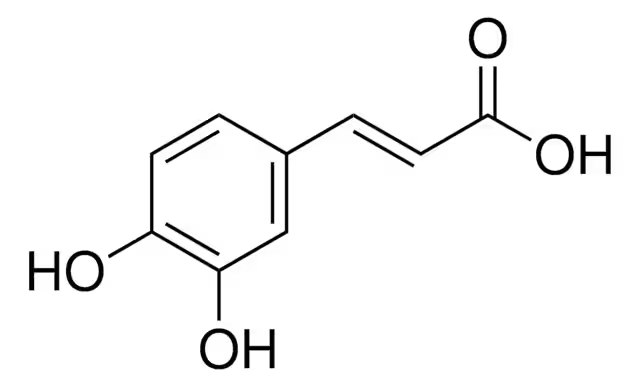
CAS Number331-39-5
SynonymsCAFFIC ACID; Caffeicacid; MFCD00004392; 3,4-dihydroxyben; 3,4-Dihydroxycinnamic acid,predominantly trans isomer; Caffeic; 3,4-Dihydroxycinnamic acid; EINECS 206-361-2; 3,4-Dihydroxy cinnamic acid; CaffeicAcidPure; Caffeic acid; 3-(3,4-Dihydroxyphenyl)acrylic acid
Molecular Formula(HO)2C6H3CH=CHCO2H
Molecular Weight180.16
Purity≥98.0 (HPLC)%
Density1.5±0.1 g/cm3
Boiling Point416.8±35.0 °C at 760 mmHg
Melting Point211-213 °C (dec.) (lit.)
Appearancepowder
EINECS206-361-2
Symbol
Signal WordWarning
| Chemical & Physical Properties | |
|---|---|
| CAS Number | 331-39-5 |
| Catalog No. | 2A-9003792 |
| Chinese Name | 咖啡酸 |
| Synonyms | CAFFIC ACID; Caffeicacid; MFCD00004392; 3,4-dihydroxyben; 3,4-Dihydroxycinnamic acid,predominantly trans isomer; Caffeic; 3,4-Dihydroxycinnamic acid; EINECS 206-361-2; 3,4-Dihydroxy cinnamic acid; CaffeicAcidPure; Caffeic acid; 3-(3,4-Dihydroxyphenyl)acrylic acid |
| Molecular Formula | (HO)2C6H3CH=CHCO2H |
| Molecular Weight | 180.16 |
| Purity | ≥98.0 (HPLC) |
| Density | 1.5±0.1 g/cm3 |
| Boiling Point | 416.8±35.0 °C at 760 mmHg |
| Melting Point | 211-213 °C (dec.) (lit.) |
| Appearance | powder |
| Water Solubility | soluble in hot water |
| Storage Condition | Warehouse Ventilation Low Temperature Drying |
| Application | Caffeic acid is an inhibitor of the TRPV1 ion channel and 5-lipoxygenase (5-LO). |
| EINECS | 206-361-2 |
| HTC | 2942000000 |
| PubChem ID | 24278290 |
| MDL Number | MFCD00004392 |
| SMILES | OC(=O)\C=C\c1ccc(O)c(O)c1 |
| InChI | 1S/C9H8O4/c10-7-3-1-6(5-8(7)11)2-4-9(12)13/h1-5,10-11H,(H,12,13)/b4-2+ |
| InChI Key | QAIPRVGONGVQAS-DUXPYHPUSA-N |
| Beilstein/REAXYS | 1954563 |
| NACRES Code | NA.77 |
| UNSPSC | 12352106 |
| Hazard Symbols | Transport |
| Risk Codes | R36/37/38;R40 |
| Safety Description | S26;S36/37/39 |
| MSDS | msds/3792_1_331_39_5.pdf |
| Bioactivity | Caffeic acid is an inhibitor of both TRPV1 ion channel and 5-Lipoxygenase (5-LO). Related Catalog Signaling Pathways >> Metabolic Enzyme/Protease >> 5-Lipoxygenase Signaling Pathways >> Membrane Transporter/Ion Channel >> TRP Channel Research Areas >> Inflammation/Immunology Natural Products >> Phenylpropanoids Target Human Endogenous Metabolite In Vitro Caffeic acid has inhibitory effects on histamine-induced responses and the inhibitory effect of Caffeic acid is gradually increased when the concentration used for pretreatment is increased from 0.1 to 1 mM, similar to typical dose-dependent responses. Pretreatment of HEK293T-TRPV1 cells with 1 mM Caffeic acid results in significant inhibition of capsaicin-induced responses. When lower concentration of Caffeic acid is used, the inhibitory effect for capsaicin-induced responses is less evident. Calcium imaging experiments show that Caffeic acid incubation results in significant inhibition in histamine-sensitive dorsal root ganglion (DRG) neurons. Pretreatment with Caffeic acid (1 mM) results in a significant decrease in the percentage of responsive DRG neurons to histamine application from 12.5% to 2.1%. Pretreatment with 1 mM Caffeic acid dramatically blocks the allylisothiocyanate (AITC)-induced intracellular calcium increase in TRPA1-expressing cells. Caffeic acid is also able to block the AITC-induced activation of TRPA1[1]. In Vivo Mice pretreated with Caffeic acid (500 mg/kg) exhibit significantly less histamine-induced scratching (30.50±10.87 bouts/1 h, n=6). It is further found that the lower dose of Caffeic acid (100 mg/kg) is not significantly effective in terms of anti-scratching effects in histamine-induced scratching, although there appears to be a tendency of reduction (49.40±12.35 bouts/1 h, n=5). The chloroquine induced scratching is significantly inhibited by pretreatment with 500 mg/kg of Caffeic acid (161.6±31.42 bouts/1 h, n=5)[1].Caffeic acid significantly reduces the expression of 5-LO mRNA (P<0.01) dose-dependently in hippocampus. Compare with the ischemia-reperfusion (I/R) non-treated group, 5-LO protein expression is significantly reduced in the I/R-Caffeic acid group (P<0.05 or P<0.01), especially in the I/R-Caffeic acid group (50 mg/kg). Compare with the I/R non-treated group, the latency to find platform is significantly shortened in low- and high-dose Caffeic acid groups, the shortened platform latency is most evident in the I/R- Caffeic acid group (50 mg/kg) (P<0.01). In the low-dose Caffeic acid group, cell injury is still marked, the pyknosis ratio is (63.6±2.8)%, whereas in the high-dose Caffeic acid group, hippocampal neuron karyopyknosis is significantly reduced and the pyknosis ratio is (13.3±3.0)%[2]. Cell Assay To determine cell viability, MTT assay is performed. HEK293T cells are cultured in 96-well plate at 37°C, a day before so that the confluence of cell is 85 to 90% on the actual day of the experiment. On the day of the experiment the cells are treated with different concentration of Caffeic acid for 10 min. Control cells are treated only with media. After removing supernatant and washing with PBS, MTT reagent (5 mg/mL) is added directly to fresh media. Cells are then incubated at 37°C for additional 4 h followed by draining of the media and overnight storage in dark condition. The next day, DMSO is added to each well and mixed in shaker for 10 min after which plate is read using microplate recorder at 490 nm with a reference wavelength of 620 nm. The relative cell viability (%) is expressed as a percentage relative to the untreated control cells[1]. Animal Admin Rats are divided into five groups: the sham group (n=9), ischemia-reperfusion (I/R) non-treated group (n=9), I/R-Caffeic acid group (10 mg/kg) (n=9), I/R-Caffeic acid group (30 mg/kg) (n=9) and I/R- Caffeic acid group (50 mg/kg) (n=9). In I/R-Caffeic acid groups, the rats are administrated Caffeic acid at 10, 30, 50 mg/kg (prepared with 0.3% sodium carboxymethyl cellulose) by intraperitoneal injection at 30 min prior to ischemia. The sham group and I/R group are treated with an equal volume of 0.3% sodium carboxymethyl cellulose[2]. References [1]. Pradhananga S, et al. Caffeic acid exhibits anti-pruritic effects by inhibition of multiple itch transmission pathways in mice. Eur J Pharmacol. 2015 Sep 5;762:313-21. [2]. Liang G, et al. The protective effect of caffeic acid on global cerebral ischemia-reperfusion injury in rats. Behav Brain Funct. 2015 Apr 18;11:18. Chemical & Physical Properties Density 1.5±0.1 g/cm3 Boiling Point 416.8±35.0 °C at 760 mmHg Melting Point 211-213 °C (dec.)(lit.) Molecular Formula C9H8O4 Molecular Weight 180.157 Flash Point 220.0±22.4 °C Exact Mass 180.042252 PSA 77.76000 LogP 1.42 Vapour Pressure 0.0±1.0 mmHg at 25°C Index of Refraction 1.707 InChIKey QAIPRVGONGVQAS-DUXPYHPUSA-N SMILES O=C(O)C=Cc1ccc(O)c(O)c1 Stability Stable. Combustible. Incompatible with strong oxidizing agents, strong bases. Water Solubility soluble in hot water |
| Use of | Caffeic acid is an inhibitor of both TRPV1 ion channel and 5-Lipoxygenase (5-LO). Properties Articles280 Name cis-caffeic acid Synonym More Synonyms Caffeic acid Biological Activity Description Caffeic acid is an inhibitor of both TRPV1 ion channel and 5-Lipoxygenase (5-LO). Related Catalog Signaling Pathways >> Metabolic Enzyme/Protease >> 5-Lipoxygenase Signaling Pathways >> Membrane Transporter/Ion Channel >> TRP Channel Research Areas >> Inflammation/Immunology Natural Products >> Phenylpropanoids Human Endogenous Metabolite References [1]. Pradhananga S, et al. Caffeic acid exhibits anti-pruritic effects by inhibition of multiple itch transmission pathways in mice. Eur J Pharmacol. 2015 Sep 5;762:313-21. [2]. Liang G, et al. The protective effect of caffeic acid on global cerebral ischemia-reperfusion injury in rats. Behav Brain Funct. 2015 Apr 18;11:18. Chemical & Physical Properties Molecular Formula C9H8O4 Exact Mass 180.042252 PSA 77.76000 Index of Refraction 1.707 InChIKey QAIPRVGONGVQAS-DUXPYHPUSA-N Stability Stable. Combustible. Incompatible with strong oxidizing agents, strong bases. Water Solubility soluble in hot water |
| Tax Rebate | 9.0% |
| Supervision | A. Customs clearance form for inbound goods B. Customs clearance form for outbound goods |
| Inspection | R. Hygiene supervision and inspection of imported food S. Hygiene supervision and inspection of exported food |
| Transport Info | Shipping Name: UN |
| MSDS Transport Info | Module 14. Shipping information 14.1 UN dangerous goods number European Land Transport Dangerous Regulations: -International Maritime Dangerous Regulations: -International Air Transport Dangerous Regulations: - 14.2 United Nations shipping name European Land Transport Dangerous Regulations: Non-dangerous goods IMDG Code: Non-dangerous goods International air transport dangerous goods regulations: non-dangerous goods 14.3 Transport hazard categories European Land Transport Dangerous Regulations: -International Maritime Dangerous Regulations: -International Air Transport Dangerous Regulations: - 14.4 Package group European Land Transport Dangerous Regulations: -International Maritime Dangerous Regulations: -International Air Transport Dangerous Regulations: - 14.5 Environmental hazards European Land Transport Danger Regulations: No International Maritime Danger Regulations International Air Transport Danger Regulations: No Marine pollutants (yes/no): No 14.6 Special reminder to users No data available |
| Related Products in Specialty Chemicals | ||
|---|---|---|
| 3,4-Difluorophenylacetonitrile | 658-99-1 | 2A-9003781 |
| 3,4-Difluorophenylhydrazine hydrochloride | 40594-37-4 | 2A-9003783 |
| 3,4-Difluorothiophenol | 60811-24-7 | 2A-9003784 |
| 3,4-Dihydro-7-hydroxycarbostyril | 22246-18-0 | 2A-9003788 |
| 3,4-Dihydroxybenzonitrile | 54337-90-5 | 2A-9003791 |
| 3,4-Diiodobenzotrifluoride | 130656-70-1 | 2A-9003793 |
| 3,4-Dimethoxy-2-(1-methylethyl)benzeneacetonitrile | 2A-103794 | 2A-9003794 |
| 3,4-Dimethoxy-5-hydroxybenzoic acid methyl ester | 83011-43-2 | 2A-9003796 |
| 3,4-Dimethoxy-6-nitrobenzoic acid | 4998-07-6 | 2A-9003797 |
| 3,4-Dimethoxybenzyl alcohol | 93-03-8 | 2A-9003798 |
| Browse all Specialty Chemicals products » | ||
Phone:
630-322-8886
630-322-8887
Email:
Office Locations:
Chicago, IL, USA
San Francisco, CA, USA


 EN
EN


 SDS
SDS