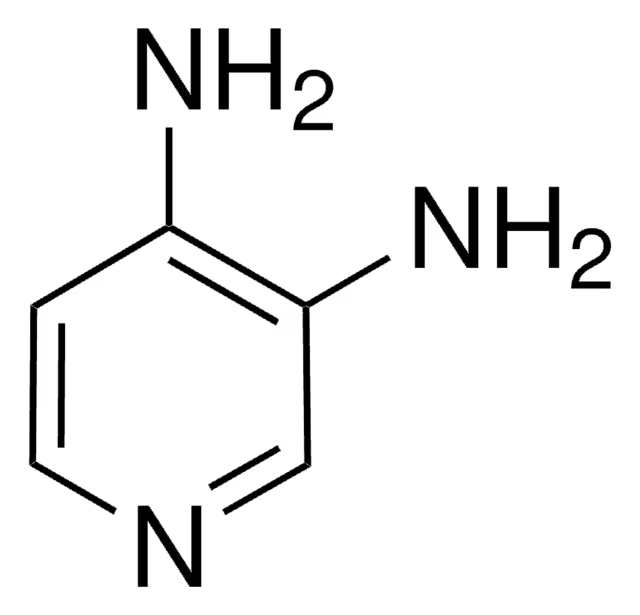
CAS Number54-96-6
Synonyms3,4-Pyridinedramine; 3,4-Diaminopyridin; 3,4-DAP; 3,4-diamino-pyridine; 3,4-diamino-pyridin; 3,4-Diaminopyridine; Amifampridine; 3 4-DIAMINOPYRIDINE; Pyridine-3,4-diamine; pyridin-3,4-diaMine; 4,5-diaminopyridine; 3,4DIAMINOPYRIDINE; EINECS 200-220-9; 3,4 DI AMINO PYRIDINE; Pyridin-3,4-diamin; 3-amino-4-pyridinylamine; MFCD00006401; 3,4-Pyridinediamine; diamino-3,4pyridine
Molecular FormulaC5H7N3
Molecular Weight109.13
Purity≥98%
Density1.3±0.1 g/cm3
Boiling Point369.3±22.0 °C at 760 mmHg
Melting Point216-218 °C (lit.)
Appearancepowder
EINECS200-220-9
Symbol
Signal WordWarning
| Chemical & Physical Properties | |
|---|---|
| CAS Number | 54-96-6 |
| Catalog No. | 2A-9003732 |
| Chinese Name | 3,4-二氨基吡啶 |
| Synonyms | 3,4-Pyridinedramine; 3,4-Diaminopyridin; 3,4-DAP; 3,4-diamino-pyridine; 3,4-diamino-pyridin; 3,4-Diaminopyridine; Amifampridine; 3 4-DIAMINOPYRIDINE; Pyridine-3,4-diamine; pyridin-3,4-diaMine; 4,5-diaminopyridine; 3,4DIAMINOPYRIDINE; EINECS 200-220-9; 3,4 DI AMINO PYRIDINE; Pyridin-3,4-diamin; 3-amino-4-pyridinylamine; MFCD00006401; 3,4-Pyridinediamine; diamino-3,4pyridine |
| Molecular Formula | C5H7N3 |
| Molecular Weight | 109.13 |
| Purity | ≥98 |
| Density | 1.3±0.1 g/cm3 |
| Boiling Point | 369.3±22.0 °C at 760 mmHg |
| Melting Point | 216-218 °C (lit.) |
| Appearance | powder |
| Water Solubility | 24 g/L (20 ºC) |
| Storage Condition | This product should be stored sealed with argon ga |
| Packaging | I |
| Application | Amifampridine acts on rare muscle diseases. |
| EINECS | 200-220-9 |
| HTC | 29333999 |
| PubChem ID | 57654120 |
| MDL Number | MFCD00006401 |
| SMILES | Nc1ccncc1N |
| InChI | 1S/C5H7N3/c6-4-1-2-8-3-5(4)7/h1-3H,7H2,(H2,6,8) |
| InChI Key | OYTKINVCDFNREN-UHFFFAOYSA-N |
| Beilstein/REAXYS | 110232 |
| NACRES Code | NA.22 |
| UNSPSC | 12352100 |
| Hazard Symbols | 6.1 |
| Risk Codes | R25;R36/37/38 |
| Safety Description | S26;S28A;S37/39;S45 |
| MSDS | msds/3732_1_54_96_6.pdf |
| Bioactivity | Amifampridine is a drug, predominantly in the treatment of a number of rare muscle diseases.Target: OthersAmifampridine is a drug, predominantly in the treatment of a number of rare muscle diseases. Amifampridine works by blocking potassium channel efflux in nerve terminals so that action potential duration is increased. Ca2+ channels can then be open for a longer time and allow greater acetylcholine release to stimulate muscle at the end plate. A 2005 systematic review from the Cochrane Collaboration found some data favouring its use in LEMS. Amifampridine is also used to treat many of the congenital myasthenic syndromes, particularly those with defects in choline acetyltransferase, downstream kinase 7, and those where any kind of defect causes "fast channel" behaviour of the acetylcholine receptor. From Wikipedia. Related Catalog Signaling Pathways >> Others >> Others Research Areas >> Others References [1]. http://en.wikipedia.org/wiki/3,4-Diaminopyridine#cite_note-4 Chemical & Physical Properties Density 1.3±0.1 g/cm3 Boiling Point 369.3±22.0 °C at 760 mmHg Melting Point 216-218 °C(lit.) Molecular Formula C5H7N3 Molecular Weight 109.129 Flash Point 204.9±9.5 °C Exact Mass 109.063995 PSA 64.93000 LogP -0.09 Vapour Pressure 0.0±0.8 mmHg at 25°C Index of Refraction 1.676 InChIKey OYTKINVCDFNREN-UHFFFAOYSA-N SMILES Nc1ccncc1N Water Solubility 24 g/L (20 ºC) |
| Use of | Amifampridine is a drug, predominantly in the treatment of a number of rare muscle diseases.Target: OthersAmifampridine is a drug, predominantly in the treatment of a number of rare muscle diseases. Amifampridine works by blocking potassium channel efflux in nerve terminals so that action potential duration is increased. Ca2+ channels can then be open for a longer time and allow greater acetylcholine release to stimulate muscle at the end plate. A 2005 systematic review from the Cochrane Collaboration found some data favouring its use in LEMS. Amifampridine is also used to treat many of the congenital myasthenic syndromes, particularly those with defects in choline acetyltransferase, downstream kinase 7, and those where any kind of defect causes "fast channel" behaviour of the acetylcholine receptor. From Wikipedia. Properties Articles33 Name 3,4-Diaminopyridine Synonym More Synonyms 3,4-Diaminopyridine Biological Activity Description Amifampridine is a drug, predominantly in the treatment of a number of rare muscle diseases.Target: OthersAmifampridine is a drug, predominantly in the treatment of a number of rare muscle diseases. Amifampridine works by blocking potassium channel efflux in nerve terminals so that action potential duration is increased. Ca2+ channels can then be open for a longer time and allow greater acetylcholine release to stimulate muscle at the end plate. A 2005 systematic review from the Cochrane Collaboration found some data favouring its use in LEMS. Amifampridine is also used to treat many of the congenital myasthenic syndromes, particularly those with defects in choline acetyltransferase, downstream kinase 7, and those where any kind of defect causes "fast channel" behaviour of the acetylcholine receptor. From Wikipedia. Related Catalog Signaling Pathways >> Others >> Others Research Areas >> Others References [1]. http://en.wikipedia.org/wiki/3,4-Diaminopyridine#cite_note-4 Chemical & Physical Properties Molecular Formula C5H7N3 Exact Mass 109.063995 PSA 64.93000 LogP -0.09 Index of Refraction 1.676 InChIKey OYTKINVCDFNREN-UHFFFAOYSA-N |
| Tax Rebate | 13.0% |
| Supervision | None. MFN tariff: 6.5%. Ordinary tariff: 20.0% |
| Transport Info | Product name: Purity: 98.0% |
| MSDS Transport Info | Module 14. Shipping information 14.1 UN dangerous goods number European Dangerous Regulations for land transport: 2811 International Dangerous Regulations for sea transport: 2811 International Dangerous Regulations for air transport: 2811 14.2 Names specified by the United Nations (UN) European Land Transport Dangerous Regulations: TOXIC SOLID, ORGANIC, N.O.S. (3,4-Diaminopyridine) IMDG Code: TOXIC SOLID, ORGANIC, N.O.S. (3,4-Diaminopyridine) International air transport hazard regulations: Toxic solid, organic, n.o.s. (3,4-Diaminopyridine) 14.3 Transport hazard categories European Land Transport Danger Regulations: 6.1 International Maritime Transport Danger Regulations: 6.1 International Air Transport Danger Regulations: 6.1 14.4 Package group European Dangerous Regulations for land transport: II International Dangerous Regulations for sea transport: II International Dangerous Regulations for air transport: II 14.5 Environmental hazards European Land Transport Dangerous Regulations: No International Maritime Transport Dangerous Regulations Maritime Pollutants: No International Air Transport Risk Regulations: No 14.6 Special reminder to users No data available |
| Related Products in Heterocyclic Building Blocks | ||
|---|---|---|
| 3-(Heptafluoro-1-propyl)-5-phenylpyrazole | 54864-78-7 | 2A-9003646 |
| 3-(Trifluoromethyl)pyridine | 3796-23-4 | 2A-9003680 |
| 3,3-Difluoropyrrolidine hydrochloride | 163457-23-6 | 2A-9003696 |
| 3,3-Dimethyl-1-ethyl-2-methyleneindoline | 2A-103699 | 2A-9003699 |
| 3,4,5-Trichloropyridine | 33216-52-3 | 2A-9003712 |
| 3,4-Dibromothiophene | 3141-26-2 | 2A-9003735 |
| 3,4-Dichloro-1,2,5-thiadiazole | 5728-20-1 | 2A-9003736 |
| 3,4-Dichloropyridine | 55934-00-4 | 2A-9003752 |
| 3,4-Dihydro-9-methyl-2H-pyrido[1,2-alpha]pyrimidin-2-one | 61751-44-8 | 2A-9003789 |
| 3,4-Dimethoxy-2-methylpyridine N-oxide | 72830-07-0 | 2A-9003795 |
| Browse all Heterocyclic Building Blocks products » | ||
Phone:
630-322-8886
630-322-8887
Email:
Office Locations:
Chicago, IL, USA
San Francisco, CA, USA


 EN
EN


 SDS
SDS