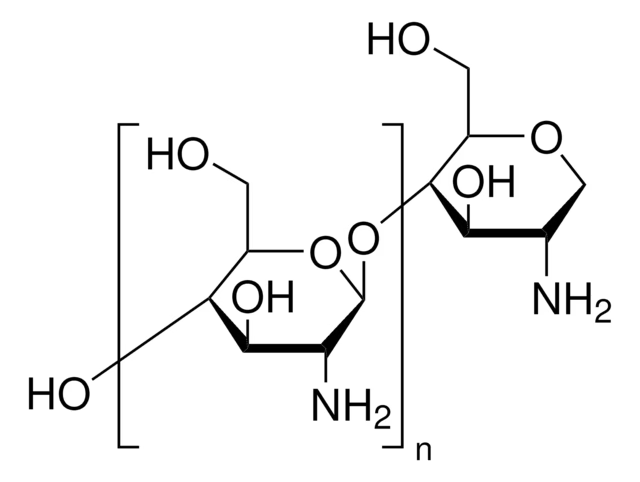
CAS Number9012-76-4
SynonymsEINECS 222-311-2; Poly(beta-(1,4)-D-glucosamine); Poly(beta-(1,4)-2-amino-2-deoxy-D-glucose); MFCD00161512; Chitosan
Molecular Formula(C6H11O4N)n
Molecular Weight161.16 (monomer)
Purity90%
Density1.75g/cm3
Melting Point88ºC
Appearancelight beige solid
Symbol
Signal WordWarning
| Chemical & Physical Properties | |
|---|---|
| CAS Number | 9012-76-4 |
| Catalog No. | 2A-9034478 |
| Chinese Name | 壳聚糖 |
| Synonyms | EINECS 222-311-2; Poly(beta-(1,4)-D-glucosamine); Poly(beta-(1,4)-2-amino-2-deoxy-D-glucose); MFCD00161512; Chitosan |
| Molecular Formula | (C6H11O4N)n |
| Molecular Weight | 161.16 (monomer) |
| Purity | 90 |
| Density | 1.75g/cm3 |
| Melting Point | 88ºC |
| Appearance | light beige solid |
| Water Solubility | dilute aqueous acid (pH <6.5).: soluble |
| Storage Condition | Sealed and protected from light at room temperatur |
| Application | Chitosan is a natural polycationic linear polysaccharide derived from chitin. |
| HTC | 2932999099 |
| SMILES | COC(=O)NC1C(OC2C(CO)OC(OC3C(CO)OC(O)C(N)C3O)C(N)C2O)OC(CO)C(OC2OC(CO)C(OC3OC(CO)C(OC4OC(CO)C(OC5OC(CO)C(OC6OC(CO)C(OC7OC(CO)C(O)C(O)C7N)C(O)C6N)C(O)C5N)C(O)C4N)C(O)C3N)C(O)C2N)C1O |
| InChI | InChI=1S/C56H103N9O39/c1-87-56(86)65-28-38(84)46(19(10-74)96-55(28)104-45-18(9-73)95-49(27(64)37(45)83)97-39-12(3-67)88-47(85)20(57)31(39)77)103-54-26(63)36(82)44(17(8-72)94-54)102-53-25(62)35(81)43(16(7-71)93-53)101-52-24(61)34(80)42(15(6-70)92-52)100-51-23(60)33(79)41(14(5-69)91-51)99-50-22(59)32(78)40(13(4-68)90-50)98-48-21(58)30(76)29(75)11(2-66)89-48/h11-55,66-85H,2-10,57-64H2,1H3,(H,65,86)/t11-,12-,13-,14-,15-,16-,17-,18-,19-,20-,21-,22-,23-,24-,25-,26-,27-,28-,29-,30-,31-,32-,33-,34-,35-,36-,37-,38-,39-,40-,41-,42-,43-,44-,45-,46-,47-,48+,49+,50+,51+,52+,53+,54+,55+/m1/s1 |
| InChI Key | FLASNYPZGWUPSU-SICDJOISSA-N |
| Hazard Symbols | transportation |
| Safety Description | S24/25 |
| Bioactivity | Chitosan is a natural polycationic linear polysaccharide derived from chitin. Related Catalog Signaling Pathways >> Anti-infection >> Bacterial Research Areas >> Cancer Natural Products >> Saccharides and Glycosides In Vitro Chitosans are recognized as versatile biomaterials because of their non-toxicity, low allergenicity, biocompatibility and biodegradability. Chitosan is reported to have other biological properties, such as antitumor, antimicrobial, and antioxidant activities. It can be used in water treatment, wound-healing materials, pharmaceutical excipient or drug carrier, obesity treatment and as a scaffold for tissue engineering[1]. Antimicrobial activity of chitosan has been demonstrated against many bacteria, filamentous fungi and yeasts. Chitosan has wide spectrum of activity and high killing rate against Gram-positive and Gram-negative bacteria, but lower toxicity toward mammalian cells[2]. Chitosan exhibits antitumor activity against different types of cancer. For example, chitosan decreases adhesion of primary melanoma A375 cell line and decreases proliferation of primary melanoma SKMEL28 cell line, it has potent pro-apoptotic effects against RPMI7951, a metastatic melanoma cell line[3]. Chitosan and its derivatives act as antioxidants by scavenging oxygen radicals such as hydroxyl, superoxide, alkyl as well as highly stable DPPH radicals in vitro[4]. In Vivo Chitosan treatment dramatically increases lifespan and inhibits tumor metastasis especially in treatment groups of the low-molecular weight compound[5]. Chitosan has some apparent treatment effects on rat PCP by reducing HSP70 mRNA expression and lung inflammation, increasing the concentrations of IL-10 and IFN-γ as well as CD4(+) T-lymphocyte numbers, reducing the CD8(+) T-lymphocyte numbers and the concentration of TNF-α and inducing significant ultrastructural damage to P. carinii[6]. References [1]. Cheung RC, et al. Chitosan: An Update on Potential Biomedical and Pharmaceutical Applications. Mar Drugs. 2015 Aug 14;13(8):5156-86. [2]. Kong M, et al. Antimicrobial properties of chitosan and mode of action: a state of the art review. Int J Food Microbiol. 2010 Nov 15;144(1):51-63. [3]. Gibot L, et al. Anticancer properties of chitosan on human melanoma are cell line dependent.Int J Biol Macromol. 2015 Jan;72:370-9. [4]. Younes I, et al. Chitin and chitosan preparation from marine sources. Structure, properties and applications. Mar Drugs. 2015 Mar 2;13(3):1133-74. [5]. Yeh MY, et al. Effects of chitosan on xenograft models of melanoma in C57BL/6 mice and hepatoma formation in SCID mice. Anticancer Res. 2013 Nov;33(11):4867-73. [6]. Liu AB, et al. Therapeutic efficacies of chitosan against Pneumocystis pneumonia of immunosuppressed rat. Parasite Immunol. 2014 Jul;36(7):292-302 Chemical & Physical Properties Density 1.75g/cm3 Melting Point 88ºC Molecular Formula (C6H13NO5)n Molecular Weight 161.16 (monomer) Index of Refraction 1.7 InChIKey FLASNYPZGWUPSU-SICDJOISSA-N SMILES COC(=O)NC1C(OC2C(CO)OC(OC3C(CO)OC(O)C(N)C3O)C(N)C2O)OC(CO)C(OC2OC(CO)C(OC3OC(CO)C(OC4OC(CO)C(OC5OC(CO)C(OC6OC(CO)C(OC7OC(CO)C(O)C(O)C7N)C(O)C6N)C(O)C5N)C(O)C4N)C(O)C3N)C(O)C2N)C1O Storage condition room temp Stability Stable. Incompatible with strong oxidizing agents. Water Solubility dilute aqueous acid (pH <6.5).: soluble |
| Use of | Chitosan is a natural polycationic linear polysaccharide derived from chitin. Properties Articles135 Name chitosan Synonym More Synonyms Chitosan Biological Activity Description Chitosan is a natural polycationic linear polysaccharide derived from chitin. Related Catalog Signaling Pathways >> Anti-infection >> Bacterial Research Areas >> Cancer Natural Products >> Saccharides and Glycosides References [1]. Cheung RC, et al. Chitosan: An Update on Potential Biomedical and Pharmaceutical Applications. Mar Drugs. 2015 Aug 14;13(8):5156-86. [2]. Kong M, et al. Antimicrobial properties of chitosan and mode of action: a state of the art review. Int J Food Microbiol. 2010 Nov 15;144(1):51-63. [3]. Gibot L, et al. Anticancer properties of chitosan on human melanoma are cell line dependent.Int J Biol Macromol. 2015 Jan;72:370-9. [4]. Younes I, et al. Chitin and chitosan preparation from marine sources. Structure, properties and applications. Mar Drugs. 2015 Mar 2;13(3):1133-74. [6]. Liu AB, et al. Therapeutic efficacies of chitosan against Pneumocystis pneumonia of immunosuppressed rat. Parasite Immunol. 2014 Jul;36(7):292-302 Chemical & Physical Properties Molecular Formula (C6H13NO5)n Index of Refraction 1.7 InChIKey FLASNYPZGWUPSU-SICDJOISSA-N Storage condition room temp Stability Stable. Incompatible with strong oxidizing agents. Water Solubility dilute aqueous acid (pH <6.5).: soluble |
| Tax Rebate | 13.0% |
| Supervision | None. MFN tariff: 6.5%. Ordinary tariff: 20.0% |
| Transport Info | Shipping Name: UN |
| MSDS Transport Info | Module 14. Shipping information 14.1 UN dangerous goods number European Land Transport Dangerous Regulations: -International Maritime Dangerous Regulations: -International Air Transport Dangerous Regulations: - 14.2 United Nations shipping name European Land Transport Dangerous Regulations: Non-dangerous goods IMDG Code: Non-dangerous goods International air transport dangerous goods regulations: non-dangerous goods 14.3 Transport hazard categories European Land Transport Dangerous Regulations: -International Maritime Dangerous Regulations: -International Air Transport Dangerous Regulations: - 14.4 Package group European Land Transport Dangerous Regulations: -International Maritime Dangerous Regulations: -International Air Transport Dangerous Regulations: - 14.5 Environmental hazards European Land Transport Danger Regulations: No International Maritime Danger Regulations International Air Transport Danger Regulations: No Marine pollutants (yes/no): No 14.6 Special reminder to users No data available |
| Related Products in Specialty Chemicals | ||
|---|---|---|
| Zein | 9010-66-6 | 2A-9034469 |
| Polychloroprene | 9010-98-4 | 2A-9034470 |
| Poly(methyl vinyl ether-alt-maleic anhydride) | 9011-16-9 | 2A-9034473 |
| Cholera toxin | 9012-63-9 | 2A-9034476 |
| beta-(1,3)-D-Glucan | 9012-72-0 | 2A-9034477 |
| Poly(dimethylsiloxane) | 9016-00-6 | 2A-9034481 |
| Poly(titanium butoxide) | 9022-96-2 | 2A-9034485 |
| Lactase | 9031-11-2 | 2A-9034487 |
| Alcohol dehydrogenase; EC 1.1.1.1 | 9031-72-5 | 2A-9034488 |
| Glucozyme | 9032-08-0 | 2A-9034489 |
| Browse all Specialty Chemicals products » | ||
Phone:
630-322-8886
630-322-8887
Email:
Office Locations:
Chicago, IL, USA
San Francisco, CA, USA


 EN
EN


 SDS
SDS