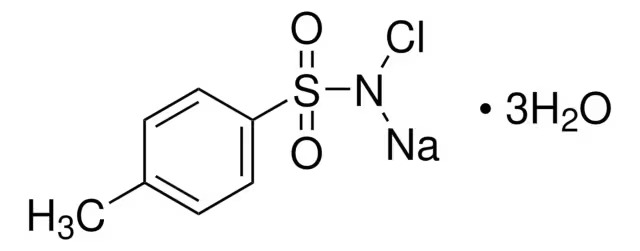
CAS Number7080-50-4
SynonymsN-chloro-toluene-4-sulfonamide,sodium salt; Chloramine-T trihydrate; MFCD00149066; TOSYLCHLORAMIDE SODIUM TRIHYDRATE; ChloraMine T&chloroamine T trihydrate; sodium chloro[(4-methylphenyl)sulfonyl]azanide trihydrate; CHLORAMINE T GR; CHLORAMINE T 3-HYDRATE; CHLORAMINE T TRIHYDRATE; N-Chloro-p-toluenesulfonamide sodium salt trihydrate; chloramine T hydratee; CHLOROMINE-T SOLUTION; Sodium chloro[(4-methylphenyl)sulfonyl]azanide hydrate (1:1:3); Chloroamine t trihydrate; Benzenesulfonamide, N-chloro-4-methyl-, sodium salt, hydrate (1:1:3); CHLOROAMINUM; Chloramine-T,Sodium salt; EINECS 204-854-7
Molecular FormulaCH3C6H4SO2NClNa · 3H2O
Molecular Weight281.69
Purity98%
Melting Point167-170 °C (lit.)
Appearancepowder
EINECS204-854-7
Symbol
Signal WordWarning
| Chemical & Physical Properties | |
|---|---|
| CAS Number | 7080-50-4 |
| Catalog No. | 2A-9033385 |
| Chinese Name | 氯胺T三水合物 |
| Synonyms | N-chloro-toluene-4-sulfonamide,sodium salt; Chloramine-T trihydrate; MFCD00149066; TOSYLCHLORAMIDE SODIUM TRIHYDRATE; ChloraMine T&chloroamine T trihydrate; sodium chloro[(4-methylphenyl)sulfonyl]azanide trihydrate; CHLORAMINE T GR; CHLORAMINE T 3-HYDRATE; CHLORAMINE T TRIHYDRATE; N-Chloro-p-toluenesulfonamide sodium salt trihydrate; chloramine T hydratee; CHLOROMINE-T SOLUTION; Sodium chloro[(4-methylphenyl)sulfonyl]azanide hydrate (1:1:3); Chloroamine t trihydrate; Benzenesulfonamide, N-chloro-4-methyl-, sodium salt, hydrate (1:1:3); CHLOROAMINUM; Chloramine-T,Sodium salt; EINECS 204-854-7 |
| Molecular Formula | CH3C6H4SO2NClNa · 3H2O |
| Molecular Weight | 281.69 |
| Purity | 98 |
| Melting Point | 167-170 °C (lit.) |
| Appearance | powder |
| Water Solubility | Water solubility: soluble; water solubility: 150 g |
| Storage Condition | Store in a sealed and cool place away from light. |
| Packaging | III |
| Application | Tosylchloramide sodium trihydrate (Chloramine T sodium trihydrate) is a widely used disinfectant in kitchens, laboratories and hospitals. Also used as a biocide in air fresheners and deodorants. |
| EINECS | 204-854-7 |
| HTC | 2935.00.7500 |
| UN(IATA) | 3263 |
| PubChem ID | 24865128 |
| MDL Number | MFCD00149066 |
| SMILES | O.O.O.Cc1ccc(cc1)S(=O)(=O)N([Na])Cl |
| InChI | 1S/C7H7ClNO2S.Na.3H2O/c1-6-2-4-7(5-3-6)12(10,11)9-8;;;;/h2-5H,1H3;;3*1H2/q-1;+1;;; |
| InChI Key | NZYOAGBNMCVQIV-UHFFFAOYSA-N |
| Beilstein/REAXYS | 3924168 |
| NACRES Code | NA.21 |
| UNSPSC | 12352100 |
| Hazard Symbols | 8 |
| MSDS | msds/33385_1_7080_50_4.pdf |
| Bioactivity | Tosylchloramide sodium trihydrate (Chloramine T sodium trihydrate) is a disinfectant agent widely used in laboratories, kitchens and hospitals. It is also used as a biocide in air fresheners and deodorants. Related Catalog Signaling Pathways >> Anti-infection >> Bacterial Research Areas >> Infection In Vitro Gram-positive growth is reduced by 95% to 100% after tosylchloramide treatment, regardless of dose, with or without serum. E coli (gram-negative; with/without serum) is reduced 94% to 100% at antiseptic concentrations of 300 and 400 ppm. At 200 ppm, E coli growth is fully inhibited without serum present and by 50% with serum. At 100 and 200 ppm, cell viability remains greater than 90% under all experimental conditions. A 300-ppm, 3-minute exposure to tosylchloramide results in cell viability of up to 70%, with longer exposures producing lower viabilities. Serum does not affect cell viability in any condition[1]. In Vivo A dose-dependently significant DNA damage in the rat tissues and inflammation is histopathologically noted around the terminal airways of the lung in both male and female rats[2]. The 24-h exposure to 50 mg/L of chloramine-T is toxic for crayfish and leads to substantial loss of energy that became apparent during subsequently conducted physical stress[3]. Tosylchloramide may potentiate the toxicity of many xenobiotics via metabolic activation and/or accumulation of reactive metabolites. The activities of CYP2E1, CYP1A1/2 CYP2B1/2, CYP3A4 and CYP4A1/2 enzymes significantly increase after treatment with 2.50, 5 and 10 mg/kg bw/day tosylchloramide, in a dose-dependent manner. This effect is not observed after tosylchloramide treatment at dose of 1.25 mg/kg bw/day[4]. Animal Admin Rats: Male and female groups of rats are exposed to tosylchloramide at concentrations of 0.2, 0.9 and 4 mg/m3 for 6 hr/day, 5 days/week during 4 weeks. All rats are sacrificed after treatment for 4 weeks[2]. References [1]. Kloth LC, et al. Bactericidal and cytotoxic effects of chloramine-T on wound pathogens and human fibroblasts in vitro. Adv Skin Wound Care. 2007 Jun;20(6):331-45. [2]. Shim I, et al. Inhalation exposure to chloramine T induces DNA damage and inflammation in lung of Sprague-Dawley rats. J Toxicol Sci. 2013;38(6):937-46. [3]. Kuklina I, et al. Investigation of chloramine-T impact on crayfish Astacus leptodactylus (Esch., 1823) cardiac activity. Environ Sci Pollut Res Int. 2014 Sep;21(17):10262-9. [4]. Martínez MA, et al. Induction of cytochrome P450-dependent mixed function oxidase activities and peroxisome proliferation by chloramine-T in male rat liver. Food Chem Toxicol. 2017 Aug;106(Pt A):86-91. Chemical & Physical Properties Melting Point 167-170 °C(lit.) Molecular Formula C7H13ClNNaO5S Molecular Weight 281.690 Flash Point 92 °C Exact Mass 281.010071 PSA 70.21000 LogP 3.09910 InChIKey NZYOAGBNMCVQIV-UHFFFAOYSA-N SMILES Cc1ccc(S(=O)(=O)[N-]Cl)cc1.O.O.O.[Na+] Storage condition 0-6°C |
| Use of | Tosylchloramide sodium trihydrate (Chloramine T sodium trihydrate) is a disinfectant agent widely used in laboratories, kitchens and hospitals. It is also used as a biocide in air fresheners and deodorants. Properties Articles27 Name Chloramine-T trihydrate Synonym More Synonyms Chloramine-T trihydrate Biological Activity Description Tosylchloramide sodium trihydrate (Chloramine T sodium trihydrate) is a disinfectant agent widely used in laboratories, kitchens and hospitals. It is also used as a biocide in air fresheners and deodorants. Related Catalog Signaling Pathways >> Anti-infection >> Bacterial Research Areas >> Infection In Vitro Gram-positive growth is reduced by 95% to 100% after tosylchloramide treatment, regardless of dose, with or without serum. E coli (gram-negative; with/without serum) is reduced 94% to 100% at antiseptic concentrations of 300 and 400 ppm. At 200 ppm, E coli growth is fully inhibited without serum present and by 50% with serum. At 100 and 200 ppm, cell viability remains greater than 90% under all experimental conditions. A 300-ppm, 3-minute exposure to tosylchloramide results in cell viability of up to 70%, with longer exposures producing lower viabilities. Serum does not affect cell viability in any condition[1]. References [1]. Kloth LC, et al. Bactericidal and cytotoxic effects of chloramine-T on wound pathogens and human fibroblasts in vitro. Adv Skin Wound Care. 2007 Jun;20(6):331-45. [2]. Shim I, et al. Inhalation exposure to chloramine T induces DNA damage and inflammation in lung of Sprague-Dawley rats. J Toxicol Sci. 2013;38(6):937-46. [3]. Kuklina I, et al. Investigation of chloramine-T impact on crayfish Astacus leptodactylus (Esch., 1823) cardiac activity. Environ Sci Pollut Res Int. 2014 Sep;21(17):10262-9. [4]. Martínez MA, et al. Induction of cytochrome P450-dependent mixed function oxidase activities and peroxisome proliferation by chloramine-T in male rat liver. Food Chem Toxicol. 2017 Aug;106(Pt A):86-91. Chemical & Physical Properties Exact Mass 281.010071 PSA 70.21000 LogP 3.09910 InChIKey NZYOAGBNMCVQIV-UHFFFAOYSA-N |
| Transport Info | Shipping Name: UN |
| MSDS Transport Info | Module 14. Shipping information 14.1 UN dangerous goods number European Land Transport Danger Regulations: 3263 International Maritime Danger Regulations: 3263 International Air Transport Danger Regulations: 3263 14.2 United Nations shipping name European Land Transport Dangerous Regulations: CORROSIVE SOLID, BASIC, ORGANIC, N.O.S. (Chloramine T trihydrate) IMDG: CORROSIVE SOLID, BASIC, ORGANIC, N.O.S. (Chloramine T trihydrate) International air transport hazard regulations: Corrosive solid, basic, organic, n.o.s. (Chloramine T trihydrate) 14.3 Transport hazard categories European Dangerous Regulations for land transport: 8 International Dangerous Regulations for sea transport: 8 International Dangerous Regulations for air transport: 8 14.4 Package group European Land Transport Danger Regulations: III International Maritime Transport Danger Regulations: III International Air Transport Danger Regulations: III 14.5 Environmental hazards European Land Transport Danger Regulations: No International Maritime Danger Regulations International Air Transport Danger Regulations: No Marine pollutants (yes/no): No 14.6 Special reminder to users No data available |
| Related Products in Specialty Chemicals | ||
|---|---|---|
| 5-Chloro-1,3-dimethoxybenzene | 7051-16-3 | 2A-9033371 |
| 2,2-Bis(3-amino-4-methylphenyl)hexafluoropropane | 7060-51-7 | 2A-9033373 |
| Vinyl trichloroacetate | 7062-87-5 | 2A-9033375 |
| Triethyl 2-chloro-2-phosphonoacetate | 7071-12-7 | 2A-9033378 |
| 3-Fluoro-2-iodoanisole | 7079-54-1 | 2A-9033384 |
| Methixene hydrochloride hydrete | 7081-40-5 | 2A-9033386 |
| 2-(3,4-Dihydroxyphenyl)-3-(beta-D-glucopyranosyloxy)-5,7-dihydroxy-1-benzopyrylium chloride | 7084-24-4 | 2A-9033389 |
| Mecoprop | 7085-19-0 | 2A-9033390 |
| 3-Bromo-5-fluoroaniline | 7087-65-2 | 2A-9033392 |
| 2-Chloro-1,10-phenanthroline | 7089-68-1 | 2A-9033394 |
| Browse all Specialty Chemicals products » | ||
Phone:
630-322-8886
630-322-8887
Email:
Office Locations:
Chicago, IL, USA
San Francisco, CA, USA


 EN
EN


 SDS
SDS