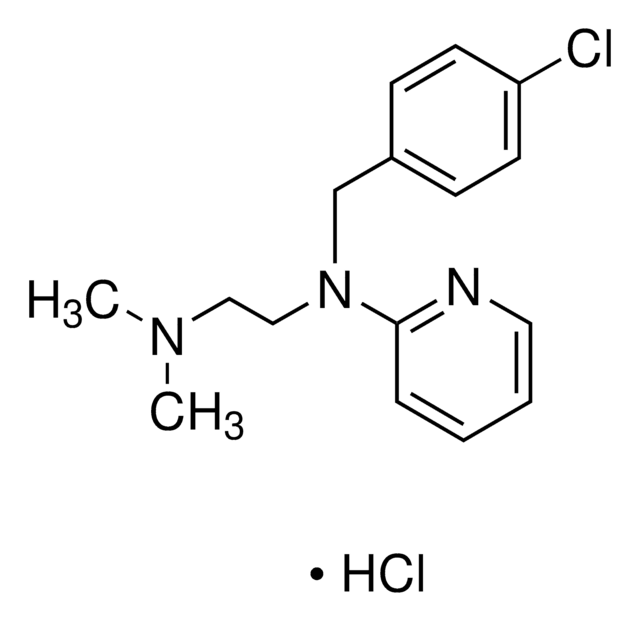
CAS Number6170-42-9
SynonymsChlorpiramin hydrochloride; Chloropyramine HCl; Chloropyramine hydrochloride; Chloropyribenzamine hydrochloride; MFCD00079009; Chlorpyramine hydrochloride; Halopyramine hydrochloride; Nilfan; N-(4-chloro-benzyl)-N',N'-dimethyl-N-[2]pyridyl-ethylenediamine,hydrochloride; Allergan S hydrochloride; Alergosan; EINECS 228-216-2; N-(4-Chlor-benzyl)-N',N'-dimethyl-N-[2]pyridyl-aethylendiamin,Hydrochlorid
Molecular FormulaC16H21Cl2N3
Molecular Weight326.26
Purity98.00%
Boiling Point413.5ºC at 760 mmHg
Appearancepowder
EINECS228-216-2
| Chemical & Physical Properties | |
|---|---|
| CAS Number | 6170-42-9 |
| Catalog No. | 2A-9032559 |
| Chinese Name | 盐酸氯吡胺 |
| Synonyms | Chlorpiramin hydrochloride; Chloropyramine HCl; Chloropyramine hydrochloride; Chloropyribenzamine hydrochloride; MFCD00079009; Chlorpyramine hydrochloride; Halopyramine hydrochloride; Nilfan; N-(4-chloro-benzyl)-N',N'-dimethyl-N-[2]pyridyl-ethylenediamine,hydrochloride; Allergan S hydrochloride; Alergosan; EINECS 228-216-2; N-(4-Chlor-benzyl)-N',N'-dimethyl-N-[2]pyridyl-aethylendiamin,Hydrochlorid |
| Molecular Formula | C16H21Cl2N3 |
| Molecular Weight | 326.26 |
| Purity | 98.00 |
| Boiling Point | 413.5ºC at 760 mmHg |
| Appearance | powder |
| Storage Condition | -20℃ |
| Application | Chloropyramine hydrochloride is a histamine receptor H1 antagonist that also inhibits the biochemical functions of VEGFR-3 and FAK. |
| EINECS | 228-216-2 |
| PubChem ID | 329774916 |
| MDL Number | MFCD00079009 |
| SMILES | Cl.CN(C)CCN(Cc1ccc(Cl)cc1)c2ccccn2 |
| InChI | 1S/C16H20ClN3.ClH/c1-19(2)11-12-20(16-5-3-4-10-18-16)13-14-6-8-15(17)9-7-14;/h3-10H,11-13H2,1-2H3;1H |
| InChI Key | VEYWWAGBHABATA-UHFFFAOYSA-N |
| NACRES Code | NA.24 |
| UNSPSC | 41116107 |
| MSDS | msds/32559_1_6170_42_9.pdf |
| Bioactivity | Chloropyramine hydrochloride is a histamine receptor H1 antagonist which can also inhibit the biochemical function of VEGFR-3 and FAK. Related Catalog Signaling Pathways >> Protein Tyrosine Kinase/RTK >> FAK Signaling Pathways >> GPCR/G Protein >> Histamine Receptor Signaling Pathways >> Immunology/Inflammation >> Histamine Receptor Research Areas >> Cancer Target VEGFR-3 In Vitro BT474 cells are highly sensitive to Chloropyramine hydrochloride (compound 1) treatment, whereby 1 µM concentrations cause a 40% reduction of viability after 48 h of treatment. It is found that at 1 µM concentrations of Chloropyramine hydrochloride, viability of control MCF7-pcDNA3 cells is significantly higher than the viability of MCF7-VEGFR-3 cells (P<0.01) and at 10 µM concentration this difference reaches twofold (P<0.001). In the BT474 cells treatment with Chloropyramine hydrochloride also leads to a concentration-dependent decrease of cell proliferation. When treatment with Chloropyramine hydrochloride is continued for 48 h, the breast cancer cells that overexpressed VEGFR-3 undergo apoptosis. This effect is dose-dependent, with 10 µM Chloropyramine hydrochloride inducing apoptosis in more than 60% of BT474 cells. In our model cell lines MCF7-pcDNA3 and MCF7-VEGFR-3, treatment with 10 µM Chloropyramine hydrochloride for 48 h leads to a 4-fold increase in apoptotic cell death in the cell line that overexpressed VEGFR-3 (18% versus 76 % respectively)[1]. In Vivo Chloropyramine hydrochloride causes a dramatic reduction of tumor growth in both model systems whereby the tumor size in the treated groups is approximately 20% of the tumor size in vehicle control groups. Doxorubicin administered at 3 mg/kg causes approximately 60% reduction of tumor growth, but has no effect on tumor growth at 0, 3 mg/kg. In contrast, there is a modest effect of Chloropyramine hydrochloride alone (50% reduction of tumor growth). The low-dose combination of Chloropyramine hydrochloride and doxorubicin has a prolonged anti-tumor effect (85% reduction of tumor growth) that is greater than either drug alone[1]. Kinase Assay Cells are incubated in presence or absence of Chloropyramine hydrochloride and stained with anti-FAK antibody 4.47 or in combination with paxillin or VEGFR-3. Detection is done with Alexa Fluor 546 secondary antibody and for dual staining combination of Alexa Fluor 488 and Alexa Fluor 546 secondary antibody is used[1]. Cell Assay Cell survival is assayed in MTS assay by measuring mitochondrial dehydrogenase activity of metabolically active cells. 5.0×10³ (100 µL) cells are plated in 96-well plates and are allowed to attach overnight. One hundred microliters of fresh media with or without Chloropyramine hydrochloride is added to each well. Cells are treated for designated amount of time. MTS assay is performed according the manufacturers protocol[1]. Animal Admin BT474 and MCF7-VEGFR-3 cells at a concentration of 2 to 5×10⁶ cells per 200 µL are subcutaneously injected into the right flank of the 5 to 6 week old mice, 5 in each group. Treatment with Chloropyramine hydrochloride is started next day after cells injection via intraperitoneal injection (IP) once a day. Tumor size is measured thrice weekly and volume is calculated using the formula length×width2×0.5. Animals are sacrificed after 21 days of treatment or when tumor size reaches protocol end point. Tumor is excised, measured and preserved for protein and RNA preparation and cytochemistry[1]. References [1]. Kurenova EV, et al. Small molecule chloropyramine hydrochloride (C4) targets the binding site of focal adhesion kinase and vascular endothelial growth factor receptor 3 and suppresses breast cancer growth in vivo. J Med Chem. 2009 Aug 13;52(15):4716-24. Chemical & Physical Properties Boiling Point 413.5ºC at 760 mmHg Molecular Formula C16H21Cl2N3 Molecular Weight 326.26400 Flash Point 203.9ºC Exact Mass 325.11100 PSA 19.37000 LogP 4.10520 InChIKey VEYWWAGBHABATA-UHFFFAOYSA-N SMILES CN(C)CCN(Cc1ccc(Cl)cc1)c1ccccn1.Cl Storage condition -20℃ |
| Use of | Chloropyramine hydrochloride is a histamine receptor H1 antagonist which can also inhibit the biochemical function of VEGFR-3 and FAK. Properties Articles28 Name N'-[(4-chlorophenyl)methyl]-N,N-dimethyl-N'-pyridin-2-ylethane-1,2-diamine,hydrochloride Synonym More Synonyms Chloropyramine hydrochloride Biological Activity Description Chloropyramine hydrochloride is a histamine receptor H1 antagonist which can also inhibit the biochemical function of VEGFR-3 and FAK. Related Catalog Signaling Pathways >> Protein Tyrosine Kinase/RTK >> FAK Signaling Pathways >> GPCR/G Protein >> Histamine Receptor Signaling Pathways >> Immunology/Inflammation >> Histamine Receptor Research Areas >> Cancer Kinase Assay Cells are incubated in presence or absence of Chloropyramine hydrochloride and stained with anti-FAK antibody 4.47 or in combination with paxillin or VEGFR-3. Detection is done with Alexa Fluor 546 secondary antibody and for dual staining combination of Alexa Fluor 488 and Alexa Fluor 546 secondary antibody is used[1]. Cell Assay Cell survival is assayed in MTS assay by measuring mitochondrial dehydrogenase activity of metabolically active cells. 5.0×10³ (100 µL) cells are plated in 96-well plates and are allowed to attach overnight. One hundred microliters of fresh media with or without Chloropyramine hydrochloride is added to each well. Cells are treated for designated amount of time. MTS assay is performed according the manufacturers protocol[1]. References [1]. Kurenova EV, et al. Small molecule chloropyramine hydrochloride (C4) targets the binding site of focal adhesion kinase and vascular endothelial growth factor receptor 3 and suppresses breast cancer growth in vivo. J Med Chem. 2009 Aug 13;52(15):4716-24. Chemical & Physical Properties Exact Mass 325.11100 PSA 19.37000 LogP 4.10520 InChIKey VEYWWAGBHABATA-UHFFFAOYSA-N Storage condition -20℃ |
| Transport Info | Product Name: Chloropyramide Hydrochloride |
| Related Products in Specialty Chemicals | ||
|---|---|---|
| Vasicine | 6159-55-3 | 2A-9032542 |
| 2-Methoxy-6-methylbenzoic acid | 6161-65-5 | 2A-9032547 |
| Tris(2-methylphenyl)phosphine | 6163-58-2 | 2A-9032548 |
| Propargyl benzenesulfonate | 6165-75-9 | 2A-9032554 |
| DL-Alaninol | 6168-72-5 | 2A-9032556 |
| 2,2-Diethoxyacetophenone | 6175-45-7 | 2A-9032560 |
| 2-Dodecanone | 6175-49-1 | 2A-9032561 |
| Glycidyl 4-nonylphenyl ether | 6178-32-1 | 2A-9032562 |
| Ethyl 3,4,5-trimethoxybenzoate | 6178-44-5 | 2A-9032563 |
| 3-Ethoxyacryloyl chloride | 6191-99-7 | 2A-9032570 |
| Browse all Specialty Chemicals products » | ||
Phone:
630-322-8886
630-322-8887
Email:
Office Locations:
Chicago, IL, USA
San Francisco, CA, USA


 EN
EN


 SDS
SDS