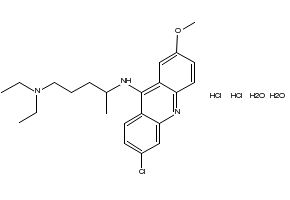
CAS Number6151-30-0
SynonymsAtebrin hydrochloride; Quinacrinehydrochlorid; MFCD00150069; 866 R.P.; Chemiochin; Acrichine; mepacrinehydrochloridedihydrate; atabrinehydrochloridedihydrate; QuinacrineHCl; QUINACRINE,ATABRINE MEPACNINE; Mepacrine dihydrochloride; Chinacrin hydrochloride; hloride2h2-o; ochloride,dihydrate; Mecryl; Erion; Pentilen; mepacrinehcl; N-(6-Chloro-2-methoxy-9-acridinyl)-N,N-diethyl-1,4-pentanediamine dihydrochloride dihydrate; AtabrineMepacnine; QUINACRINE DIHYDROCHLORIDE; Palusan; 1,4-Pentanediamine, N-(6-chloro-2-methoxy-9-acridinyl)-N,N-diethyl-, hydrochloride, hydrate (1:2:2); Crinodora; Akrichin; Italchin; Metochin; Metoquine; Palacrin; 69-05-6 {Anhydrous}
Molecular FormulaC23H36Cl3N3O3
Molecular Weight508.92
Purity95.00%
Boiling Point557.1ºC at 760 mmHg
Melting Point247 °C
Appearancepowder
| Chemical & Physical Properties | |
|---|---|
| CAS Number | 6151-30-0 |
| Catalog No. | 2A-9032526 |
| Chinese Name | 米帕林盐酸盐 |
| Synonyms | Atebrin hydrochloride; Quinacrinehydrochlorid; MFCD00150069; 866 R.P.; Chemiochin; Acrichine; mepacrinehydrochloridedihydrate; atabrinehydrochloridedihydrate; QuinacrineHCl; QUINACRINE,ATABRINE MEPACNINE; Mepacrine dihydrochloride; Chinacrin hydrochloride; hloride2h2-o; ochloride,dihydrate; Mecryl; Erion; Pentilen; mepacrinehcl; N-(6-Chloro-2-methoxy-9-acridinyl)-N,N-diethyl-1,4-pentanediamine dihydrochloride dihydrate; AtabrineMepacnine; QUINACRINE DIHYDROCHLORIDE; Palusan; 1,4-Pentanediamine, N-(6-chloro-2-methoxy-9-acridinyl)-N,N-diethyl-, hydrochloride, hydrate (1:2:2); Crinodora; Akrichin; Italchin; Metochin; Metoquine; Palacrin; 69-05-6 {Anhydrous} |
| Molecular Formula | C23H36Cl3N3O3 |
| Molecular Weight | 508.92 |
| Purity | 95.00 |
| Boiling Point | 557.1ºC at 760 mmHg |
| Melting Point | 247 °C |
| Appearance | powder |
| Water Solubility | 2.8 g/100 mL |
| Storage Condition | Store airtight in a cool, dry warehouse. |
| Application | Quinacrine hydrochloride hydrate (Mepacrine hydrochloride hydrate) is an antimalarial agent with anti-tumor effects both in vivo and in vitro. Quinacrine hydrochloride hydrate inhibits NF-κB and activ |
| MDL Number | C23H36Cl3N3O3 |
| SMILES | CCN(CC)CCCC(C)Nc1c2ccc(Cl)cc2nc2ccc(OC)cc12.Cl.Cl.O.O |
| InChI | InChI=1S/C23H30ClN3O.2ClH.2H2O/c1-5-27(6-2)13-7-8-16(3)25-23-19-11-9-17(24)14-22(19)26-21-12-10-18(28-4)15-20(21)23;;;;/h9-12,14-16H,5-8,13H2,1-4H3,(H,25,26);2*1H;2*1H2 |
| InChI Key | RZFNKJVCPDLQQA-UHFFFAOYSA-N |
| MSDS | msds/32526_1_6151_30_0.pdf |
| Bioactivity | Quinacrine hydrochloride hydrate (Mepacrine hydrochloride hydrate) is an antimalarial agent, which possess anticancer effect both in vitro and vivo. Quinacrine hydrochloride hydrate suppresses NF-κB and activates p53 signaling, which results in the induction of the apoptosis[1]. Related Catalog Signaling Pathways >> Apoptosis >> Apoptosis Research Areas >> Cancer Research Areas >> Infection Signaling Pathways >> Autophagy >> Autophagy Signaling Pathways >> Autophagy >> Mitophagy In Vitro Quinacrine (5-20 μM; 24 hours) inhibits the growth of SGC-7901 cells[1]. Quinacrine (7.5 and 15 μM; 24 hours) induces apoptosis in SGC-7901 cells, which is associated with mitochondria-dependent signal pathway and involves p53 upregulation and caspase-3 activation pathway[1]. Quinacrine (15 μM; 24 hours) treatment significantly increased the levels of proapoptotic proteins, including cytochrome c, Bax, and p53, and decreased the levels of antiapoptotic protein Bcl-2, thus shifting the ratio of Bax/Bcl-2 in favor of apoptosis [1]. Cell Viability Assay[1] Cell Line: SGC-7901 cells Concentration: 0, 5, 10, 15, and 20 μM Incubation Time: 24 hours Result: Cell viability was inhibited in a dose-dependent manner, and the mean IC50 value is 16.18 μM. Apoptosis Analysis[1] Cell Line: SGC-7901 cells Concentration: 7.5 and 15 μM Incubation Time: 24 hours Result: The percentage of apoptotic cells, including the early phase and late phase apoptosis, increased to 26.30%, compared with control group of 3.37%. Western Blot Analysis[1] Cell Line: SGC-7901 cells Concentration: 15 μM Incubation Time: 24 hours Result: The relative quantity of cytochrome c protein was upregulated, increased from 0.10 to 0.24. The relative quantity of p53 protein was dramatically increased, from 0.06 to 0.19. The Bax/Bcl-2 ratio was dramatically elevated from 1.21 to 2.59. In Vivo Quinacrine (100 mg/kg three times per week for two consecutive weeks) significantly suppresses circulating blast cells at days 30/31 and increases the median survival time (MST). Quinacrine does not decrease the body weight of treated animals at the tested dose[2]. Animal Model: Female SCID mice with acute myeloid leukemia (AML)-PS model[2] Dosage: 100 mg/kg Administration: Administered by oral gavage (po); three times a week for two consecutive weeks Result: In the first AML mouse in vivo study, evaluation of circulating leukemic cells detected in blood samples (in percent of white blood cells (WBC)) at day 30/31 showed 72% human tumor cells in the control mice, whereas in mice treated with Quinacrine, this was only 2.2%. The MST of control mice was 34 days whereas it was 46 days in Quinacrine-treated mice. References [1]. Xiaoyang Wu, et al. Quinacrine Inhibits Cell Growth and Induces Apoptosis in Human Gastric Cancer Cell Line SGC-7901. Curr Ther Res Clin Exp. 2012 Feb;73(1-2):52-64. [2]. Anna Eriksson, et al. Towards repositioning of quinacrine for treatment of acute myeloid leukemia - Promising synergies and in vivo effects. Leuk Res. 2017 Dec;63:41-46. Chemical & Physical Properties Boiling Point 557.1ºC at 760 mmHg Melting Point 247 °C Molecular Formula C23H36Cl3N3O3 Molecular Weight 508.909 Exact Mass 507.182220 PSA 55.85000 LogP 7.52080 InChIKey RZFNKJVCPDLQQA-UHFFFAOYSA-N SMILES CCN(CC)CCCC(C)Nc1c2ccc(Cl)cc2nc2ccc(OC)cc12.Cl.Cl.O.O Storage condition -20℃ Water Solubility 2.8 g/100 mL |
| Use of | Quinacrine hydrochloride hydrate (Mepacrine hydrochloride hydrate) is an antimalarial agent, which possess anticancer effect both in vitro and vivo. Quinacrine hydrochloride hydrate suppresses NF-κB and activates p53 signaling, which results in the induction of the apoptosis[1]. Properties Name Mepacrine hydrochloride Synonym More Synonyms Quinacrine Dihydrochloride Dihydrate Biological Activity Description Quinacrine hydrochloride hydrate (Mepacrine hydrochloride hydrate) is an antimalarial agent, which possess anticancer effect both in vitro and vivo. Quinacrine hydrochloride hydrate suppresses NF-κB and activates p53 signaling, which results in the induction of the apoptosis[1]. Related Catalog Signaling Pathways >> Apoptosis >> Apoptosis Research Areas >> Cancer Research Areas >> Infection Signaling Pathways >> Autophagy >> Autophagy Signaling Pathways >> Autophagy >> Mitophagy References [2]. Anna Eriksson, et al. Towards repositioning of quinacrine for treatment of acute myeloid leukemia - Promising synergies and in vivo effects. Leuk Res. 2017 Dec;63:41-46. Chemical & Physical Properties Exact Mass 507.182220 PSA 55.85000 LogP 7.52080 InChIKey RZFNKJVCPDLQQA-UHFFFAOYSA-N Storage condition -20℃ |
| Transport Info | Product name: Quinacrine Dihydrochloride Dihydrate |
| Related Products in Nutritional Ingredients | ||
|---|---|---|
| 5-Sulfosalicylic acid dihydrate | 5965-83-3 | 2A-9032357 |
| Creatine monohydrate | 6020-87-7 | 2A-9032407 |
| N-Benzoyl-L-glutamic acid | 6094-36-6 | 2A-9032470 |
| N-Formyl-L-leucine | 6113-61-7 | 2A-9032490 |
| Mangostin | 6147-11-1 | 2A-9032518 |
| Riboflavin 5'-monophosphate sodium salt dihydrate | 6184-17-4 | 2A-9032565 |
| cis-4,7,10,13,16,19-Docosahexaenoic acid | 6217-54-5 | 2A-9032593 |
| L-Glutamic acid 5-tert-butyl 1-methyl ester hydrochloride | 6234-01-1 | 2A-9032615 |
| L-Glutamic acid 1-methyl ester | 6384-08-3 | 2A-9032840 |
| DL-Arginine | 7200-25-1 | 2A-9033480 |
| Browse all Nutritional Ingredients products » | ||
Phone:
630-322-8886
630-322-8887
Email:
Office Locations:
Chicago, IL, USA
San Francisco, CA, USA


 EN
EN


 SDS
SDS