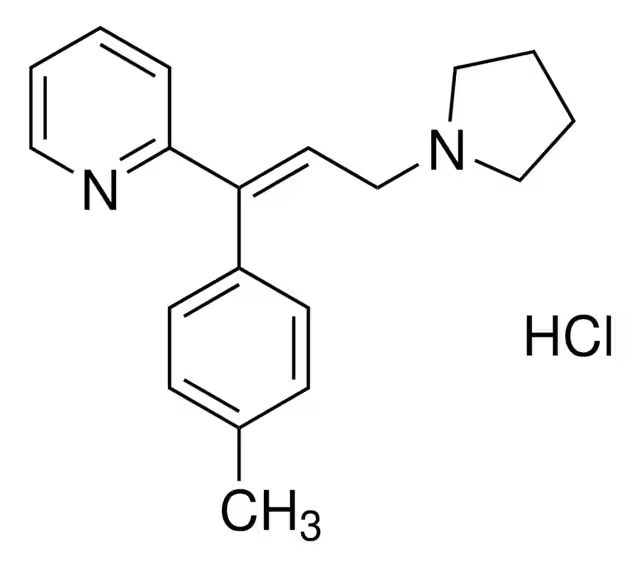
| Chemical & Physical Properties | |
|---|---|
| CAS Number | 6138-79-0 |
| Catalog No. | 2A-9032507 |
| Chinese Name | 盐酸曲普利啶 |
| Synonyms | MFCD00150574; Triprolidine hydrochloride |
| Molecular Formula | C19H25ClN2O |
| Molecular Weight | 314.85 |
| Purity | ≥99 |
| Boiling Point | 462ºC at 760 mmHg |
| Melting Point | 115-120ºC |
| Appearance | White crystalline powder |
| Water Solubility | ≥10 g/100 mL at 20 ºC |
| Storage Condition | 2-8°C |
| Application | Triprolidine hydrochloride is an orally active, cell-permeable, first-generation histamine H1 antagonist [1]. Triprolidine hydrochloride is an antihistamine that can be used for allergic rhinitis, ast |
| PubChem ID | 24277808 |
| MDL Number | MFCD00039044 |
| SMILES | CC(C=C1)=CC=C1/C(C2=NC=CC=C2)=C\CN3CCCC3.Cl |
| InChI | 1S/C19H22N2.ClH/c1-16-7-9-17(10-8-16)18(19-6-2-3-12-20-19)11-15-21-13-4-5-14-21;/h2-3,6-12H,4-5,13-15H2,1H3;1H/b18-11+; |
| InChI Key | WYUYEJNGHIOFOC-NWBUNABESA-N |
| NACRES Code | NA.77 |
| UNSPSC | 12352200 |
| MSDS | msds/32507_1_6138_79_0.pdf |
| Bioactivity | Triprolidine hydrochloride monohydrate is an orally active, cell-permeable and first-generation histamine H1 antagonist[1]. Triprolidine hydrochloride monohydrate is an antihistamine and can be used in allergic rhinitis; asthma; and urticaria[2]. Related Catalog Signaling Pathways >> Immunology/Inflammation >> Histamine Receptor Research Areas >> Neurological Disease Signaling Pathways >> GPCR/G Protein >> Histamine Receptor Target H1 Receptor In Vivo Triprolidine (intraseptal infusion; 0.5 μM in 0.5 μl; 30, 60, and 180 min after tetanus) had no significant effects on the baseline fEPSPs, however, it is followed by a smaller Long-term potentiation (LTP) induced during walking (173% of the baseline at 60 min) compared with saline infusion (208% at 60 min) in rats[2]. Animal Model: Adult male Long-Evans TMN (tuberomammillary nucleus (TMN) neurons) lesion rats[2] Dosage: 0.5 μm in 0.5 μl Administration: Intraseptal infusion; 30, 60, and 180 min after tetanus Result: Attenuated the walking-associated enhancement of LTP. References [1]. Tao Luo, et al. Endogenous Histamine Facilitates Long-Term Potentiation in the Hippocampus During WalkingJ Neurosci. 2010 Jun 9;30(23):7845-52. [2]. Sang-Chul Shin, et al. Controlled Release of Triprolidine Using Ethylene-Vinyl Acetate Membrane and Matrix Systems. Eur J Pharm Biopharm Chemical & Physical Properties Boiling Point 462ºC at 760 mmHg Melting Point 115-120ºC Molecular Formula C19H25ClN2O Molecular Weight 314.85200 Flash Point 233.2ºC Exact Mass 314.15500 PSA 16.13000 LogP 4.65740 InChIKey WYUYEJNGHIOFOC-NWBUNABESA-N SMILES Cc1ccc(C(=CCN2CCCC2)c2ccccn2)cc1.Cl Storage condition 2-8°C Stability Stable, but discolours in light. Incompatible with strong oxidizing agents. Water Solubility ≥10 g/100 mL at 20 ºC |
| Use of | Triprolidine hydrochloride monohydrate is an orally active, cell-permeable and first-generation histamine H1 antagonist[1]. Triprolidine hydrochloride monohydrate is an antihistamine and can be used in allergic rhinitis; asthma; and urticaria[2]. Properties Articles29 Name triprolidine hydrochloride monohydrate Synonym More Synonyms Triprolidine hydrochloride Biological Activity Description Triprolidine hydrochloride monohydrate is an orally active, cell-permeable and first-generation histamine H1 antagonist[1]. Triprolidine hydrochloride monohydrate is an antihistamine and can be used in allergic rhinitis; asthma; and urticaria[2]. Related Catalog Signaling Pathways >> Immunology/Inflammation >> Histamine Receptor Research Areas >> Neurological Disease Signaling Pathways >> GPCR/G Protein >> Histamine Receptor H1 Receptor References [1]. Tao Luo, et al. Endogenous Histamine Facilitates Long-Term Potentiation in the Hippocampus During WalkingJ Neurosci. 2010 Jun 9;30(23):7845-52. [2]. Sang-Chul Shin, et al. Controlled Release of Triprolidine Using Ethylene-Vinyl Acetate Membrane and Matrix Systems. Eur J Pharm Biopharm Chemical & Physical Properties Exact Mass 314.15500 PSA 16.13000 LogP 4.65740 InChIKey WYUYEJNGHIOFOC-NWBUNABESA-N Stability Stable, but discolours in light. Incompatible with strong oxidizing agents. |
| Transport Info | Product name: trans-tripridine hydrochloride |
| Related Products in Plastic & Specialty Additives | ||
|---|---|---|
| 2-Acetamidopyridine | 5231-96-9 | 2A-9031547 |
| Tetrakis(triphenylphosphine)palladium | 14221-01-3 | 2A-9031630 |
| 3-Isothioureidopropionic acid | 5398-29-8 | 2A-9031749 |
| Butriptyline hydrochloride | 5585-73-9 | 2A-9031994 |
| Ethyl 2-(triphenylphosphoranylidene)propionate | 5717-37-3 | 2A-9032090 |
| (+/-)-Pseudopelletierine oxime | 6164-67-6 | 2A-9032549 |
| Propyltriphenylphosphonium bromide | 6228-47-3 | 2A-9032606 |
| (Triphenylsilyl)acetylene | 6229-00-1 | 2A-9032608 |
| 4-Iodophthalic acid | 6301-60-6 | 2A-9032704 |
| Triphenylphosphine hydrobromide | 6399-81-1 | 2A-9032854 |
| Browse all Plastic & Specialty Additives products » | ||
Phone:
630-322-8886
630-322-8887
Email:
Office Locations:
Chicago, IL, USA
San Francisco, CA, USA


 EN
EN


 SDS
SDS