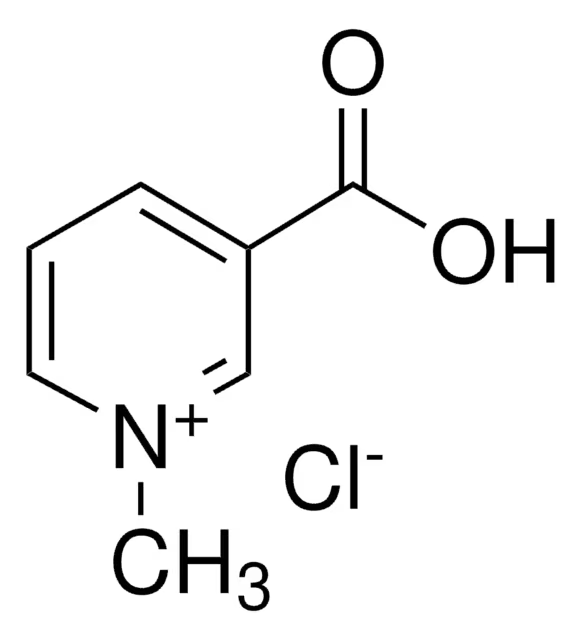
CAS Number6138-41-6
SynonymsPyridinium, 3-carboxy-1-methyl-, chloride (1:1); 3-Carboxy-1-methylpyridinium chloride; Trigonelline hydroch; TRIGONELLINE HCL; trigonellinium chloride; 1-Methyl-3-pyridiniumcarboxylathydrochlorid; TRIGONELLIN HYDROCHLORIDE; 1-Methylpyridinium-3-carboxylate hydrochloride (1:1); EINECS 228-119-5; N-METHYLNICOTINIC ACID BETAINE HYDROCHLORIDE; 1-Méthyl-3-pyridiniumcarboxylate chlorhydrate; 1-methylnicotinic acid chloride; Pyridinium, 3-carboxy-1-methyl-, chloride; N-methylpyridinium-3-carboxylate hydrochloride; 1-Methyl-3-pyridiniumcarboxylate hydrochloride; MFCD00077250; Trigonelline chloride
Molecular FormulaC7H8ClNO2
Molecular Weight173.60
Purity98.00%
Melting Point~260 °C (dec.)
AppearanceSolid;White to Almost white powder to crystal
EINECS228-119-5
| Chemical & Physical Properties | |
|---|---|
| CAS Number | 6138-41-6 |
| Catalog No. | 2A-9032506 |
| Chinese Name | 盐酸胡芦巴碱; N-甲基烟酸内盐盐酸盐 |
| Synonyms | Pyridinium, 3-carboxy-1-methyl-, chloride (1:1); 3-Carboxy-1-methylpyridinium chloride; Trigonelline hydroch; TRIGONELLINE HCL; trigonellinium chloride; 1-Methyl-3-pyridiniumcarboxylathydrochlorid; TRIGONELLIN HYDROCHLORIDE; 1-Methylpyridinium-3-carboxylate hydrochloride (1:1); EINECS 228-119-5; N-METHYLNICOTINIC ACID BETAINE HYDROCHLORIDE; 1-Méthyl-3-pyridiniumcarboxylate chlorhydrate; 1-methylnicotinic acid chloride; Pyridinium, 3-carboxy-1-methyl-, chloride; N-methylpyridinium-3-carboxylate hydrochloride; 1-Methyl-3-pyridiniumcarboxylate hydrochloride; MFCD00077250; Trigonelline chloride |
| Molecular Formula | C7H8ClNO2 |
| Molecular Weight | 173.60 |
| Purity | 98.00 |
| Melting Point | ~260 °C (dec.) |
| Appearance | Solid;White to Almost white powder to crystal |
| Water Solubility | Water solubility: soluble |
| Storage Condition | -20°C |
| Application | Trigonelline chloride is an alkaloid found in large amounts in coffee and has potential antidiabetic activity. |
| EINECS | 228-119-5 |
| HTC | 2933399090 |
| PubChem ID | 329826825 |
| MDL Number | MFCD00077250 |
| SMILES | [Cl-].C[n+]1cccc(c1)C(O)=O |
| InChI | 1S/C7H7NO2.ClH/c1-8-4-2-3-6(5-8)7(9)10;/h2-5H,1H3;1H |
| InChI Key | TZSYLWAXZMNUJB-UHFFFAOYSA-N |
| Beilstein/REAXYS | 3734169 |
| NACRES Code | NA.24 |
| UNSPSC | 41116107 |
| MSDS | msds/32506_2_6138_41_6.pdf |
| Bioactivity | Trigonelline chloride, an alkaloid with potential antidiabetic activity, is present in considerable amounts in coffee. Related Catalog Signaling Pathways >> Others >> Others Natural Products >> Alkaloid Research Areas >> Metabolic Disease In Vitro It is found that Trigonelline chloride (TG) significantly rescues the morphology of the H9c2 cells. Treatment of cells with Trigonelline chloride attenuates H2O2 induced cell deaths and improves the antioxidant activity. In addition, Trigonelline chloride regulates the apoptotic gene caspase-3, caspase-9 and anti-apoptotic gene Bcl-2, Bcl-XL during H2O2 induced oxidative stress in H9c2 cells. For evident, flow cytometer results also confirm that Trigonelline chloride significantly reduces the H2O2 induced necrosis and apoptosis in H9c2 cells. However, further increment of Trigonelline chloride concentration against H2O2 can induce the necrosis and apoptosis along with H2O2[1]. In Vivo Trigonelline chloride decreases bone mineralization and tends to worsen bone mechanical properties in streptozotocin-induced diabetic rats. In nicotinamide/streptozotocin-treated rats, Trigonelline chloride significantly increases bone mineral density (BMD) and tends to improve cancellous bone strength. Trigonelline chloride differentially affects the skeletal system of rats with streptozotocin-induced metabolic disorders, intensifying the osteoporotic changes in streptozotocin-treated rats and favorably affecting bones in the non-hyperglycemic (nicotinamide/streptozotocin-treated) rats[2]. Cell Assay The H9c2 cells are seeded in the 96 well at a density of 1×10⁵ cells/well. The cells are treated with different concentrations of Trigonelline chloride (TG) (25 to 150 μM) and hydrogen peroxide (25 to 125 μM). It is incubated at 37°C in 5% CO2 incubator for 24 h and 6 h respectively and then the culture is treated with the water soluble tetrazolium (WST) reagent incubated for 2 h to 4 h. The living cells absorb the WST then it is converted into an orange colour product. Then, the intensity of colour is measured at 450 nm using spectra count ELISA reader. For cardio protective activity, the cells are seeded and separated into six groups: control, H2O2 alone, the rest of groups are initially exposed to different concentration (25 to 125 μM) of Trigonelline chloride for 48 hours. Then, 100 μM of H2O2 is added and incubated for 4 hours, after, read the absorbance at 450 nm for cell viability assay[1]. Animal Admin Three-month-old female Wistar rats are used in this study. The animals are divided into five groups (n=10): Control rats, Streptozotocin-treated control rats, Streptozotocin-treated rats receiving Trigonelline chloride (50 mg/kg p.o. daily), Nicotinamide/streptozotocin-treated control rats, and Nicotinamide/streptozotocin-treated rats receiving Trigonelline chloride (50 mg/kg p.o. daily). Administration of Trigonelline chloride starts two weeks after streptozotocin and lasts four weeks. Trigonelline chloride is administered once daily by a stomach tube. All control rats receive tap water (the vehicle) at the same volume of 2 mL/kg p.o. The four-week period of Trigonelline chloride administration is long enough to demonstrate skeletal effects of Trigonelline chloride and other compounds of plant origin in rats. The rats are fasted overnight after the last Trigonelline chloride or vehicle administration. The next day, the blood glucose level is measured and the rats are anesthetized with ketamine and xylazine, and then sacrificed by cardiac exsanguination[2]. References [1]. Ilavenil S, et al. Trigonelline protects the cardiocyte from hydrogen peroxide induced apoptosis in H9c2 cells. Asian Pac J Trop Med. 2015 Apr;8(4):263-8. [2]. Joanna Folwarczna, et al. Effects of Trigonelline, an Alkaloid Present in Coffee, on Diabetes-Induced Disorders in the Rat Skeletal System. Nutrients. 2016 Mar; 8(3): 133. Chemical & Physical Properties Melting Point ~260 °C (dec.) Molecular Formula C7H8ClNO2 Molecular Weight 173.597 Exact Mass 173.024353 PSA 44.01000 InChIKey TZSYLWAXZMNUJB-UHFFFAOYSA-N SMILES C[n+]1cccc(C(=O)O)c1.[Cl-] Storage condition -20°C |
| Use of | Trigonelline chloride, an alkaloid with potential antidiabetic activity, is present in considerable amounts in coffee. Properties Articles30 Name Trigonelline hydrochloride Synonym More Synonyms Trigonelline chloride Biological Activity Description Trigonelline chloride, an alkaloid with potential antidiabetic activity, is present in considerable amounts in coffee. Related Catalog Signaling Pathways >> Others >> Others Natural Products >> Alkaloid Research Areas >> Metabolic Disease In Vivo Trigonelline chloride decreases bone mineralization and tends to worsen bone mechanical properties in streptozotocin-induced diabetic rats. In nicotinamide/streptozotocin-treated rats, Trigonelline chloride significantly increases bone mineral density (BMD) and tends to improve cancellous bone strength. Trigonelline chloride differentially affects the skeletal system of rats with streptozotocin-induced metabolic disorders, intensifying the osteoporotic changes in streptozotocin-treated rats and favorably affecting bones in the non-hyperglycemic (nicotinamide/streptozotocin-treated) rats[2]. References [2]. Joanna Folwarczna, et al. Effects of Trigonelline, an Alkaloid Present in Coffee, on Diabetes-Induced Disorders in the Rat Skeletal System. Nutrients. 2016 Mar; 8(3): 133. Chemical & Physical Properties Exact Mass 173.024353 PSA 44.01000 InChIKey TZSYLWAXZMNUJB-UHFFFAOYSA-N |
| Tax Rebate | 13.0% |
| Supervision | None. MFN tariff: 6.5%. Ordinary tariff: 20.0% |
| Transport Info | Product name: Summary 2933399090. other compounds containing an unfused pyridine ring (whether or not hydrogenated) in the structure. VAT:17.0%. Tax rebate rate:13.0%. . MFN tariff:6.5%. General tariff:20.0% |
| Related Products in Specialty Chemicals | ||
|---|---|---|
| Sodium cacodylate trihydrate | 6131-99-3 | 2A-9032500 |
| Sodium carbonate decahydrate | 6132-02-1 | 2A-9032501 |
| 1-Methylxanthine | 6136-37-4 | 2A-9032503 |
| 3-Acetylbenzonitrile | 6136-68-1 | 2A-9032504 |
| D(+)-Trehalose dihydrate | 6138-23-4 | 2A-9032505 |
| Methyl 3-methyl-2-furoate | 6141-57-7 | 2A-9032511 |
| 5-Norbornen-2-yl acetate | 6143-29-9 | 2A-9032514 |
| 3-Chlorophenylguanidine | 6145-41-1 | 2A-9032515 |
| Tris(2-chloropropyl) phosphate | 6145-73-9 | 2A-9032516 |
| 6-Nitrophthalide | 610-93-5 | 2A-9032519 |
| Browse all Specialty Chemicals products » | ||
Phone:
630-322-8886
630-322-8887
Email:
Office Locations:
Chicago, IL, USA
San Francisco, CA, USA


 EN
EN


 SDS
SDS