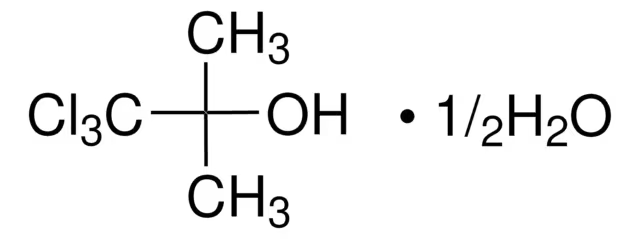
CAS Number6001-64-5
Synonyms1,1,1-Trichloro-2-methyl-2-propanol hemihydrate; 1,1,1-Trichloro-2-methyl-2-propanol hydrate (2:1); MFCD02179352; 1,1,1-trichloro-2-methyl-2-propanol(hydrate) (2:1); Chlorobutanol Hemihydrate; 1,1,1-Trichloro-2-methylpropan-2-ol hydrate (2:1); 2-Propanol, 1,1,1-trichloro-2-methyl-, hydrate (2:1)
Molecular FormulaCl3CC(CH3)2OH · 0.5H2O
Molecular Weight186.46
Purity98%
Boiling Point167ºC
Melting Point77-79 °C (lit.)
Appearancesolid
EINECS249-042-3
Symbol
Signal WordWarning
| Chemical & Physical Properties | |
|---|---|
| CAS Number | 6001-64-5 |
| Catalog No. | 2A-9032387 |
| Chinese Name | 三氯叔丁醇 半水合物 |
| Synonyms | 1,1,1-Trichloro-2-methyl-2-propanol hemihydrate; 1,1,1-Trichloro-2-methyl-2-propanol hydrate (2:1); MFCD02179352; 1,1,1-trichloro-2-methyl-2-propanol(hydrate) (2:1); Chlorobutanol Hemihydrate; 1,1,1-Trichloro-2-methylpropan-2-ol hydrate (2:1); 2-Propanol, 1,1,1-trichloro-2-methyl-, hydrate (2:1) |
| Molecular Formula | Cl3CC(CH3)2OH · 0.5H2O |
| Molecular Weight | 186.46 |
| Purity | 98 |
| Boiling Point | 167ºC |
| Melting Point | 77-79 °C (lit.) |
| Appearance | solid |
| Water Solubility | Slightly soluble in water, very soluble in ethanol |
| Storage Condition | Avoid light, keep in a cool and dry place, sealed |
| Application | Chlorobutanol hemihydrate is a pharmaceutical preservative with sedative-hypnotic properties. Chlorobutanol hemihydrate is resistant to a variety of Gram-positive and Gram-negative bacteria as well as |
| EINECS | 249-042-3 |
| PubChem ID | 24847062 |
| MDL Number | MFCD02179352 |
| SMILES | O.CC(C)(O)C(Cl)(Cl)Cl |
| InChI | 1S/2C4H7Cl3O.H2O/c2*1-3(2,8)4(5,6)7;/h2*8H,1-2H3;1H2 |
| InChI Key | WRWLCXJYIMRJIN-UHFFFAOYSA-N |
| Beilstein/REAXYS | 878167 |
| NACRES Code | NA.22 |
| UNSPSC | 12352100 |
| Hazard Symbols | transportation |
| MSDS | msds/32387_1_6001_64_5.pdf |
| Bioactivity | Chlorobutanol hemihydrate is a pharmaceutical preservative with sedative-hypnotic actions. Chlorobutanol hemihydrate is active against a wide variety of Gram-positive and Gram-negative bacteria, and several mold spores and fungi. Chlorobutanol hemihydrate is widely used in food and cosmetic industry[1][2]. Related Catalog Research Areas >> Infection Signaling Pathways >> Anti-infection >> Fungal Research Areas >> Neurological Disease Signaling Pathways >> Anti-infection >> Bacterial References [1]. Smoak IW, et al. Chlorobutanol: maternal serum levels and placental transfer in the mouse. Vet Hum Toxicol. 1997 Oct;39(5):287-90. [2]. Friesen WT, et al. The antibacterial stability of chlorobutanol stored in polyethylene bottles. Am J Hosp Pharm. 1971 Jul;28(7):507-12. Chemical & Physical Properties Boiling Point 167ºC Melting Point 75-79ºC Molecular Formula C4H9Cl3O2 Molecular Weight 372.929 Flash Point 100ºC Exact Mass 369.923065 PSA 29.46000 LogP 2.06320 Appearance of Characters Crystalline Powder, Crystals and/or Chunks | White to almost white InChIKey WRWLCXJYIMRJIN-UHFFFAOYSA-N SMILES CC(C)(O)C(Cl)(Cl)Cl.CC(C)(O)C(Cl)(Cl)Cl.O Storage condition -20°C Stability Stable. Generates toxic fumes on combustion. Incompatible with strong oxidizing agents. Water Solubility Slightly soluble in water, very soluble in ethanol (96 per cent), soluble in glycerol (85 per cent). | Soluble in ethanol, ether, chloroform, and glycerol. Insoluble in water. |
| Use of | Chlorobutanol hemihydrate is a pharmaceutical preservative with sedative-hypnotic actions. Chlorobutanol hemihydrate is active against a wide variety of Gram-positive and Gram-negative bacteria, and several mold spores and fungi. Chlorobutanol hemihydrate is widely used in food and cosmetic industry[1][2]. Properties Name 1,1,1-Trichloro-2-Methyl-2-Propanol Hemihydrate Synonym More Synonyms Chlorobutanol hemihydrate Biological Activity Description Chlorobutanol hemihydrate is a pharmaceutical preservative with sedative-hypnotic actions. Chlorobutanol hemihydrate is active against a wide variety of Gram-positive and Gram-negative bacteria, and several mold spores and fungi. Chlorobutanol hemihydrate is widely used in food and cosmetic industry[1][2]. Related Catalog Research Areas >> Infection Signaling Pathways >> Anti-infection >> Fungal Research Areas >> Neurological Disease Signaling Pathways >> Anti-infection >> Bacterial References [1]. Smoak IW, et al. Chlorobutanol: maternal serum levels and placental transfer in the mouse. Vet Hum Toxicol. 1997 Oct;39(5):287-90. [2]. Friesen WT, et al. The antibacterial stability of chlorobutanol stored in polyethylene bottles. Am J Hosp Pharm. 1971 Jul;28(7):507-12. Chemical & Physical Properties Exact Mass 369.923065 PSA 29.46000 LogP 2.06320 Appearance of Characters Crystalline Powder, Crystals and/or Chunks | White to almost white InChIKey WRWLCXJYIMRJIN-UHFFFAOYSA-N SMILES CC(C)(O)C(Cl)(Cl)Cl.CC(C)(O)C(Cl)(Cl)Cl.O Stability Stable. Generates toxic fumes on combustion. Incompatible with strong oxidizing agents. Water Solubility Slightly soluble in water, very soluble in ethanol (96 per cent), soluble in glycerol (85 per cent). | Soluble in ethanol, ether, chloroform, and glycerol. Insoluble in water. |
| Transport Info | Shipping Name: UN |
| MSDS Transport Info | Module 14. Shipping information 14.1 UN dangerous goods number European Land Transport Dangerous Regulations: -International Maritime Dangerous Regulations: -International Air Transport Dangerous Regulations: - 14.2 United Nations shipping name European Land Transport Dangerous Regulations: Non-dangerous goods IMDG Code: Non-dangerous goods International air transport dangerous goods regulations: non-dangerous goods 14.3 Transport hazard categories European Land Transport Dangerous Regulations: -International Maritime Dangerous Regulations: -International Air Transport Dangerous Regulations: - 14.4 Package group European Land Transport Dangerous Regulations: -International Maritime Dangerous Regulations: -International Air Transport Dangerous Regulations: - 14.5 Environmental hazards European Land Transport Danger Regulations: No International Maritime Danger Regulations International Air Transport Danger Regulations: No Marine pollutants (yes/no): No 14.6 Special reminder to users No data available |
| Related Products in Specialty Chemicals | ||
|---|---|---|
| Patchouli alcohol | 5986-55-0 | 2A-9032374 |
| Oxybuprocaine hydrochloride | 5987-82-6 | 2A-9032376 |
| L-Dihydroorotic acid | 5988-19-2 | 2A-9032377 |
| Zinc citrate dihydrate | 5990-32-9 | 2A-0202016 |
| N-(Carboxymethyl)-N-(phosphonomethyl)-glycine | 5994-61-6 | 2A-9032382 |
| L-Alanine hydrochloride | 6003-05-0 | 2A-9032389 |
| Chelidonic acid monohydrate | 6003-94-7 | 2A-9032390 |
| Cetylpyridinium chloride monohydrate | 6004-24-6 | 2A-9032391 |
| 1-Cyclopentylethanone | 6004-60-0 | 2A-9032392 |
| 2-Methyl-1,3-dithiane | 6007-26-7 | 2A-9032394 |
| Browse all Specialty Chemicals products » | ||
Phone:
630-322-8886
630-322-8887
Email:
Office Locations:
Chicago, IL, USA
San Francisco, CA, USA


 EN
EN


 SDS
SDS