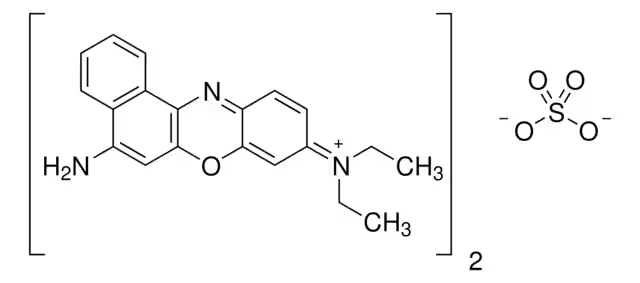
CAS Number3625-57-8
SynonymsBis[N-(5-amino-9H-benzo[a]phenoxazin-9-ylidene)-N-ethylethanaminium] sulfate; EINECS 222-832-5; Nile Blue A sulfate; Bis[9-(diethylamino)-5H-benzo[a]phenoxazin-5-iminium] sulfate; MFCD00064529; Nile Blue A; Basic Blue 12,Nile blue sulfate; Nile Blue A,certified; Nile blue, sulfate; Basic Blue-12; Basic Blue 12 Nile blue sulfate; Nile blue sulfate; Nile Blue A (sulfate)
Molecular Formula2C20H20N3O · SO4
Molecular Weight732.85
Purity98.00%
Boiling Point487.9ºC
Melting Point>300 °C (dec.) (lit.)
Appearancepowder
EINECS222-832-5
Symbol
Signal WordWarning
| Chemical & Physical Properties | |
|---|---|
| CAS Number | 3625-57-8 |
| Catalog No. | 2A-9030019 |
| Chinese Name | 耐尔兰 |
| Synonyms | Bis[N-(5-amino-9H-benzo[a]phenoxazin-9-ylidene)-N-ethylethanaminium] sulfate; EINECS 222-832-5; Nile Blue A sulfate; Bis[9-(diethylamino)-5H-benzo[a]phenoxazin-5-iminium] sulfate; MFCD00064529; Nile Blue A; Basic Blue 12,Nile blue sulfate; Nile Blue A,certified; Nile blue, sulfate; Basic Blue-12; Basic Blue 12 Nile blue sulfate; Nile blue sulfate; Nile Blue A (sulfate) |
| Molecular Formula | 2C20H20N3O · SO4 |
| Molecular Weight | 732.85 |
| Purity | 98.00 |
| Boiling Point | 487.9ºC |
| Melting Point | >300 °C (dec.) (lit.) |
| Appearance | powder |
| Water Solubility | Soluble in water, ethanol |
| Storage Condition | Keep away from light, in a ventilated and dry plac |
| Application | Nile Blue A can be used to differentiate between melanin and lipofuscin. It can also be used for fat staining and preparation of current glucose sensors. |
| EINECS | 222-832-5 |
| HTC | 2934999090 |
| PubChem ID | 24897743 |
| MDL Number | MFCD00064529 |
| SMILES | [O-]S([O-])(=O)=O.CC\[N+](CC)=C1/C=CC2=Nc3c(OC2=C1)cc(N)c4ccccc34.CC\[N+](CC)=C5/C=CC6=Nc7c(OC6=C5)cc(N)c8ccccc78 |
| InChI | 1S/2C20H19N3O.H2O4S/c2*1-3-23(4-2)13-9-10-17-18(11-13)24-19-12-16(21)14-7-5-6-8-15(14)20(19)22-17;1-5(2,3)4/h2*5-12,21H,3-4H2,1-2H3;(H2,1,2,3,4) |
| InChI Key | QIRDPEPUXNCOLD-UHFFFAOYSA-N |
| NACRES Code | NA.47 |
| UNSPSC | 12171500 |
| Hazard Symbols | transportation |
| MSDS | msds/30019_1_3625_57_8.pdf |
| Bioactivity | Nile Blue A is used to differentiate melanins and lipofuscins. It is also useful for staining fats and preparation of an amperometric glucose sensor. Related Catalog Signaling Pathways >> Others >> Others Dye Reagents Research Areas >> Others In Vitro Nile blue A is a basic oxazine dye which is soluble in water and ethyl alcohol. Nile blue A is a satisfactory stain for PHB granules in bacteria and is in fact superior to Sudan black B for this purpose. Poly-p3-hydroxybutyrate granules exhibits a strong orange fluorescence when stained with Nile blue A. Nile blue A appears to stain many more PHB granules than Sudan black B does and is not as easily ished from the cell by decolorization procedures[1]. Nile blue A is used as a stain for polyhydroxyalkanoic acid-accumulating microorganisms or to detect polyhydroxyalkanoic acids in microorganisms. Escherichia coli cells that do not accumulate detectable polyhydroxyalkanoic acids can be stained with Nile blue A and that this staining is sufficient for identifying these cells in fluorescence-activated cell sorting (FACS) experiments. Nile blue A staining does not affect either surface display of peptides or specific labeling of these peptides by a second fluorescence. Staining E. coli for flow cytometry using Nile blue A is an easy-to-handle and low-cost alternative to other fluorescent dyes or the intracellular expression of, for example, green fluorescent protein[2]. Nile blue A is one of the most studied benzophenoxazine dyes, as a potent photosensitizer for photodynamic therapy. The dye when administered intravenously disperses throughout the body by circulating through blood and is taken up by most cells that emphasize its interaction with various biomolecule[3]. Cell Assay 1% aqueous solution of Nile blue A is prepared and filtered before use. Mild heating may be necessary to fully dissolve the stain. Heat-fixed smears of bacterial cells are stained with the Nile blue A solution at 55°C for 10 min in a coplin staining jar. After being stained, the slides are washed with tap water to remove excess stain and with 8% aqueous acetic acid for 1 min. The stained smear is washed and blotted dry with bibulous paper, remoistened with tap water, and covered with a no. 1 glass cover slip. The preparation is examined with a Nikon Labphot microscope with an episcopic fluorescence attachment[1]. The PHA− strain Escherichia coli UT5600(DE3) is stained with Nile blue A. In an Erlenmeyer flask, 20 mL of Luria-Bertani (LB) broth is inoculated with one colony of UT5600(DE3) and incubated for 14 h at 37 °C and 200 rpm. Subsequently, 20 mL of LB broth containing Nile blue A in a final concentration of 0.5 μg/mL is inoculated with 200 μL of the 14-h culture and cultured to an optical density at 578 nm (OD578) of 0.6. As a control, 20 mL of LB broth (without Nile blue A) is inoculated with 200 μL of the 14-h culture and is also cultured to an optical density at OD578 of 0.6. Every 20 min, the OD578 is determined for both cultures to verify whether there is any influence of the dye on the growth of the bacteria[2]. Nile blue A stock solution is prepared using ethanol as the solvent. The concentration of NB is maintained at 5 μM for all the studies. The solutions are left for 1 h to achieve equilibrium before spectral measurements. The absorption spectra are recorded using Shimadzu Spectrophotometer (UV-1800) and the emission spectra are recorded using Jobin-Yvon Spectrofluorimeter. A 450 nm nano-LED is used as the light source and the fluorescence lifetime is collected at λem=672 nm[3]. References [1]. Ostle AG, et al. Nile blue A as a fluorescent stain for poly-beta-hydroxybutyrate. Appl Environ Microbiol. 1982 Jul;44(1):238-41. [2]. Betscheider D, et al. Nile blue A for staining Escherichia coli in flow cytometer experiments. Anal Biochem. 2009 Jan 1;384(1):194-6. [3]. Mishra SS, et al. Spectroscopic investigation of interaction of Nile Blue A, a potent photosensitizer, with bile salts in aqueous medium. J Photochem Photobiol B. 2014 Dec;141:67-75. Chemical & Physical Properties Boiling Point 487.9ºC Melting Point >300ºC (dec.)(lit.) Molecular Formula C20H20N3O3S0.5 Molecular Weight 366.42 Flash Point 248.8ºC PSA 198.76000 LogP 7.86520 InChIKey QIRDPEPUXNCOLD-UHFFFAOYSA-N SMILES CC[N+](CC)=c1ccc2nc3c(cc(N)c4ccccc43)oc-2c1.CC[N+](CC)=c1ccc2nc3c(cc(N)c4ccccc43)oc-2c1.O=S(=O)([O-])[O-] Water Solubility Soluble in water, ethanol |
| Use of | Nile Blue A is used to differentiate melanins and lipofuscins. It is also useful for staining fats and preparation of an amperometric glucose sensor. Properties Articles26 Name [9-(diethylamino)benzo[a]phenoxazin-5-ylidene]azanium,sulfate Synonym More Synonyms Nile Blue A (sulfate) Biological Activity Description Nile Blue A is used to differentiate melanins and lipofuscins. It is also useful for staining fats and preparation of an amperometric glucose sensor. Related Catalog Signaling Pathways >> Others >> Others Dye Reagents Research Areas >> Others In Vitro Nile blue A is a basic oxazine dye which is soluble in water and ethyl alcohol. Nile blue A is a satisfactory stain for PHB granules in bacteria and is in fact superior to Sudan black B for this purpose. Poly-p3-hydroxybutyrate granules exhibits a strong orange fluorescence when stained with Nile blue A. Nile blue A appears to stain many more PHB granules than Sudan black B does and is not as easily ished from the cell by decolorization procedures[1]. Nile blue A is used as a stain for polyhydroxyalkanoic acid-accumulating microorganisms or to detect polyhydroxyalkanoic acids in microorganisms. Escherichia coli cells that do not accumulate detectable polyhydroxyalkanoic acids can be stained with Nile blue A and that this staining is sufficient for identifying these cells in fluorescence-activated cell sorting (FACS) experiments. Nile blue A staining does not affect either surface display of peptides or specific labeling of these peptides by a second fluorescence. Staining E. coli for flow cytometry using Nile blue A is an easy-to-handle and low-cost alternative to other fluorescent dyes or the intracellular expression of, for example, green fluorescent protein[2]. Nile blue A is one of the most studied benzophenoxazine dyes, as a potent photosensitizer for photodynamic therapy. The dye when administered intravenously disperses throughout the body by circulating through blood and is taken up by most cells that emphasize its interaction with various biomolecule[3]. References [1]. Ostle AG, et al. Nile blue A as a fluorescent stain for poly-beta-hydroxybutyrate. Appl Environ Microbiol. 1982 Jul;44(1):238-41. [2]. Betscheider D, et al. Nile blue A for staining Escherichia coli in flow cytometer experiments. Anal Biochem. 2009 Jan 1;384(1):194-6. [3]. Mishra SS, et al. Spectroscopic investigation of interaction of Nile Blue A, a potent photosensitizer, with bile salts in aqueous medium. J Photochem Photobiol B. 2014 Dec;141:67-75. Chemical & Physical Properties Molecular Formula C20H20N3O3S0.5 PSA 198.76000 LogP 7.86520 InChIKey QIRDPEPUXNCOLD-UHFFFAOYSA-N Water Solubility Soluble in water, ethanol |
| Tax Rebate | 13.0% |
| Supervision | None. MFN tariff: 6.5%. Ordinary tariff: 20.0% |
| Transport Info | Shipping Name: UN |
| MSDS Transport Info | Module 14. Shipping information 14.1 UN dangerous goods number European Land Transport Dangerous Regulations: -International Maritime Dangerous Regulations: -International Air Transport Dangerous Regulations: - 14.2 United Nations shipping name European Land Transport Dangerous Regulations: Non-dangerous goods IMDG Code: Non-dangerous goods International air transport dangerous goods regulations: non-dangerous goods 14.3 Transport hazard categories European Land Transport Dangerous Regulations: -International Maritime Dangerous Regulations: -International Air Transport Dangerous Regulations: - 14.4 Package group European Land Transport Dangerous Regulations: -International Maritime Dangerous Regulations: -International Air Transport Dangerous Regulations: - 14.5 Environmental hazards European Land Transport Danger Regulations: No International Maritime Danger Regulations International Air Transport Danger Regulations: No Marine pollutants (yes/no): No 14.6 Special reminder to users No data available |
| Related Products in Specialty Chemicals | ||
|---|---|---|
| Mordant Red 7 | 3618-63-1 | 2A-9029999 |
| Jatrorrhizine | 3621-38-3 | 2A-9030005 |
| N-Butyl-benzenesulfonamide | 3622-84-2 | 2A-9030014 |
| 1-Phenyl-2-propyn-1-one | 3623-15-2 | 2A-9030016 |
| Mordant Blue 9 | 3624-68-8 | 2A-9030018 |
| Direct Orange S | 3626-36-6 | 2A-9030020 |
| Magnesium gluconate | 3632-91-5 | 2A-9030021 |
| 1,3-Bis(isocyanatomethyl)benzene | 3634-83-1 | 2A-9030022 |
| 3',4'-Dimethylacetophenone | 3637-01-2 | 2A-9030023 |
| 3-[Dimethyl-[2-(2-methylprop-2-enoyloxy)ethyl]azaniumyl]propane-1-sulfonate | 3637-26-1 | 2A-9030024 |
| Browse all Specialty Chemicals products » | ||
Phone:
630-322-8886
630-322-8887
Email:
Office Locations:
Chicago, IL, USA
San Francisco, CA, USA


 EN
EN


 SDS
SDS