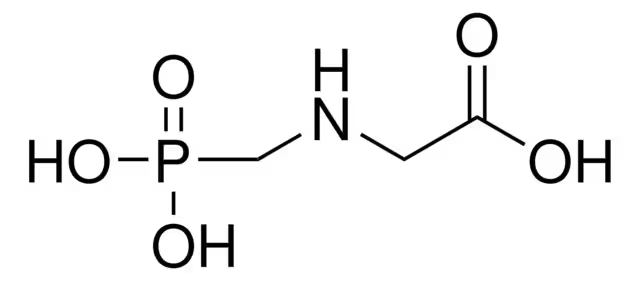
CAS Number1071-83-6
SynonymsRoundup; N-phosphonomethylglycine acid; EINECS 213-997-4; 2-((Phosphonomethyl)amino)acetic acid; Glyphosate; (Carboxymethylamino)methylphosphonic acid; [(Phosphonomethyl)amino]acetic acid; Glyphodin A; MFCD00055350; Glysate; N-Phosphomethylglycine; Forsat; Glyphosate CT; Glialka; N-(Phosphonomethyl)glycine; (Phosphonomethyl)glycine; Accord; Folusen; Glialka 36; phosphonomethyl glycine; Phorsat; Rebel Garde; Glifocas
Molecular Formula(HO)2P(O)CH2NHCH2CO2H
Molecular Weight169.07
Purity95%
Density1.7±0.1 g/cm3
Boiling Point465.8±55.0 °C at 760 mmHg
Melting Point230 °C (dec.)(lit.)
Appearancewhite powder
Symbol
Signal WordWarning
| Chemical & Physical Properties | |
|---|---|
| CAS Number | 1071-83-6 |
| Catalog No. | 2A-9026017 |
| Chinese Name | 草甘膦 |
| Synonyms | Roundup; N-phosphonomethylglycine acid; EINECS 213-997-4; 2-((Phosphonomethyl)amino)acetic acid; Glyphosate; (Carboxymethylamino)methylphosphonic acid; [(Phosphonomethyl)amino]acetic acid; Glyphodin A; MFCD00055350; Glysate; N-Phosphomethylglycine; Forsat; Glyphosate CT; Glialka; N-(Phosphonomethyl)glycine; (Phosphonomethyl)glycine; Accord; Folusen; Glialka 36; phosphonomethyl glycine; Phorsat; Rebel Garde; Glifocas |
| Molecular Formula | (HO)2P(O)CH2NHCH2CO2H |
| Molecular Weight | 169.07 |
| Purity | 95 |
| Density | 1.7±0.1 g/cm3 |
| Boiling Point | 465.8±55.0 °C at 760 mmHg |
| Melting Point | 230 °C (dec.)(lit.) |
| Appearance | white powder |
| Water Solubility | 1.2 g/100 mL |
| Storage Condition | Keep container sealed and store in a cool, dry pla |
| Application | Glyphosate is an herbicidal derivative of the amino acid glycine. Glyphosate targets and blocks a plant metabolic pathway not found in animals, the shikimate pathway, which is required for plants to s |
| HTC | 2931900041 |
| PubChem ID | 329769733 |
| SMILES | O=C(O)CNCP(=O)(O)O |
| InChI | InChI=1S/C3H8NO5P/c5-3(6)1-4-2-10(7,8)9/h4H,1-2H2,(H,5,6)(H2,7,8,9) |
| InChI Key | XDDAORKBJWWYJS-UHFFFAOYSA-N |
| Hazard Symbols | Category 6.1 Poisons |
| Bioactivity | Glyphosate is an herbicidal derivative of the amino acid glycine. Glyphosate targets and blocks a plant metabolic pathway not found in animals, the shikimate pathway, required for the synthesis of aromatic amino acids in plants[1]. Related Catalog Signaling Pathways >> Apoptosis >> Apoptosis Research Areas >> Cancer Signaling Pathways >> Autophagy >> Autophagy In Vitro Glyphosate is a high-efficiency, low-toxicity, broad-spectrum herbicide. The residues of glyphosate-based herbicides are frequent pollutants in the environment. Glyphosate exposure could interfere with mouse oocyte maturation by generating oxidative stress and early apoptosis.Glyphosate induces early apoptosis and autophagy in mouse oocytes[2]. References [1]. Greim H, et al. Evaluation of carcinogenic potential of the herbicide glyphosate, drawing on tumor incidence data from fourteen chronic/carcinogenicity rodent studies. Crit Rev Toxicol. 2015;45(3):185-208. [2]. Zhang JW, et al The toxic effects and possible mechanisms of glyphosate on mouse oocytes. Chemosphere. 2019 Dec;237:124435. Chemical & Physical Properties Density 1.7±0.1 g/cm3 Boiling Point 465.8±55.0 °C at 760 mmHg Melting Point 230 °C (dec.)(lit.) Molecular Formula C3H8NO5P Molecular Weight 169.073 Flash Point 235.5±31.5 °C Exact Mass 169.014008 PSA 116.67000 LogP -2.36 Vapour Pressure 0.0±2.5 mmHg at 25°C Index of Refraction 1.529 InChIKey XDDAORKBJWWYJS-UHFFFAOYSA-N SMILES O=C(O)CNCP(=O)(O)O Water Solubility 1.2 g/100 mL |
| Use of | Glyphosate is an herbicidal derivative of the amino acid glycine. Glyphosate targets and blocks a plant metabolic pathway not found in animals, the shikimate pathway, required for the synthesis of aromatic amino acids in plants[1]. Properties Articles110 Name Glyphosate Synonym More Synonyms Glyphosate Biological Activity Description Glyphosate is an herbicidal derivative of the amino acid glycine. Glyphosate targets and blocks a plant metabolic pathway not found in animals, the shikimate pathway, required for the synthesis of aromatic amino acids in plants[1]. Related Catalog Signaling Pathways >> Apoptosis >> Apoptosis Research Areas >> Cancer Signaling Pathways >> Autophagy >> Autophagy In Vitro Glyphosate is a high-efficiency, low-toxicity, broad-spectrum herbicide. The residues of glyphosate-based herbicides are frequent pollutants in the environment. Glyphosate exposure could interfere with mouse oocyte maturation by generating oxidative stress and early apoptosis.Glyphosate induces early apoptosis and autophagy in mouse oocytes[2]. References [1]. Greim H, et al. Evaluation of carcinogenic potential of the herbicide glyphosate, drawing on tumor incidence data from fourteen chronic/carcinogenicity rodent studies. Crit Rev Toxicol. 2015;45(3):185-208. [2]. Zhang JW, et al The toxic effects and possible mechanisms of glyphosate on mouse oocytes. Chemosphere. 2019 Dec;237:124435. Chemical & Physical Properties Molecular Formula C3H8NO5P Exact Mass 169.014008 PSA 116.67000 LogP -2.36 Index of Refraction 1.529 InChIKey XDDAORKBJWWYJS-UHFFFAOYSA-N SMILES O=C(O)CNCP(=O)(O)O |
| Tax Rebate | 0.0% |
| Supervision | S (Import and export pesticide registration certificate) |
| Transport Info | Product name: Chemical name |
| Related Products in Agrochemical Intermediates | ||
|---|---|---|
| 2,4-Dimethylimidazole | 930-62-1 | 2A-9025654 |
| 2,4-Diamino-6-(hydroxymethyl)pteridine | 945-24-4 | 2A-9025752 |
| 2,4-Dinitrodiphenylamine | 961-68-2 | 2A-9025792 |
| 2,4,5-Tribromo-1-methylimidazole | 1003-91-4 | 2A-9025879 |
| 1-(2,4-Dimethylphenyl)piperazine | 1013-76-9 | 2A-9025939 |
| 3-Amino-2,4-dimethylpyridine | 1073-21-8 | 2A-9026035 |
| 2,4-Dimethyl-3-nitropyridine | 1074-76-6 | 2A-9026052 |
| 2,4-Dimethylbenzophenone | 1140-14-3 | 2A-9026316 |
| 5-Amino-2,4-dimethylpyridine | 1193-71-1 | 2A-9026428 |
| 2,4,5-Triamino-6-chloropyrimidine | 1194-78-1 | 2A-9026435 |
| Browse all Agrochemical Intermediates products » | ||
Phone:
630-322-8886
630-322-8887
Email:
Office Locations:
Chicago, IL, USA
San Francisco, CA, USA


 EN
EN


 SDS
SDS